BACK UP BLOG (no longer updating)

This blog was a backup for American Indian Adoptees blog
USE THE SEARCH BAR or SEARCH TOPICS at bottom of this blog

If you need support

Support Info: If you are a Survivor and need emotional support, a national crisis line is available 24 hours a day, seven days a week: Residential School Survivor Support Line: 1-866-925-4419. Additional Health Support Information: Emotional, cultural, and professional support services are also available to Survivors and their families through the Indian Residential Schools Resolution Health Support Program. Services can be accessed on an individual, family, or group basis.” These & regional support phone numbers are found at https://nctr.ca/contact/survivors/ . MY EMAIL: tracelara@pm.me

Search This Blog

Thursday, June 10, 2021

In The News

Continuing Coverage: (click headline)

Nelson Star

Stephen Bronstein was suspended for one month and fined $4,000 after admitting to mishandling the cases of Sixties Scoop survivors.  A First Nation in B.C.’s Cariboo region is condemning the B.C. Law Society’s handling of a Vancouver lawyer’s mishandling of residential school survivor cases.

Bronstein was  fined $4,000 after admitting to mishandling the cases of residential school survivors. He was also barred from acting as counsel for any ’60s Scoop claimants in the future.

The ’60s Scoop was a large-scale program that allowed child welfare organizations to remove Indigenous children from their families and place them in the foster care system and allow them to be adopted by white families.

The Tŝilhqot’in Nation on Wednesday condemned the law society for not adequately punishing Bronstein, noting that many of his clients were from the First Nation.

**

CKOM News Talk Sports
He pointed to an event in the legislative building when Moe jigged with '60s Scoop survivors but after that, Belanger said, the survivors got nothing.
**
KTVZ
The bill codifies provisions from the federal Indian Child Welfare Act in state law and will ensure that Oregon's practices better serve Indian children, ...
 **
 
Nunatsiaq News
Sinclair said the Truth and Reconciliation Commission's Calls to Action 71 to 84 discuss missing children and those burial sites specifically.

** 

Orange Shirt Day founder Phyllis Webstad was recently told she is a link for reconciliation between First Nations and non-First Nations in Canada.
Phyllis Webstad was 6 years old when the new orange shirt she chose for her 1st day of school was stripped off her back. It was the early 70s & she was the 3rd generation to attend St. Joseph’s Residential School in Williams Lake, BC.

OUR HOMETOWN: Truth and reconciliation champion

Phyllis Webstad continues to help the country understand the residential school legacy 

WATCH

While the suggestion is daunting, the 53-year-old member of the Stswecem’c Xgat’tem First Nation said she cannot help but think about a picture of a bridge hanging on her living room wall that her Aunt Agnes Jack purchased at a yard sale.

“The bridge is woven together with rope and tree roots,” she said. “It’s not pretty, it’s not perfect, but it’s enough that you could walk across it.”

Webstad said she keeps thinking about that.

“That’s been my life it seems because I grew up on the reserve, I’m half Secwepemc, I’m half white and I have lighter skin so I’ve been more readily accepted in the non-Indigenous community and I’ve been able to be a bridge builder or gap person.”

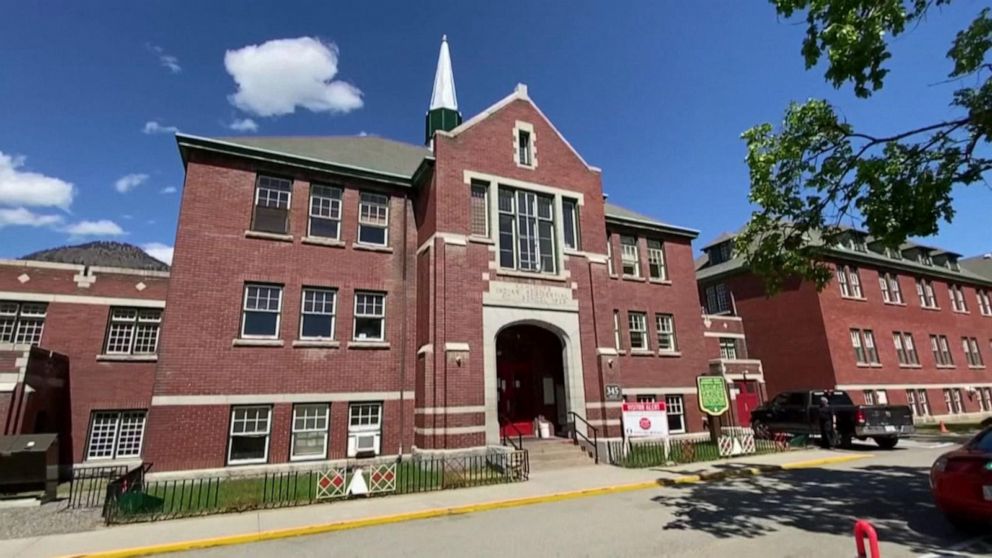
She described the time period since the announcement confirming the remains of 215 children buried at the former Kamloops Indian Residential School as a whirlwind.

Webstad’s mom Rose Wilson gave birth to her in July 1967 at her grandmother Lena Jack’s home in Dog Creek. She found her birth father in Kamloops a few years ago. “I have eight other siblings, one passed away, so there are seven. They all live in Kamloops.”

 Read more: Orange Shirt Society launches first textbook on residential school history

READ EVEN MORE


Woman says her mother gave her up for adoption to spare her from residential school

Tina Taphouse is pictured in Langley, B.C., Monday, June 7, 2021. Photo by: The Canadian Press/Jonathan Hayward

#Langley woman says her mother gave her up for adoption to spare her residential school experience. #residentialschool #Sixtiesscoop 

LANGLEY, BRITISH COLUMBIA, B.C. — Tina Taphouse has spent a lot of time lately reflecting on the impact the Kamloops Indian Residential School has had on her life's path.

Taphouse didn't go to the school because her mother, who worked there and had also grown up in residential school, made the impossible decision to put her up for adoption so she wouldn't have to attend.

While Tina escaped the horrors that many survivors of the '60s Scoop and residential schools endured, Taphouse said she also wasn't brought up in her culture, with her family or her traditions and she felt lost.

She began reconnecting with her roots after her biological father reached out to her through an adoption reunification registry in 1994. Over time, she has learned more about her own family and story, although she said she doesn't push her mother to share sensitive details.

READ: Woman says her mother gave her up for adoption to spare her from

Warning: The information and material here may trigger unpleasant feelings or thoughts of past abuse. Please contact the 24-hour Residential School Crisis Line at 1-866-925-4419 if you require emotional support.

Wednesday, June 9, 2021

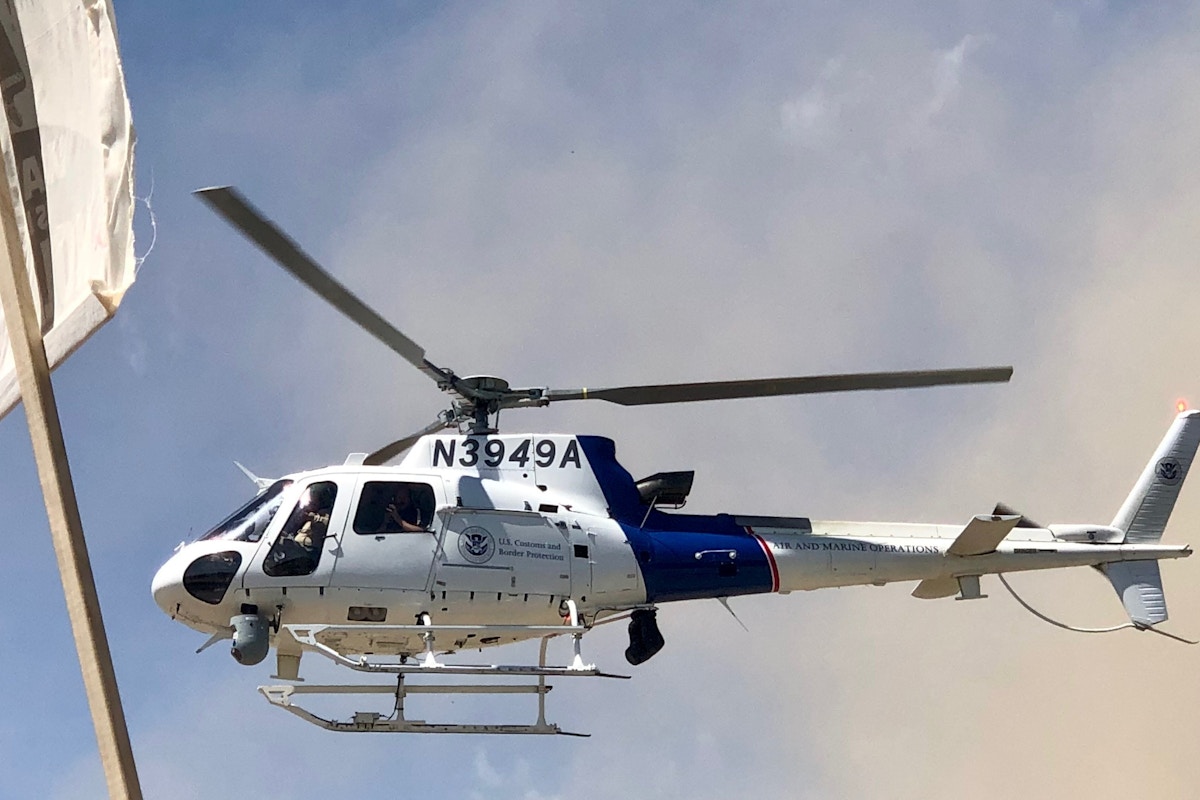
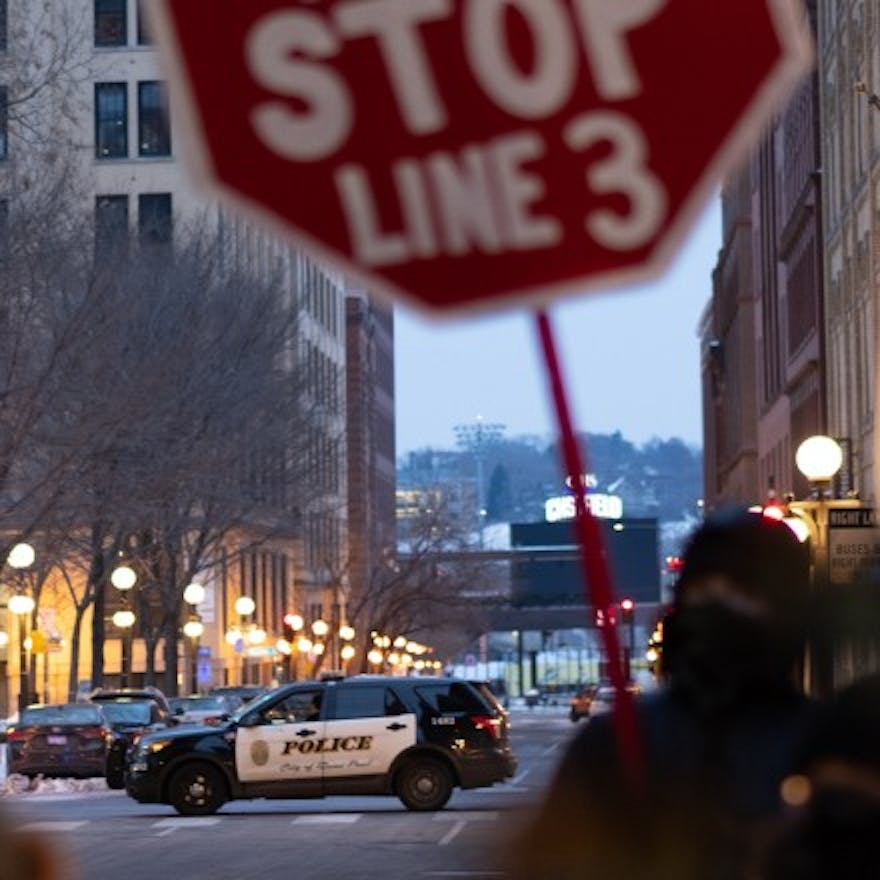
Low-Flying DHS Helicopter Showers Anti-Pipeline Protests With Debris #Line3


Authorities said the risky low-flying maneuver was used to warn demonstrators to disperse, but the reasoning doesn’t hold up.

The largest civil disobedience yet against new pipeline construction in Minnesota was met by a furious response — and a cloud of debris. A Department of Homeland Security Border Patrol helicopter descended on the protest against the Enbridge Line 3 tar sands pipeline, kicking up dust and showering demonstrators with sand, in an unusual attempt to disperse the crowd.

“I couldn’t see because it got in my eyes,” said Big Wind, a 28-year-old Northern Arapaho organizer with the anti-pipeline Giniw Collective, who was there when the helicopter swooped over the civil disobedience action. “After it pulled up there were a lot of people who were ducking, who were in the fetal position, just because they didn’t know what was going to happen and were trying to protect themselves from the sand.”

***

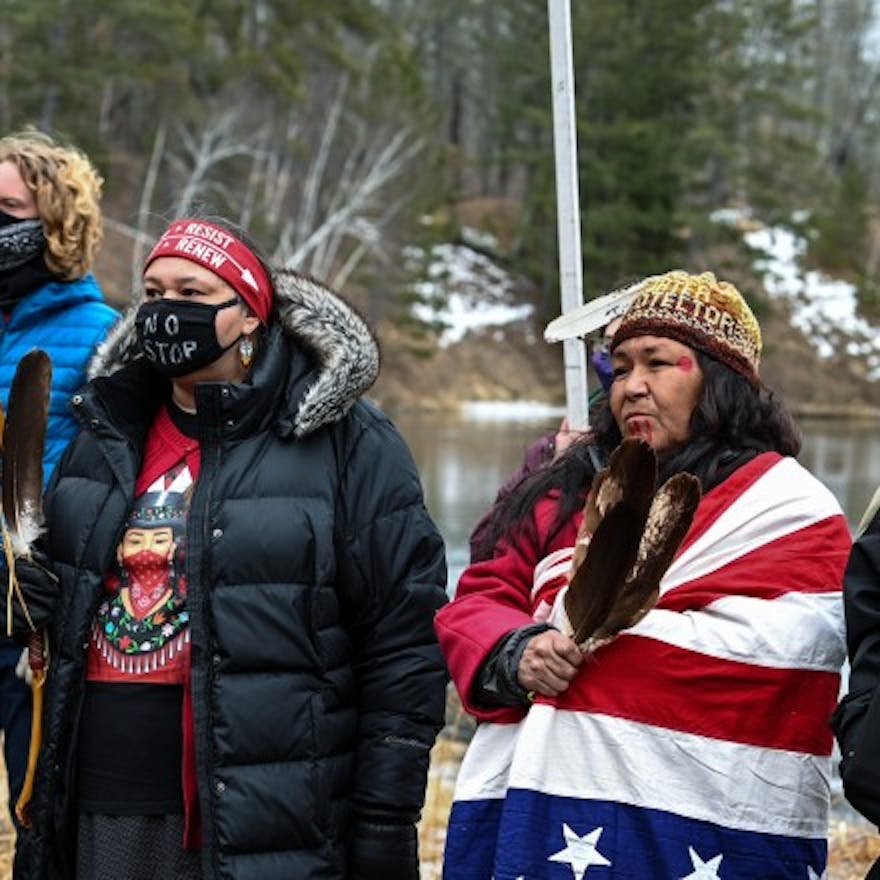
The anti-pipeline protests are in response to plans from the Canadian
energy firm Enbridge to ramp up construction as a springtime hiatus
lifts. Enbridge is preparing to drill under northern Minnesota rivers
that are central to the lifeways of local Ojibwe people — and are
protected by treaties between tribes and the federal government.
Pipeline opponents have for weeks asserted that this weekend’s Treaty
People Gathering would draw more than 1,000 people to northern Minnesota
to fight the tar sands pipeline.

BIG READ: Low-Flying DHS Helicopter Showers Anti-Pipeline Protests With Debris


Low-Flying DHS Helicopter Showers Anti-Pipeline Protests With Debris #Line3


Authorities said the risky low-flying maneuver was used to warn demonstrators to disperse, but the reasoning doesn’t hold up.

The largest civil disobedience yet against new pipeline construction in Minnesota was met by a furious response — and a cloud of debris. A Department of Homeland Security Border Patrol helicopter descended on the protest against the Enbridge Line 3 tar sands pipeline, kicking up dust and showering demonstrators with sand, in an unusual attempt to disperse the crowd.

“I couldn’t see because it got in my eyes,” said Big Wind, a 28-year-old Northern Arapaho organizer with the anti-pipeline Giniw Collective, who was there when the helicopter swooped over the civil disobedience action. “After it pulled up there were a lot of people who were ducking, who were in the fetal position, just because they didn’t know what was going to happen and were trying to protect themselves from the sand.”

***

The anti-pipeline protests are in response to plans from the Canadian energy firm Enbridge to ramp up construction as a springtime hiatus lifts. Enbridge is preparing to drill under northern Minnesota rivers that are central to the lifeways of local Ojibwe people — and are protected by treaties between tribes and the federal government. Pipeline opponents have for weeks asserted that this weekend’s Treaty People Gathering would draw more than 1,000 people to northern Minnesota to fight the tar sands pipeline.

BIG READ: Low-Flying DHS Helicopter Showers Anti-Pipeline Protests With Debris


Tuesday, June 8, 2021

Indigenous lawyer: Investigate discovery of 215 children’s graves in Kamloops as a crime against humanity

Author:   Acting Dean and Associate Professor, Law, University of Windsor

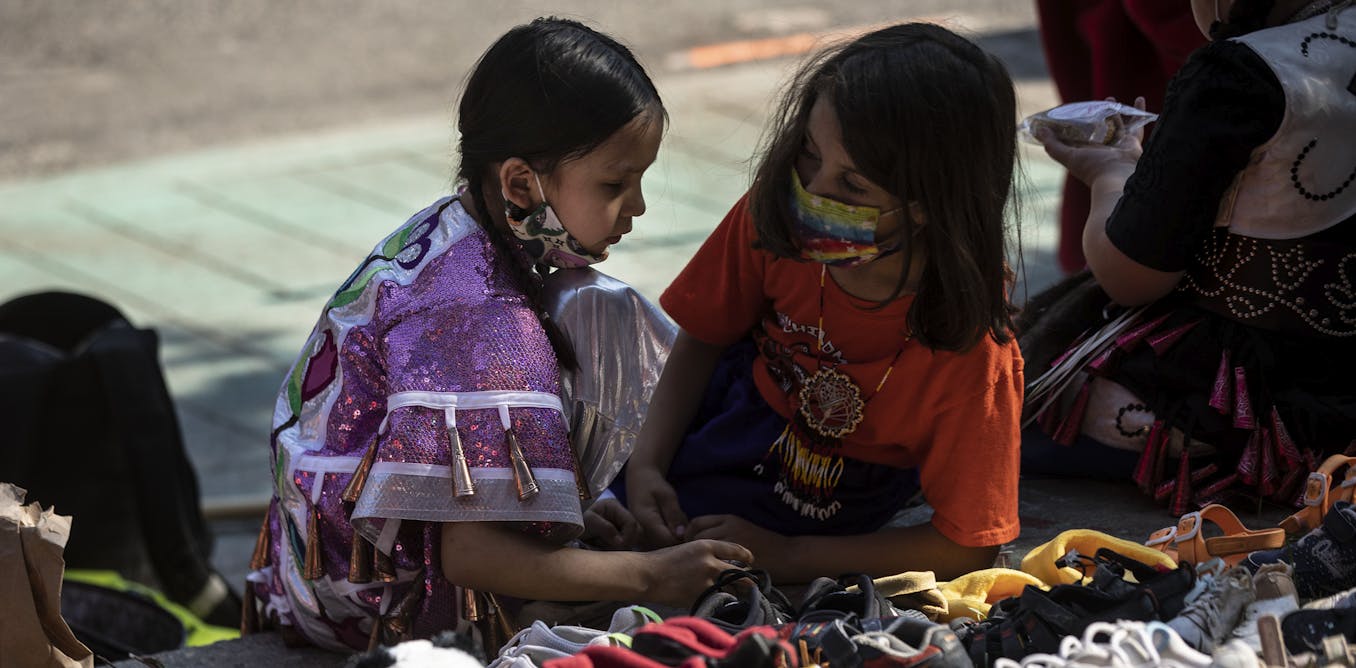
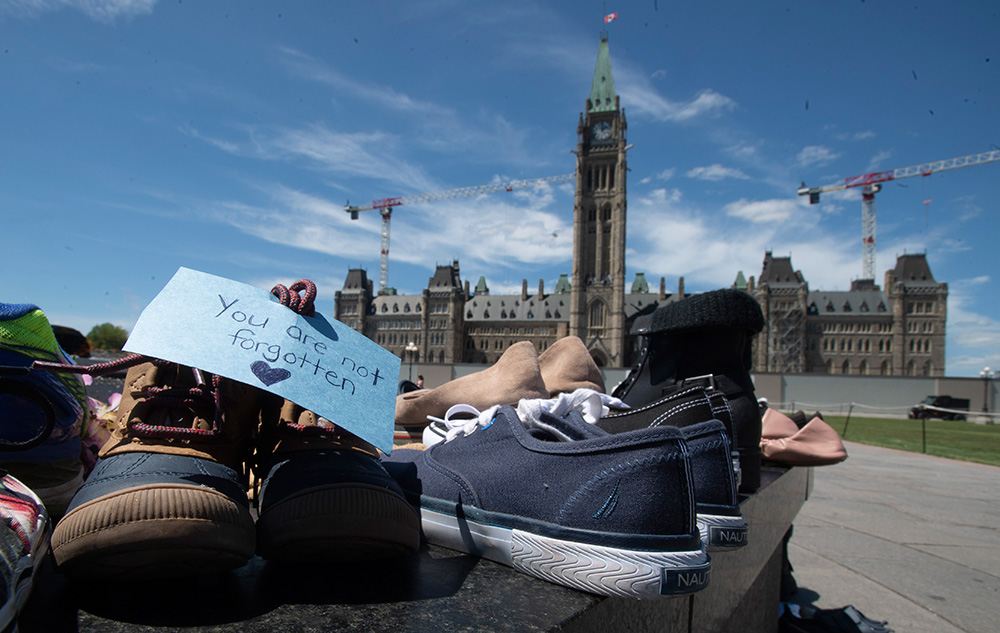
Two young children sit next to shoes left in front of a statue of Egerton Ryerson, who was instrumental in the design and implementation of the Indian Residential School System. THE CANADIAN PRESS/Chris Young

As I reflect on the recent and horrific news about the discovery of the bodies of 215 children at the former site of Kamloops Indian Residential School, I am reminded about the resiliency of our people.

But the uncovering of the remains of children must be investigated as a crime against humanity. All entities involved in residential schools — including different levels and branches of the Canadian government and various denominations of churches — must be charged with genocide and tried at the International Criminal Court.

Like others who have been speaking out, I want the ground-penetrating radar that was used at Kamloops Indian Residential School to be used at all other former residential school sites.

What happened to Indigenous children is genocide, and the legacy of that continues through denial and inaction.

Aftermath of genocide

Nehiyaw (Cree) legal scholar Tamara Starblanket argues that Canada must be held accountable for crimes of genocide.

The National Inquiry on Missing and Murdered Indigenous Women and Girls (MMIWG) produced a supplementary report dedicated to the issue of Canada’s genocide. Its most powerful statement reads:

Legally speaking, this genocide consists of a composite wrongful act that triggers the responsibility of the Canadian state under international law. Canada has breached its international obligations through a series of actions and omissions taken as a whole, and this breach will persist as long as genocidal acts continue to occur and destructive policies are maintained. Under international law, Canada has a duty to redress the harm it caused and to provide restitution, compensation and satisfaction to Indigenous peoples.

I have watched and felt the aftermath of this genocide. I’ve felt it all my life and I know my parents and grandparents felt it too. My grandmother went to a residential school and didn’t talk about it until she was sick and dying. She told my aunt that she saw a child being buried beside the laneway to the Mohawk Institute, also known as the Mush Hole, in Brantford, Ont.

This pain and trauma has been passed down from generation to generation.

The Mohawk Institute is one of the last standing Indian Residential Schools in Canada. It has since been turned into the Woodland Cultural Centre.

Resiliency and survival

As a lawyer working with Sunchild Law, I represented residential school survivors at their Independent Assessment Process (IAP) hearings. The IAP was established to resolve claims of serious physical, sexual or emotional abuse suffered at Indian Residential Schools.


Read more: Residential school survivors' stories and experiences must be remembered as class action settlement finishes


While advocating for survivors, I found this process not only difficult as an Indigenous lawyer and intergenerational survivor, but as someone who had to witness the re-traumatization of survivors. I also saw and felt their amazing strength as they persevered through this process.

As a professor of law at the University of Windsor, I am grateful our students have been able to learn Indigenous Legal Orders from Indigenous faculty with specializations in Haudenosaunee, Nêhiyaw and Anishinaabe laws.

We have done a lot at the University of Windsor Faculty of Law to implement the Truth and Reconciliation Commission’s Call to Action 28 — which calls upon “law schools in Canada to require all law students to take a course in Aboriginal people and the law.” We’ve done more than establish one course and in fact have established an Indigenous Law Stream Certificate. It’s not nearly enough, but it is a start.

Indigenous peoples’ connection to our lands, communities and peoples have enabled resilience. Our ceremonies and the strength of our Indigenous laws are strong; we are still here with our languages, songs and healing ceremonies.

The strength of the Tk’emlúps te Secwépemc peoples was seen with healing ceremonies, songs and dances to respect and honour the spirits of the 215 children.

‘Ohero:kon Under the Husk’ by Katsitsionni Fox shows young Mohawk women who are on a spiritual, emotional and physical journey to womanhood through their traditional rites of passage.

Ongoing genocide

I’ve seen and felt the strength of our people to recover and heal from the impacts of genocidal, colonial laws and policy — like The Indian Act and the ‘60s Scoop — that have been happening for decades. These feelings of pain and trauma are not new.

They are consistently and persistently triggered every time a survivor speaks out, when one of our women goes missing or is found murdered, when our people are targeted for being Indigenous, for protecting their lands and territories or when we’re violated in any way.

The MMIWG final report goes on to say:

But first and foremost, Canada’s violation of one of the most fundamental rules of international law necessitates an obligation of cessation: Canada must put an end to its perennial pattern of violence against and oppression of Indigenous peoples.

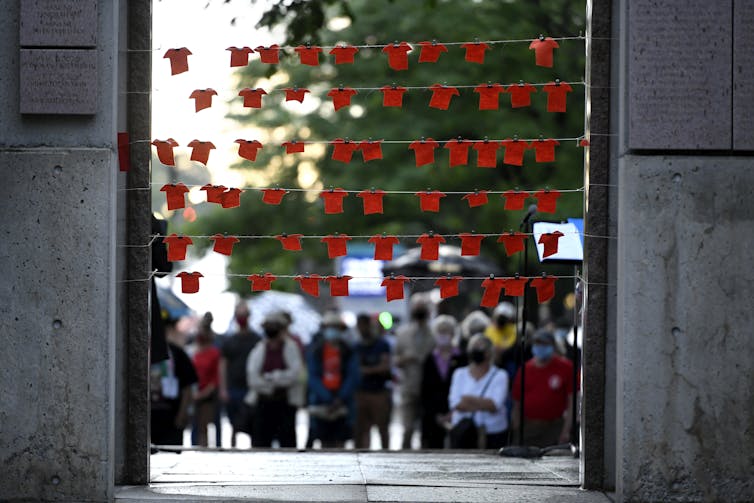
Orange fabric cut in the shape of shirts are pinned to string at the Human Rights Monument in Ottawa. They're strung across like clothes on a clothes line as people stand blurred in the background.
Orange fabric cut in the shape of shirts are pinned to string at the Human Rights Monument in Ottawa, during a vigil to honour the 215 children whose remains were found at the grounds of the former Kamloops Indian Residential School. THE CANADIAN PRESS/Justin Tang

Investigating crimes against humanity

Canada’s genocidal laws and policies are not historic: the Indian Act still exists today as one of the most racist and sexist pieces of legislation in the world. At one point, it dictated that every Indigenous child must attend a residential school.

The discovery of the remains of Indigenous children must be investigated as a crime against humanity and further investigation must happen at other former residential school sites. The perpetrators must be held accountable so that genocide will stop and healing and reconciliation can occur.

I urge all Canadians to care, learn, listen, respect and unlearn the lies that have been told. I wish for all Canadians who are unaware of this genocide to learn the truth and accept that they’ve benefited from Canada’s genocidal policies and laws that have tried to erase us from existence.

Our children and survivors have to be celebrated, honoured and respected.

Byron Louis, Chief of the Okanagan Indian Band in British Columbia, posted on LinkedIn a message that should stay with all of us:

“Do not lower your head and cry, hold your head up in praise and honour them and most importantly support them. This is what they rightfully deserve in their service to our People. They need our praise not pity!”

If you are an Indian Residential School survivor, or have been affected by the residential school system and need help, you can contact the 24-hour Indian Residential Schools Crisis Line: 1-866-925-4419


Monday, June 7, 2021

DEATHS: the true figure could be far higher

 CONTINUING COVERAGE

Across the country, more than 150,000 First Nations, Métis and Inuit children were forced to attend the government-run school system between the 1870s and 1997.

The final report by the Truth and Reconciliation Commission in 2015 identified 3,200 children who died as a result of residential schools, including 38 in Quebec. But Indigenous leaders and other experts believe the true figure could be far higher.

In her testimony before the TRC, Marthe Basile-Coocoo recalled the grey day when, as a six-year-old, she first saw the school at Pointe-Bleue.

"The nuns separated us, my brothers, and then my uncles, then I no longer understood," she said. "That was a period of suffering, nights of crying. We all gathered in a corner … and there we cried."

The Roman Catholic school in Fort George was the first residential school in Quebec. It opened in 1931. (Truth and Reconciliation Commission/Deschâtelets Archives)

READ: Quebec's residential school system started later than most in Canada — and also has history of abuse | CBC News

Sunday, June 6, 2021

Cut to the Chase: 215

Pope meets Canadian cardinals after indigenous school scandal


Pope Francis met with two Canadian Cardinals on Saturday amid mounting pressure on the Catholic Church to take responsibility for Canada’s residential school…

Some 150,000 First Nations, Metis and Inuit children were forcibly sent to residential schools, where many suffered abuse and even death.

The Missionary Oblates of Mary Immaculate ran about 47 per cent of Canada’s residential schools, including the one in Kamloops. The Oblates have refused to release their records to help identify the remains.

Prime Minister Justin Trudeau also put pressure on the Catholic Church Friday, calling on officials to “step up” and take responsibility for its role in the system and urging the release of records related to the schools.

Trudeau said he was “deeply disappointed” by the position the Catholic Church has taken, adding that he personally asked Pope Francis in 2017 to consider apologizing for the institution’s part in the government-sponsored, church-run schools.

“It’s something we are all still waiting for the Catholic Church to do,” Trudeau said.

“The judiciary should conduct criminal investigations into all suspicious death and allegations of torture and sexual violence against children hosted in residential schools, and prosecute and sanction the perpetrators and concealers who may still be alive,” the experts said in the release.

The signatories to the release included Mama Fatima Singhateh, an expert on the sexual exploitation of children, and Francisco Cali Tzay, an expert on the rights of Indigenous people.

READ: Pope meets Canadian cardinals after indigenous school scandal | Calgary Sun

Pope meets Canadian cardinals after indigenous school scandal


Pope Francis met with two Canadian Cardinals on Saturday amid mounting pressure on the Catholic Church to take responsibility for Canada’s residential school…

Some 150,000 First Nations, Metis and Inuit children were forcibly sent to residential schools, where many suffered abuse and even death.

The Missionary Oblates of Mary Immaculate ran about 47 per cent of Canada’s residential schools, including the one in Kamloops. The Oblates have refused to release their records to help identify the remains.

Prime Minister Justin Trudeau also put pressure on the Catholic Church Friday, calling on officials to “step up” and take responsibility for its role in the system and urging the release of records related to the schools.

Trudeau said he was “deeply disappointed” by the position the Catholic Church has taken, adding that he personally asked Pope Francis in 2017 to consider apologizing for the institution’s part in the government-sponsored, church-run schools.

“It’s something we are all still waiting for the Catholic Church to do,” Trudeau said.

“The judiciary should conduct criminal investigations into all suspicious death and allegations of torture and sexual violence against children hosted in residential schools, and prosecute and sanction the perpetrators and concealers who may still be alive,” the experts said in the release.

The signatories to the release included Mama Fatima Singhateh, an expert on the sexual exploitation of children, and Francisco Cali Tzay, an expert on the rights of Indigenous people.

READ: Pope meets Canadian cardinals after indigenous school scandal | Calgary Sun

Knowledge of residential schools woefully lacking #TRC

 NEWS

TRC requested $1.5M to find graves at residential schools. The feds denied the money in 2009

 continuing news...

Canadian Prime Minister Justin Trudeau says it’s not an isolated incident that over 200 children were found buried at a former Indigenous residential school

READ: Canada: Bodies at Indigenous school not isolated incident


In 2009, the TRC asked the federal government to help fund investigating the location of gravesites where residential students are believed to be buried. The request was denied.

Read more: Work underway for forensics experts to identify and repatriate B.C. school remains

...She said she had visited schoolyard cemeteries across Canada in an attempt to find where missing children were buried. But the process of finding the unmarked graves was slow because the “TRC suffers from a chronic lack of funding.”

“That second step of doing the ground-penetrating radar is not something that we’re funded to do,” she told the media outlet. “There are approximately 140 schools on the list now. … There will be probably as many cemeteries as there are schools and in five years we just don’t have the time to do an in-depth investigation of each one of them.”

Cindy Blackstock, executive director of the First Nations Child & Family Caring Society, told Global News that the underfunding of Indigenous projects, like the missing Children Project, is repeated in history.

“They’re making a conscious choice that these kids are not worth the money,” she said. “Like these inequalities, like water, etc., like they were always complaining, ‘Oh, well, we don’t have the money,’ therefore, the default is, ‘We’re going to racially discriminate against children as fiscal policy.'”

Under the TRC, there are six proposals for the Missing Children Project.

Click to play video: 'Mary Ellen Turpel-Lafond on B.C.’s residential schools'
Mary Ellen Turpel-Lafond on B.C.’s residential schools – May 29, 2021
 Among them is a call for former residential school students to establish an online registry of residential school cemeteries, including, plot maps showing the location of deceased children.

According to the Crown-Indigenous Relations and Northern Affairs Canada website, the 2019 federal budget announced $33.8 million over three years to develop and maintain the National Residential School Student Death Register and help maintain an online registry of residential school cemeteries.

Morton argues more needs to be done to help Indigenous communities find the unmarked graves, as there may be many more sites across Canada.

The same survey techniques used in Kamloops — such as the use of ground-penetrating radar to detect bodies — are needed, she said, as well as funds to access archival research, like residential schools survivor stories and archives from the churches or provinces.

“The research components have a cost associated, but the actual physical work of searching the grounds itself would also have a cost component,” she said.

READ: TRC requested $1.5M to find graves at residential schools. The feds denied the money in 2009 | Globalnews.ca


TRC requested $1.5M to find graves at residential schools. The feds denied the money in 2009

 continuing news...

Canadian Prime Minister Justin Trudeau says it’s not an isolated incident that over 200 children were found buried at a former Indigenous residential school

READ: Canada: Bodies at Indigenous school not isolated incident


In 2009, the TRC asked the federal government to help fund investigating the location of gravesites where residential students are believed to be buried. The request was denied.

Read more: Work underway for forensics experts to identify and repatriate B.C. school remains

...She said she had visited schoolyard cemeteries across Canada in an attempt to find where missing children were buried. But the process of finding the unmarked graves was slow because the “TRC suffers from a chronic lack of funding.”

“That second step of doing the ground-penetrating radar is not something that we’re funded to do,” she told the media outlet. “There are approximately 140 schools on the list now. … There will be probably as many cemeteries as there are schools and in five years we just don’t have the time to do an in-depth investigation of each one of them.”

Cindy Blackstock, executive director of the First Nations Child & Family Caring Society, told Global News that the underfunding of Indigenous projects, like the missing Children Project, is repeated in history.

“They’re making a conscious choice that these kids are not worth the money,” she said. “Like these inequalities, like water, etc., like they were always complaining, ‘Oh, well, we don’t have the money,’ therefore, the default is, ‘We’re going to racially discriminate against children as fiscal policy.'”

Under the TRC, there are six proposals for the Missing Children Project.

Click to play video: 'Mary Ellen Turpel-Lafond on B.C.’s residential schools'
Mary Ellen Turpel-Lafond on B.C.’s residential schools – May 29, 2021
 Among them is a call for former residential school students to establish an online registry of residential school cemeteries, including, plot maps showing the location of deceased children.

According to the Crown-Indigenous Relations and Northern Affairs Canada website, the 2019 federal budget announced $33.8 million over three years to develop and maintain the National Residential School Student Death Register and help maintain an online registry of residential school cemeteries.

Morton argues more needs to be done to help Indigenous communities find the unmarked graves, as there may be many more sites across Canada.

The same survey techniques used in Kamloops — such as the use of ground-penetrating radar to detect bodies — are needed, she said, as well as funds to access archival research, like residential schools survivor stories and archives from the churches or provinces.

“The research components have a cost associated, but the actual physical work of searching the grounds itself would also have a cost component,” she said.

READ: TRC requested $1.5M to find graves at residential schools. The feds denied the money in 2009 | Globalnews.ca


Saturday, June 5, 2021

Meeting his father - after 45 years apart #60sScoop


Moose Jaw’s Hadwen, '60s Scoop survivor, to meet biological father for first time in 45 years

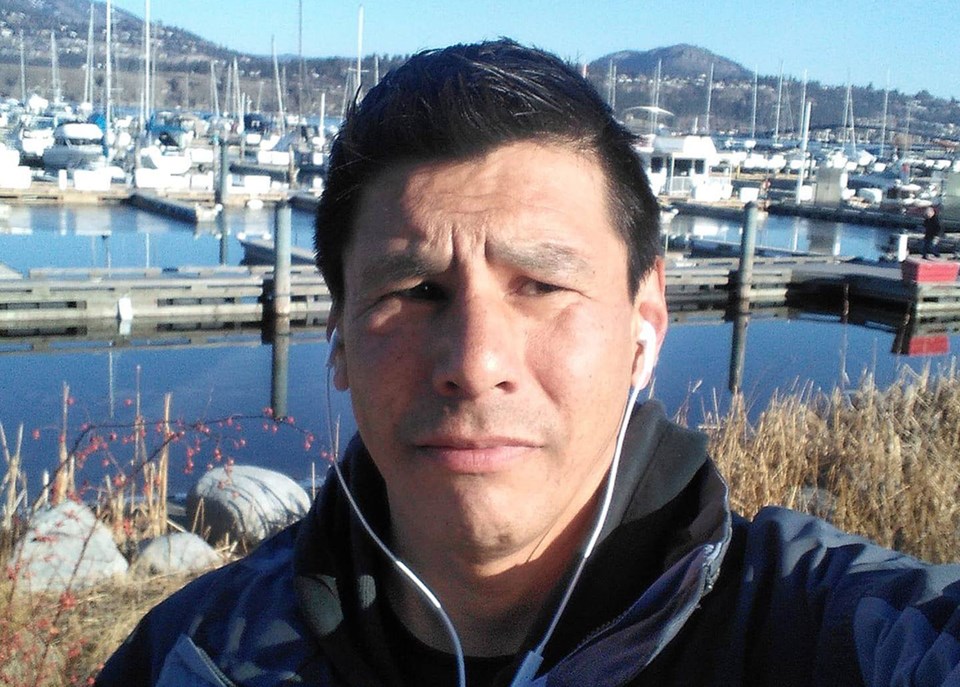
Timothy Hadwen
Moose Jaw’s Timothy Hadwen will have a chance to meet his biological father on Saturday afternoon outside of St. Andrew’s Church.

 A lifelong quest to find his biological parents is about to come to fruition for Moose Jaw’s Timothy Hadwen.

Hadwen, 45, will meet his birth father for the first time this Saturday afternoon (June 5) when the two finally cross paths outside of the St. Andrew’s Church memorial to the lost 215.

“It seems to be one of those happy-ending stories where we’ve been hearing so many sad stories with so much heartbreak and racism and finger-pointing, who’s to blame and who should take responsibility,” Hadwen said on Friday afternoon.

“But not every story has a happy ending like this… I’m one of the lucky ones to gets to meet my birth father, who I never met. And there are a lot of children who are still out there who are looking.”

Hadwen and his three sisters were adopted by Larry and Rosa Hadwen when he was a young child, and he grew up in an environment that was “wonderful, and I still talk about them and rave about them and how much they did for us... They’ve always wanted me to know about my background and who my birth parents are and now we do.”

Even growing up, the question of ‘where did I come from’ was in the back of his head, which eventually led Hadwen to reach out to Saskatchewan post-adoption services. At first, they weren’t a lot of help as records of his biological birth parents weren’t available, but his birth record was. And on that record was his birth mother’s name.

That led Hadwen to get in touch with his advocate from Montreal Lake Cree Nation, and a startling revelation.

“After I e-mailed that to him he replied right away ‘I know where your biological parents are, I’ve known them my whole life almost’,” Hadwen said with an incredulous laugh. “They only live a kilometre apart from each other up in Little Red. It’s amazing how close we are together and how we were still so far away.”

Unfortunately, his birth mother had passed away. But Timothy had a phone call to make to 78-year-old Stanley Halkett of Little Red River First Nation, located a half-hour north of Prince Albert.

“It was very nerve-wracking at the beginning,” Hadwen said of making that first connection. “It took me a while to muster up the courage to move forward and make that first call. And when I did make that call, you could hear it in my voice, it was shaky, very emotional, but I pushed through it and we had a good conversation.”

That first contact also brought forward another surprise.

“Stanley never stopped looking for me the whole 45 years,” Timothy said. “Now he’s so excited and he said ‘I’m dropping everything and I’m coming to see you, I don’t care about the weather, I have to see you and I have to hold you’. It’s an amazing feeling and at the same time it’s a very exciting moment.”

It was also a moment tinged with sadness, given what he and his adopted parents had been told.

“I was led to believe that my birth parents didn’t want me and that’s why I was up for adoption, but my adopted parents, they were lied to this whole time,” Hadwen said. “It’s heartbreaking because I’m not the only one, there are so many kids who never had a chance to be with their biological families.”

In other words, exactly the situation so, so many other Indigenous people went through as part of the 60’s Scoop. Hadwen has chosen to let that part of the past stay the past, though, even as he continues to deal with the outcome of that heinous chapter of Canadian history.

“I don’t want to point fingers or blame anyone for what happened, it’s time to move forward and heal,” he said.

Part of that healing will happen Saturday. 

Stanley is making the four-hour trip south from Little Red River, and when the two finally meet, Timothy has little idea how it will go other than it will be an amazing moment for both men.

“I know it’s going to be emotional, we spoke again this morning and we’re just moving ahead with the meeting, however it goes,” Hadwen said. “It was 45 years ago I was in my mother’s stomach and he didn’t even know I was born, what day I was born, time I was born… apparently they decided my birth mother wasn’t worth keeping me and that’s how I ended up in the system.

“But now I get to meet my birth father, and it’s going to be incredible.”

Hadwen plans to stream the meeting on Facebook Live, and you can watch the meeting happen at www.facebook.com/timothy.hadwen.1.

How little done on Truth and Reconciliation #TRC

 Two TRC Calls to Action Are a Litmus Test for Governments. They’re Failing

An abandoned Kamloops graveyard of children remind us of how little has been done even to begin the work on truth and reconciliation.

Tom McMahon 3 Jun 2021 | TheTyee.ca

Tom McMahon is former general counsel of the Truth and Reconciliation Commission, former executive secretary of the Manitoba Aboriginal Justice Inquiry and former senior counsel at Elections Canada.

As we all struggle with the news of 215 Indigenous children found in a Kamloops graveyard, many are demanding that the Canadian government finally implement the Truth and Reconciliation Commission’s 94 Calls to Action. I was general legal counsel to the TRC and previously executive secretary to the Manitoba Aboriginal Justice Inquiry, both under the direction of Murray Sinclair and the other commissioners.

Some media have noted that five of six Calls to Action relevant to these children have yet to be fulfilled. But there are other calls that matter, and failing to name them hurts our ability to hold the government to account. The media needs to get this right.

(And when the government says that some of these Calls to Action are “in progress,” do not believe it. It has been six years since the commission finished its work. When does “progress” become “completed”? Those of us who have worked in government and seen replies to various reports know that “in progress” means the government does not intend to implement the recommendation but is trying to figure out a way to get credit for having done so.)

I want to highlight two of the TRC Calls to Action in particular: 81 and 82. Every time there’s an article about missing children, about a John A. Macdonald statue, about a Hector-Louis Langevin place name, and every time I see an article about a new monument for Canada’s dead soldiers in Afghanistan or the victims of communism, or a new parliamentary statement about a foreign genocide, I look to see if the news articles mention those two Calls to Action about Indian Residential Schools.

They never do. Why is that?

81. We call upon the federal government, in collaboration with Survivors and their organizations, and other parties to the Settlement Agreement, to commission and install a publicly accessible, highly visible, Residential Schools National Monument in the city of Ottawa to honour Survivors and all the children who were lost to their families and communities.
82. We call upon provincial and territorial governments, in collaboration with Survivors and their organizations, and other parties to the Settlement Agreement, to commission and install a publicly accessible, highly visible, Residential Schools Monument in each capital city to honour Survivors and all the children who were lost to their families and communities.

Why do I care about TRC Calls to Action 81 and 82? It’s empty symbolism, right?

I care because I see them as being such an easy, inexpensive thing to do. I see 81 and 82 as a litmus test for our governments. If you’re not even willing to do this simple thing, what does it say about your sincerity, honour, goodwill and credibility on the other Calls to Action?

I care because our current monuments and place names and flags are such “in-your-face” and “rub-your-nose-in-it” strutting examples of colonialism and white supremacy. Canada desperately needs balance and diversity in our public symbols. We desperately need some historical accuracy.

I care because national and provincial public monuments would be a daily public statement that we remember, that we accept the truth of what we have heard and that we commit ourselves to be better.

I care because we create monuments to ourselves and our ancestors all the time. The lack of balance in monuments for other Canadians is a painful reminder of who we value and who we don’t value.

I care because the purpose of Calls to Action 81 and 82 is “to honour Survivors and all the children who were lost to their families and communities.” Who could be opposed to that?

Here are other Calls to Action that are relevant to the missing children.

67. We call upon the federal government to provide funding to the Canadian Museums Association to undertake, in collaboration with Aboriginal peoples, a national review of museum policies and best practices to determine the level of compliance with the United Nations Declaration on the Rights of Indigenous Peoples and to make recommendations.
68. We call upon the federal government, in collaboration with Aboriginal peoples and the Canadian Museums Association, to mark the 150th anniversary of Canadian Confederation in 2017, by establishing a dedicated national funding program for commemoration projects on the theme of reconciliation.
69. We call upon Library and Archives Canada to:

i) Fully adopt and implement the United Nations Declaration on the Rights of Indigenous Peoples and the United Nations Joinet-Orentlicher Principles, as related to Aboriginal peoples’ inalienable right to know the truth about what happened and why, with regard to human rights violations committed against them in residential schools.

ii) Ensure that its record holdings related to residential schools are accessible to the public.

iii) Commit more resources to its public education materials and programming on residential schools.

70. We call upon the federal government to provide funding to the Canadian Association of Archivists to undertake, in collaboration with Aboriginal peoples, a national review of archival policies and best practices to:

i) Determine the level of compliance with the United Nations Declaration on the Rights of Indigenous Peoples and the United Nations Joinet-Orentlicher Principles, as related to Aboriginal peoples’ inalienable right to know the truth about what happened and why, with regard to human rights violations committed against them in the residential schools.

ii) Produce a report with recommendations for full implementation of these international mechanisms as a reconciliation framework for Canadian archives.

77. We call upon provincial, territorial, municipal and community archives to work collaboratively with the National Centre for Truth and Reconciliation to identify and collect copies of all records relevant to the history and legacy of the residential school system, and to provide these to the National Centre for Truth and Reconciliation.
79. We call upon the federal government, in collaboration with Survivors, Aboriginal organizations and the arts community, to develop a reconciliation framework for Canadian heritage and commemoration. This would include, but not be limited to:

i) Amending the Historic Sites and Monuments Act to include First Nations, Inuit and Métis representation on the Historic Sites and Monuments Board of Canada and its Secretariat.

ii) Revising the policies, criteria and practices of the National Program of Historical Commemoration to integrate Indigenous history, heritage values, and memory practices into Canada’s national heritage and history.

iii) Developing and maintaining a national heritage plan and strategy for commemorating residential school sites, the history and legacy of residential schools and the contributions of Aboriginal Peoples to Canada’s history.

Here is what the media is reporting as being the only Calls to Action relevant to missing children.

71. We call upon all chief coroners and provincial vital statistics agencies that have not provided to the Truth and Reconciliation Commission of Canada their records on the deaths of Aboriginal children in the care of residential school authorities to make these documents available to the National Centre for Truth and Reconciliation.
72. We call upon the federal government to allocate sufficient resources to the National Centre for Truth and Reconciliation to allow it to develop and maintain the National Residential School Student Death Register established by the Truth and Reconciliation Commission of Canada.
73. We call upon the federal government to work with churches, Aboriginal communities, and former residential school students to establish and maintain an online registry of residential school cemeteries, including, where possible, plot maps showing the location of deceased residential school children.
74. We call upon the federal government to work with the churches and Aboriginal community leaders to inform the families of children who died at residential schools of the child’s burial location, and to respond to families’ wishes for appropriate commemoration ceremonies and markers, and reburial in home communities where requested.
75. We call upon the federal government to work with provincial, territorial, and municipal governments, churches, Aboriginal communities, former residential school students, and current landowners to develop and implement strategies and procedures for the ongoing identification, documentation, maintenance, commemoration, and protection of residential school cemeteries or other sites at which residential school children were buried. This is to include the provision of appropriate memorial ceremonies and commemorative markers to honour the deceased children.
76. We call upon the parties engaged in the work of documenting, maintaining, commemorating, and protecting residential school cemeteries to adopt strategies in accordance with the following principles:

1. The Aboriginal community most affected shall lead the development of such strategies.

2. Information shall be sought from residential school Survivors and other Knowledge Keepers in the development of such strategies.

3. Aboriginal protocols shall be respected before any potentially invasive technical inspection and investigation of a cemetery site.

It is not too much to expect our media and our politicians to actually read all of the TRC Calls to Action and to discuss them specifically.  [Tyee]

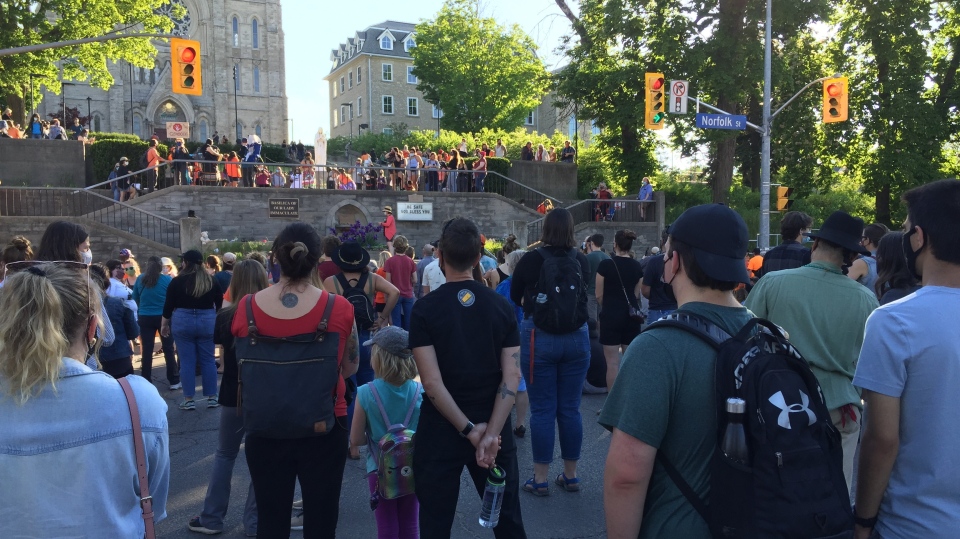
Guelph residents gather to honour 215 Indigenous children found at B.C. residential school

 Why Canada is mourning the deaths of 215 children...

Guelph residents gathered on Tuesday night to honour victims and survivors of residential schools.

WATCH: Guelph residents gather to honour 215 Indigenous children found at B.C. residential school

BBC News
The landmark Truth and Reconciliation Commission (TRC) report, released in 2015, described the government-led policy as cultural genocide.

MORE NEWS

CLICK OLDER POSTS (above) to see more news

CLICK OLDER POSTS  (above) to see more news

MEGWETCH THANK YOU

HUGE Thank you for visiting this blog and sharing this with your kin. It's appreciated. Contact Trace anytime! Use the form below.

BOOKSHOP

Please use BOOKSHOP to buy our titles. We will not be posting links to Amazon.

Popular Posts

To Veronica Brown

Veronica, we adult adoptees are thinking of you today and every day. We will be here when you need us. Your journey in the adopted life has begun, nothing can revoke that now, the damage cannot be undone. Be courageous, you have what no adoptee before you has had; a strong group of adult adoptees who know your story, who are behind you and will always be so.

OUR HISTORY

OUR HISTORY
BOOK 5: Lost Children of the Indian Adoption Projects