BACK UP BLOG (no longer updating)

This blog was a backup for American Indian Adoptees blog
USE THE SEARCH BAR or SEARCH TOPICS at bottom of this blog

If you need support

Support Info: If you are a Survivor and need emotional support, a national crisis line is available 24 hours a day, seven days a week: Residential School Survivor Support Line: 1-866-925-4419. Additional Health Support Information: Emotional, cultural, and professional support services are also available to Survivors and their families through the Indian Residential Schools Resolution Health Support Program. Services can be accessed on an individual, family, or group basis.” These & regional support phone numbers are found at https://nctr.ca/contact/survivors/ . MY EMAIL: tracelara@pm.me

Search This Blog

Tuesday, November 26, 2019

We see exactly what Goldwater wants #AttackonICWA #ICWA #NAAM2019


Indian child welfare legal challenge is about ending tribal sovereignty


Before the law more than a quarter of American Indian and Alaska Native children were removed from their homes

This story is like a scary movie. In “Fatal Attraction” Glen Close’s character won’t give up her murderous quest. She comes back again and again. The legal challenges to the Indian Child Welfare Act follow a similar plot line.

The scene in the 1970’s for American Indian and Alaska Native children was disturbing, some 25 to 35 percent of the population were removed from their homes by state welfare and private adoption agencies. This was slow motion genocide by literally removing the future from the home.

The Indian Child Welfare Act was enacted as to reverse this narrative and to recognize that tribes, as sovereign nations, have control over the welfare of their own children.

Attacks on the law, enacted in 1978, have inexplicably risen in the past seven years and attracted the support of a seemingly disparate array of high power ultra conservative players and organizations.
Today’s challenges to the child welfare protocols aren’t only about adoption because if the Indian Child Welfare Act is found to be unconstitutional that would undermine tribal governments. So much is at stake: The authority of tribal courts, economic nationhood, including casinos, and the control of tribal land, potentially an opening for fossil fuels and other extractive industry development.
“Eliminating ICWA is part of an ultra-conservative agenda to return Indian Country to the Termination Era, abrogate tribal treaties, and made tribes and tribal citizens fully subjects to state law,” said former tribal prosecutor J. Eric Reed.

The latest Indian Child Welfare Act challenge is again before the 5th U.S. Circuit Court of Appeals. The court made the unusual decision to vacate its August 9 decision in Brakeen v. Bernhardt finding child welfare law is not race-based but a valid, constitutional statute; then the court announced it would rehear the case En Banc.

The use of En Banc, in which all judges of a particular court hear a case, is a relatively uncommon legal procedure usually reserved for the purposes of maintaining uniformity of the court’s decisions or to show that the proceeding involves a question of exceptional importance.

In its original decision finding ICWA to, indeed, be constitutional, one of the three judges, Priscilla R. Owen wrote her dissenting opinion in an August 16 modification. Owen wrote that in requiring states to maintain records relating to placement of Indian children as part of compliance with Indian Child Welfare Act violates the constitution’s 10th Amendment anti-commandeering doctrine. According to the 10th Amendment, “The powers not delegated to the United States by the Constitution, nor prohibited by it to the States are reserved to the States respectively or to the people.”

Owens wrote: “The defendants in the present case contend that the Indian Commerce Clause empowers Congress to direct the States as it has done in the ICWA. They are mistaken. Where a federal interest is sufficiently strong to cause Congress to legislate, it must do so directly; it may not conscript state governments as its agents.”

This opinion underscores the rise of Federalist philosophies in conservative politics supporting states rights over federal authority, questioning the constitutionality of requiring state governments to carry out federal policies.

The 5th U.S. Circuit Court of Appeals long considered the most politically conservative court in the country, has grown more so after five appointments to its ranks by President Trump. A total of 17 judges occupy the court.

According to federal court watchers, President Trump is engaged in a quiet revolution to populate federal courts with judges who align with his brand of politically conservative politics. Although his 157 judicial appointments place him roughly even with both Barack Obama and George W. Bush during the same point in their tenures, his focus on federal appeals courts sets him apart from his predecessors according to the New York Times. If all of his current nominees are confirmed, they will account for 1.4 of the country’s federal appeals court judges.

National Public Radio’s Carrie Johnson described Trump’s appointment of James Ho to the Fifth Circuit Court as exemplifying the Trump era. A first time judge, Ho’s first Fifth Circuit opinion has been described by legal scholars as political commentary rather than legal opinion. In Zimmerman v. City of Austin, involving limiting campaign contributions in Austin, Texas, he wrote in his dissenting opinion, “If you don’t like big money in politics, then you should oppose big government in our lives,”

Vanita Gupta, president and chief operating officer of the Leadership Conference on Civil and Human Rights issued a statement about Trump’s court nominees: “The majority of his nominees have long records of hostility to civil and human rights, and too many are unqualified. Leader McConnell and Senate Republicans are transforming our federal courts because their agenda is failing in Congress and the court of public opinion.”
She notes that appointments to the federal judiciary are lifetime positions.

History of Brakeen v. Bernhardt before the Fifth Circuit

On October 4, 2018, U.S. District Judge Reed O’Connor of the Northern District of Texas ruled that the Indian Child Welfare Act is unconstitutional because it’s race-based.

The ruling was based on Chad and Jennifer Brackeen, non-Natives, experience in trying to adopt a Native child, an enrolled citizen of the Navajo and Cherokee Nations whom they had fostered for a year-and-a-half. In 2017, the Brackeens filed a lawsuit in Texas seeking to adopt the two-year-old boy, identified in the lawsuit as A.L.M. Although a Navajo family was available to take the boy in January 2018 the Brackeens won their case in a Texas district court, and successfully finalized their adoption. But their lawsuit, Brackeen v. Bernhardt, proceeded anyway, joined by several other plaintiffs, including the states of Texas, Louisiana, and Indiana, and eventually landed before Judge O’Connor.

Most media coverage of O’Connor’s ruling, such as a story by National Public Radio, tended to gloss over the law's political and legal context and the far-reaching implications of its reversal.
Many failed to mention that conflicts concerning the child welfare system that can often be traced back to the failure of state and county authorities to notify a tribe when an enrolled child enters child protective services. And most neglected to explain that tribal identity is based not on racial identifiers, or whether a child “looks Indian,” but on their political and citizenship connections to a sovereign nation. And that gets at issues that go far beyond the ability of non-Natives to adopt Native American children.

The designation that the children of enrolled tribal citizens are automatically enrolled citizens as well “is foundational to federal Indian law,” noted a statement released by the Native American Journalists Association. In March 2019, the Fifth Circuit Court of Appeals in New Orleans heard oral arguments in the Brackeen case and issued its now vacated decision in August finding that the child welfare law is not race based, unconstitutional nor does it counter the 10th amendment. If the court finds during rehearing that ICWA is unconstitutional on any front, it opens the door to overturning tribal sovereignty.

And without sovereignty, treaties between the U.S. government and tribes could be subject to debate.
Reversing the Indian Child Welfare Act would mean that “the hundreds and thousands of federal statutes benefiting Indians would be open for reconsideration,” said Michigan State University law professor Matthew Fletcher, a member of the Grand Traverse Band of Ottawa and Chippewa Indians and editor of Turtle Talk, the leading blog on American Indian law and policy. “Federal services for Indians and statutes such as the Indian Self Determination Act, Indian Gaming Regulatory Act and others could be challenged.”

And that might be the point. Tribal leaders, legal scholars and child welfare advocates speculate that attacks on the law are seldom rooted in genuine concern for American Indian children, but are merely the latest strategy for right-wing groups to advance agendas rooted in racism, greed and the othering of poor people.

Since 2013, challenges to the law have gained new urgency and support from wealthy right-wing interest groups. Brackeen v. Bernhardt was itself bankrolled by an unlikely alliance of right-wing political, legal, economic and religious groups that outwardly appear to have little connection to Indian Country or its children. They include right-wing think tanks, representatives of the private adoption industry, the evangelical adoption movement, anti-treaty rights organizations and conservative fossil fuel industrialists.

Although the final goals of these seemingly disparate groups may differ, their shared strategy of commodifying Native American children reveals a colonial mindset that not only depicts Native American people as incapable of managing their own affairs, but also frames their children and resources as free for the taking.

According to J. Eric Reed, former tribal prosecutor and a member of the Choctaw Nation, the current legal fight is part of a strategy that feeds into ending the federal government’s trust relationship with tribes as well as challenging federal authority over states’ rights.

“Brackeen v. Zinke,” said Reed, “is a right-wing foot in the door to rewrite the Constitution.”
Although the decision to rehear Brankeen v. Bernhardt appears to be based on Owen’s dissenting opinion that ICWA violates the Constitution’s anti commandeering doctrine, it will mean all plaintiff’s complaints in the original case will be up for reconsideration.

The law’s opponents are emboldened by each small favorable court decision in their favor. For instance, since 2013, with an infamous lawsuit known as “Baby Veronica” that reached the Supreme Court, challenges to ICWA have increased. In the Baby Veronica case—formally called Adoptive Couple v. Baby Girl—powerful interests in the adoption industry and evangelical churches joined with high-profile attorneys to challenge ICWA’s authority regarding the adoption of an infant citizen of the Cherokee Nation named Veronica. Eventually the non-Native couple seeking to adopt Veronica, Matt and Melanie Capobianco, prevailed.

Although the court found that ICWA was, indeed, constitutional, it found in favor of the Capobianco’s because the child’s Native father had not maintained custody since her birth. Not long after the Supreme Court ruled in the Capobiancos’ favor, Veronica’s non-Native biological mother, Christina Maldonado, signed onto a lawsuit against the U.S. government claiming that ICWA was unconstitutional. (She later dismissed the suit voluntarily)

“ICWA opponents want another crack at the Supreme Court,” said Nicole Adams of the Colville Confederated Tribes and advisor at the Partnership for Native Children.
“Redefining ICWA as race-based furthers their final agenda of dismantling Indian law as a whole,” she said.

PHOTO:
Chiracahua Apaches arriving at the Carlisle Indian School, 1886, and after "training" in 1886. From the Records of the Office of the Chief Signal Officer (National Archives)

The Roots of the child welfare act
Most people in the U.S. have never heard of the Indian Child Welfare Act, enacted in 1978 to stop the near wholesale removal of Native American children from their birth families to non-Native foster and adoption placements. Today, under that law, tribes typically try to place children who come into tribal or state care with a family member, a member of their tribe or, failing that, a family from another tribe.

“Typically, the mainstream press picks up a story regarding ICWA only when a non-Indian family has somehow been injured,” said Terry Cross, founding director and current advisor for the National Indian Child Welfare Association

But the law stems from generations of abusive policies that tore Native American families apart. Beginning in the late 19th Century, the federal government forced or coerced the separation of thousands of Native children from their families, sending them to federal or religious boarding schools often many hours away from their homelands.

Created as part of President Ulysses S. Grant’s Peace Policy of 1869, the boarding school era was framed as a bloodless, more humane answer to the country’s “Indian Problem.” The schools’ explicit mission was to destroy Native cultures, languages, and spirituality, and prepare the children for assimilation into American society. Modeled on education tactics used on Native prisoners at Fort Mason in the 1870s by Captain Richard H. Pratt, the boarding schools followed a punitive philosophy of rigid order and Pratt’s motto: “Kill the Indian, and save the man.”

Today, Native American and Alaska Natives remain overrepresented in foster care at a rate 2.7 times greater than their proportion in the general population.

It’s these dynamics that ICWA was created to address: helping ensure that tribes, as sovereign nations, have jurisdiction over their own children. Since the act’s establishment, several prominent child advocacy organizations have declared it the gold standard for child welfare policies and practices for American Indian children.

Despite the law, tribes often decide not to transfer eligible children to tribal jurisdiction for a number of reasons: that the child may have close tribal and family connections in a non-Indian placement, or the tribe may lack the resources to intervene in cases located far from the reservation. Notably, in the Brackeen, the tribs ruled in favor of the non-Native family’s adoptions. These scenarios, however, seldom receive media coverage.

There is little data regarding states’ compliance with Indian Child Welfare Act, but a 2015 study by Casey Family Programs suggests that many government child protection agencies fail to follow the law. The lack of federal oversight for enforcing ICWA adds to gaps in compliance.
“For years, under ICWA, tribes have been making determinations in child welfare cases based on the best interest of the child,” noted law professor Matthew Fletcher. “Suggesting that tribes don’t routinely make child welfare decisions based on the best interest of the child is just ignorant.”
The legal battle over ICWA will likely continue for several years, and Fletcher and others believe that future challenges are inevitable.

Termination of tribal sovereignty
From the mid-1940s through 1970, the federal government employed a series of assimilationist policies designed to privatize American Indian lands, destroy tribal cultures, and reverse the tribes’ and government’s “trust relationship,” which protects tribal treaty rights, lands, assets, and resources.The assault on this trust responsibility and Indian rights became known as the Termination Era.

But the 2018 ruling Brackeen v. Bernhardt, Judge O’Connor seemed to endorse the anti-tribal government view that it’s a race-based statue.

“If you’re a right-wing interest group and can figure out a way to get the case heard in Judge O’Connor’s court, you can expect a sympathetic ear,” Fletcher said.

The leading figures in the newest anti-Indian Child Welfare Act drama include the right-wing think tank the Goldwater Institute; the National Council for Adoption, representing the private adoption industry; and an evangelical Christian adoption movement that sees adoption as a means to live out their faith.

Ancillary supporters include the Koch brothers; the DeVos family; the Mercer Family (who are among Trump’s largest donors); the Cato Institute; the American Legislative Exchange Council (ALEC); the anti-treaty group Citizens Equal Rights Alliance which advocates for the termination of U.S. and tribal treaty agreements; the Southern Baptist Convention, and others.
“It’s like this weird triad of strange and powerful bedfellows,” said Adams. Some of the players may have unwittingly signed on to this war and don’t necessary share the duplicitousness of others. But their combined opposition to ICWA represents titanic influence, power, and money in service of an anti-tribal sovereignty agenda.

One of the richest anti-ICWA funders is the Goldwater Institute. Since 2015, the libertarian non-profit has underwritten several legal challenges to ICWA. Attorneys at the Goldwater Institute filed an amicus brief in Brackeen v. Bernhardt, reiterating its past claims that ICWA is race-based and unconstitutional. And Timothy Sandefur, the Institute’s vice president for litigation, compared ICWA to discrimination suffered under Jim Crow laws, telling The Nation in 2017 that ICWA subjects Native children to an unfair set of rules based on race.

The Institute, along with the Cato Institute and the Texas Public Policy Foundation filed an amicus curiae brief supporting the current Fifth Circuit’s decision to hold En Banc hearings on ICWA.
The Institute describes Indian communities as environments “where poverty, crime, abuse and suicide are rampant,” and cites data showing that American Indian children have the highest rate of foster care of any ethnic group as an argument against ICWA. In essence, this blames American Indians for the outcomes of generations of federal assimilationist policies and recommends more of the same as a solution.

And yet, as Fletcher noted, “The Goldwater Institute has no history of expressing interest in either Indian or family law.” Although the Goldwater Institute has created an organization called Equal Protection for Native Children and frequently works with other ICWA opponents such as the Cato Institute, it has no history of working to improve the economic, educational, or health circumstances of Native children. Indeed, according to the organization’s income tax filing from 2016, its primary areas of research include constitutional law, education reform, and healthcare policy.
Among the Goldwater Institute’s major donors are the Koch brothers, well-known opponents to federal power and spending. Through their various advocacy organizations, the Koch brothers fund and support groups such as ALEC, which, like the Goldwater Institute, has called for a constitutional convention that would focus on elevating states’ rights and reducing federal oversight and regulation.
The other ally against the child welfare law the National Council for Adoption, and the adoption movement it represents. Matthew McGill, the lead plaintiffs’ attorney in Brackeen v. Bernhardt, is part of a husband-and-wife legal team with a long history of challenging the Indian Child Welfare Act.

McGill’s wife, Lori Alvino McGill, also a lawyer, represented the adoptive parents and the non-Indian biological mother in the Baby Veronica case ,accompanying them on a media tour, including an appearance on the Today Show that helped make their challenge to ICWA a national story.
The couple represent a larger constituency in the private adoption industry, which has become a powerful lobby against ICWA. Private adoptions are a lucrative business, with attorney fees routinely running between $10,000 and $40,000. But as obstacles to international adoptions have grown, there is a greater interest in domestic adoptions in the U.S.—including adoptions from Indian Country.
Many clients of private adoption attorneys like the McGills are members of a Christian adoption movement that encourages evangelicals to see adoption as a means to live out their faith help the needy, and evangelize children. The statement of faith for Nightlight Christian Adoptions — the agency affiliated with the Baby Veronica case — holds that adoption fulfills the Bible’s mandate to make disciples of all nations.

Practicing Christians are more than twice as likely to adopt than the general population, according to a 2013 study by the Barna Group. The study also found that most adoptive parents are White, while the children they adopt are overwhelmingly non-White.

For many Native Americans, these demographics bear a troubling resemblance to historical interactions between White Christians and Native peoples—whether the Catholic Church’s 15th Century documents granting European Christian explorers permission to use any means necessary to subdue and convert indigenous peoples, or the more recent abuses of the boarding school era.
“There is nothing original about some of the evangelical Christian adoption movements to focus on Native children and take it upon themselves to decide what’s best for Native families,” said the Partnership for Native Children’s Nicole Adams.

Sandy White Hawk, program manager with the Indian Child Welfare Act Law Center in Minneapolis, and a team of researchers, found that adult American Indians who were adopted to non-Indian parents experienced high rates of sexual, physical, and emotional abuse in their adoptive families. Adoptees also experience traits common to trauma survivors such as anxiety, intrusive imagery or nightmares, depression, withdrawal/isolation, guilt, and unresolved grief. The National Indian Child Welfare Association also cites studies indicating that Indian children placed in non-Indian adoptive homes suffer a far greater risk than the general American Indian population of psychological damage and have a higher tendency to abuse drugs and alcohol.

“I believe some of the motivation for evangelical Christians to adopt American Indian children comes from a savior complex,” said White Hawk. “Minority populations are often portrayed as unable to care adequately for their children; some of the adoptive parents may believe they are offering homes for unwanted, neglected children.”

But too often, then as now, this impulse may spring from a failure to understand American Indian culture or extended family structure, wherein aunts or uncles might raise a child instead of her biological parent. As child welfare workers labeled that tradition as neglect, generations of Indian children were removed from their homes.
“Instead of saving Native families, these policies robbed them of the nurturing traditional values where the whole community embraced the child,” said Nicole Adams. “Who are these people to think they can take away ICWA, one of the few good things Native people have to protect our families?”
What’s next?
“Right now we know one judge from the panel (Owen) was concerned about one or two sections of the statute, but not its entirety. It may be the En Banc court will re-open the whole panoply of constitutional challenges; We just don’t know yet,” said Matthew Fletcher.
Amicus briefs are due December 16 and January 14, 2020. Oral arguments and case hearing are scheduled in New Orleans for the week of January 20, 2020.

Mary Annette Pember works as an independent journalist focusing on Indian issues and culture with a special emphasis on mental health and women’s health. Winner of the Ida B. Wells Fellowship for Investigative Reporting, Rosalynn Carter Fellowship for Mental Health Journalism, the USC Annenberg National Health Fellowship and Dennis A. Hunt Fund for health journalism she has reported extensively on the impact of historical trauma among Indian peoples. She has contributed to ReWire.News, The Guardian, The Atlantic and Indian Country Today. An enrolled member of the Red Cliff Band of Wisconsin Ojibwe, she is based in Cincinnati, Ohio. See more at MAPember.com.

Portions of this article first appeared in Public Eye Magazine on November 11, 2019 for Political Research Associates

Migrant children may be adopted after parents are deported #NAAM2019

AP | TheHill
 VIDEO
Holes in immigration laws are allowing state court judges to grant custody of migrant children to American families without notifying their deported parents, the Associated Press reported in October.
The AP scoured hundreds of court documents and immigration records to reveal several cases of children being permanently, legally taken from their families after initial separations.
The case study presented is indicative of larger loopholes in the immigration system, the AP contends. Because state governments tend to run child-welfare systems, inconsistencies between federal law and its application at the state level are frequent.
AP's conclusions are especially important given that 300 parents were deported to Central America without their children just this summer as part of the Trump administration's "zero tolerance" policy at the border.

CHILD TARGETS: AP: Migrant children may be adopted after parents are deported | TheHill

This will be an ongoing story since these children are being trafficked to American adopters.

Spiritual Abuse: RAD (3 parts) by Levi Eagle Feather

RAD: Guest Post: Levi Eagle Feather Sr. (Part 3)


Part Two: RAD
by Levi Eagle Feather Sr.
Part Two: RAD
by Levi Eagle Feather Sr.

Part Three: RAD

By Levy Eagle Feather Sr.

The twentieth century has produced a world of conflicting visions, intense emotions, and unpredictable events, and the opportunities for grasping the substance of life have faded as the pace of activity has increased. Electronic media shuffle us through a myriad of experiences which would have baffled earlier generations and seem to produce in us a strange isolation from the reality of human history. Our heroes fade into mere personality, are consumed and forgotten, and we avidly seek more venues to express our humanity. Reflection is the most difficult of all our activities because we are no longer able to establish relative priorities from the multitude of sensations that engulf us. Times such as these seem to illuminate the classic expressions of eternal truths and great wisdom seems to stand out in the crowd of ordinary maxims... -Vine Deloria Jr. (preface to John Neihardt's book "Black Elk Speaks")

Reality can be such a bastard sometimes! Just when you think you got it nailed, something happens and it all slips away. Good fortune, its second cousin, seems to operate along these same lines! You work hard, you’re ready, waiting, arms wide open and everything, then something happens blowing it all away. Does this sound familiar? Some people would say a person who thinks this way is just, “waiting for the axe to fall”. And if you think this way, too much of the time, it becomes a self-fulfilling prophecy.  
In medical terms, they say someone who thinks like this or sees life in this way is showing signs of paranoia. Meaning that someone is showing “a tendency….. toward excessive or irrational suspiciousness and distrustfulness of others.”1 In some situations, this kind of thinking can develop into a more serious condition known as schizophrenia. Noah Webster says schizophrenia is “a  psychotic disorder characterized by loss of contact with the environment, by noticeable deterioration in the level of functioning in everyday life, and by disintegration of personality expressed as disorder of feeling, thought (as delusions), perception (as hallucinations), and behavior —called also dementia praecox — compare paranoid schizophrenia”2  
In the two previous installments on RAD. I said my piece about certain spiritually abusive things that have happened to us American Indian people since western society brought its socially dysfunctional ways to our land. All of these happenings have been inducing an isolating oriented trauma on our people for several generations now. These things in particular, were the wars, reservations, boarding schools, relocation programs and adoption. Things which have worked in harmony, one after the other or simultaneously together, pretty much shattering and destroying the ways in which the beauty and magnificence of who we are as human beings can be fully realized, understood and enjoyed. I would say at this point RAD was intentioned and paranoid and schizophrenic type thinking and behavior are to be expected. 
The people who started these practices against us, in the past and continue to practice them today, have gotten away with it and continue making money off of doing it. Maybe not directly anymore, but indirectly still and that’s as simple and as good for them, as it can get! It indicates success, at least to them, of their westernized way of doing things.
By agitating and manipulating the destruction of others, confiscation of birthrights and through carefully and systemically applied abuses. These people have been capable, down through history of drastically changing tribal realities. Changing realities from systems which were built on self-reliance and were constructed for self-perpetuation to a single system which is built and designed solely for controlling and perpetuating the continued self-destruction of tribalism for profit. In short using you, your relatives and your friends to educate and labor towards your own self-destruction.      
If you think I'm wrong or misguided in my way of thinking. Look and see who has all the land, all the say and continues smiling all the way to the bank. We’ll call this group the top layer of western society. It is a top down system and we’ll call this layer the instigators or the 1% er’s of western society. The shot callers so to speak. There are other layers to this society. Here in America we know them as the middle, the lower, and the indigent classes. But for now I want to draw your attention to something else.
A simple fact! Obscured quite possibly by our own cultural amnesia of our individual ancestral roots is the fact we knew this was coming. A little less than 150 years ago my people, the Lakota, still understood our purpose. We knew and understood what sacrificing of ourselves was about. Of course, we still lived in Tipi’s on the wide open prairie and still hunted buffalo and much more. But we also lived in a civilized manner as civilized human beings then too. We knew and understood how fragile yet necessary keeping good relationships were to our health and wellbeing. We also knew and understood the threat and danger western thought and living posed to our health and well-being. The inevitability of this threat coming to fruition came through in dreams and visions of some of our great leaders of that time. Black Elk, a healer, was one of those leaders.
Black Elk was born in 1863 and lived until 1950. He was born well before the time of either the Sioux or the American Indian. He was born and lived as a Lakota. He thought, reasoned and behaved according to the Lakota way of being. He lived his life, perceiving reality understanding it and speaking of it in the language from within the worldview of his time. The Lakota worldview.
In the summer of 1872 at the age of nine Black Elk experienced a vision. In 1930, through a translator, Black Elk related his experience to John Neihardt, who in turn wrote about it as, “The Great Vision" in his book 'Black Elk Speaks". Whether this vision came to him through intuition, spiritual insight, or from hearing reports of what was befalling our Dakota relatives to the east, Black Elk's vision was spot on. Experienced well before the reservation, boarding school, relocation, and adoption eras of our people it was a foretelling. A vision foretelling the, as yet, unforeseen problems of becoming westernized. Something that we now experience on the regular, day in and day out. 
The following is an excerpt from this "The Great Vision:" 
And as we went the voice behind me said: "Behold a good nation walking in a sacred manner in a good land!"
Then I looked up and saw that there were four ascents ahead, and these were generations I should know. Now we were on the first ascent and all the land was green. And as the long line climbed, all the old men and women raised their hands, palms forward, to the far sky yonder and began to croon a song together, and the sky ahead was filled with clouds of baby faces.
When we came to the end of the first ascent we camped in the sacred circle as before, and in the center stood the holy tree, and still about us was all green.
Then we started on the second ascent, marching as before, and still the land was green, but it was getting steeper. And as I looked ahead, the people changed into elks and bison and all four footed beings and even into fowls, all walking in a sacred manner on the good red road together. And I myself was a spotted eagle soaring over them. But just before we stopped to camp at the end of that ascent, all the marching animals grew restless and afraid that they were not what they had been, and began sending forth voices of trouble, calling to their chiefs. And when they camped at the end of that ascent, I looked down and saw that leaves were falling from the holy tree.
And the Voice said: "Behold your nation, and remember what your Six Grandfathers gave you, for thenceforth your people walk in difficulties."
Then the people broke camp again, and saw the black road before them towards where the sun goes down, and black clouds coming yonder; and they did not want to go but could not stay. And as they walked the third ascent, all the animals and fowls that were the people ran here and there, for each one seemed to have his own little vision that he followed and his own rules; and all over the universe I could hear the winds at war like wild beasts fighting.6
And when we reached the summit of the third ascent and camped, the nation's hoop was broken like a ring of smoke that spreads and scatters and the holy tree seemed dying and all its birds were gone. And when I looked ahead I saw that the fourth ascent would be terrible.
Then when the people were getting ready to begin the fourth ascent, the Voice spoke like someone weeping, and it said: "Look there upon your nation." And when I looked down, the people were all changed back to human, and they were thin, their faces sharp, for they were starving. Their ponies were only hide and bones and the holy tree was gone.

6 At this point Black Elk remarked: "I think we are near that place now, and I am afraid something very bad is going to happen all over the world." He cannot read and knows nothing of world affairs.
Adoption causes RAD and RAD is a more normal reaction to adoption than not. Adoption in western society, especially the transracial adoption of American Indian children was and is an unnecessary and unnatural situation. Historically, the process of taking American Indian children away from families who birth them, love them, view them and understood them as their future causes immense suffering and loss that reverberates and is felt throughout each one of our nations. It broke our sacred hoop keeping the beauty of life just out of arms reach or so it seems.
The destruction didn’t happen overnight of course. Each and every one of these abuses aimed at destroying us was applied incrementally, generation after generation. Each and every one of them has done a pretty good job at what it was intended, and it isn’t over yet. It happened, some of it is still happening, and there isn't a whole lot we can do to stop it at this point. At least, I don't know of anything I can do that will.
This is not the reason I started writing this article, however. To talk endlessly about the things I cannot do or cannot change. The past is the past and there isn’t much we can do about that. Blaming won’t help, blaming ourselves and each other definitely won’t, but by being responsible and holding ourselves and each other accountable for recourse and recovery can.
As depressing as these three articles have all sounded, it was! I now prefer to spend the majority of my time working against the effects it has had on the hearts and minds of our people. So this will be the last I will have to say about all of that.
I’ve been working against the negative effects our past has had on us for the past 35 years or so. Both personally in my own life and the lives of my family members. As well as, professionally and as a volunteer within the American Indian community. Whenever the opportunity arose wherever it was I might have happened to be living at the time. Most recently I was able to offer my programming abroad, as a side job, amongst the folk in Germany, whenever the opportunity would arise.
I started out slowly of course way back then with baby steps. Thirty-five years have gone by and I seem to be walking much better now. On good days I think I might even be able to walk and chew gum. We shall see.
In the next series of blog articles I will be breaking away from the past. 
This series I’ll call Recourse and Repatriation, I will touch a little more on Black Elk’s vision and segue into a more personal accounting of my own experience of recourse and recovery from RAD. As well as offer my personal understanding of cultural repatriation and spiritual re-acculturation Lakota style.    
I am an American Indian, rightly enough. A card carrying one for all it might mean and for whatever purposes to which it matters. And I was adopted at one time. So be it. None of this has ever changed the facts of what really matters. I am a human being and I belong and so do my people. We belong to Mother Earth right here on this the North American continent. Until next time I wish you all enough. Hau Mitakuye Oyasin!

Monday, November 25, 2019

NARF responds to Goldwater Attack on #ICWA

Indian Child Welfare Law Under Attack

NARF Legal Review 44-2 cover
The latest edition of our NARF Legal Review features a story on the current attack on the Indian Child Welfare Act (ICWA). ICWA was enacted in 1978. Congress took this action when they realized that Native American children were being removed from their families and communities at an alarming rate.

By the time that Congress recognized the problem in 1978, more than a quarter of all Native children had been separated from their families. ICWA was created to improve the handling of Indian child welfare cases and their outcomes. The law has been called the gold standard of child welfare practices. But in recent years it has come under attack. Learn more about these attacks, and how NARF is responding, in the latest edition of the NARF Legal Review.

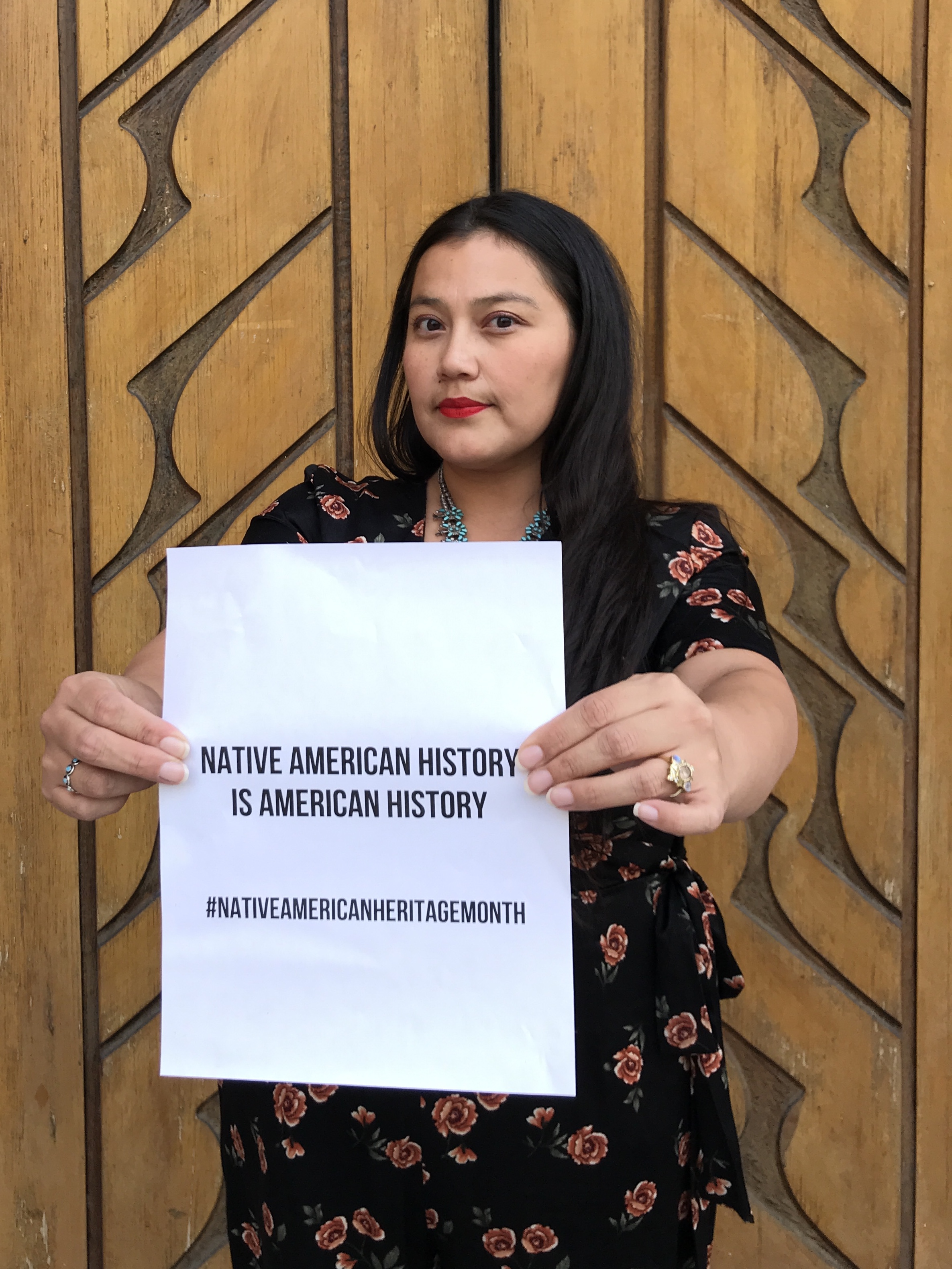
Native American History is American History + taking on the myth of Thanksgiving

Growing up as a Diné woman, I was taught to carry on my cultural practices of reverence for land and place. I was molded by the beliefs, prayers, and encouragement of my parents and grandmothers, and was raised hearing stories of our creation—stories that relate us to the world around us. In my community, fall brings with it a full of appreciation of the harvest and new practices to welcome the colder months.

While this time is filled with reverence internally, outside of my community the fall season is also full of cringe-worthy debacles. Between the racist costumes that arise around Halloween, the offensive mascots that storm the field, and the continued perpetuation of the false history of Thanksgiving, this season is challenging as a Native person.

Since the 1990s, the federal government has declared November “Native American Heritage Month.”

This year, however, the White House made another tactical effort to malign Native communities and Nations, proclaiming November as “National American History and Founders Month.” The announcement centers colonizers and “founding fathers,” invisibilizing the Indigenous people whose land was taken and the millions of Indigenous lives lost since contact because of genocide. 

As Philip Deloria asks in his essay, “The Invention of Thanksgiving,” “how does one take on a myth?” At the USDAC we know that is not as simple as saying Indigenous peoples “are still here.” These times call on all of us to deconstruct the myths and falsehoods related to the “founding” of this country, and to work in active solidarity with Native communities. At the USDAC, we want to offer a few ways we might start:

Start Conversations + Take Action
  • Begin conversation around your turkey dinner this year. Use the USDAC’s #HonorNativeLand Toolkit to investigate whose land you’re gathering on and offer a land acknowledgment as a way of opening conversation. Discuss with your loved ones the history you learned or didn’t learn about Native peoples. Brainstorm together how can you move beyond acknowledgment and into allyship and action. Is there a commitment you can make together to learning more about the history of the Indigenous communities that have inhabited the land you occupy? Are there Indigenous-led organizations in your community that you can support?
  • Understand that 100% of the land this country is on is occupied Native land. All. Of. It. In the video “The ‘Indian Problem’” Suzan Harjo shares, “There was no land brought here, the land here was Native Nations’.” She shares the power of myths and falsehoods and how critical they are to the continual dispossession of Native Peoples of their land.
  • Join the movement to recognize Native American history as American History. This social media campaign is working to visually represent how there would be no American History without the Native American contributions, protection and stewardship of Turtle Island (the above photo of me is part of this campaign).
  • Read up! Here’s a great, annotated list of selections from the First Nations Development Institute.
  • Indigenous peoples and communities are on the frontlines of the protection of Earth Mother. USDAC, has been working to support Climate Strikes through the USDAC Bureau of Energy, Power, and Art. We feel strongly this intersection is one we will grow in the next year and encourage you to show up for the next Global Strike on Friday, November 29th.
When I dream of future worlds, I see one that includes and centers Indigenous peoples through a true telling of history, where Native sovereignty and culture is protected and Native land recognized and stewarded with respect. When you understand the history of this country and the treatment of my ancestors, you understand how truly radical this dream is.

Ahe'hee,
Jaclyn Roessel
USDAC Director of Decolonized Futures & Radical Dreams

Sunday, November 24, 2019

Guatemala Trafficking #NAAM2019


Finding Fernanda: Two Mothers, One Child, and a Cross-Border Search for Truth by Erin Siegal

The dramatic story of how an American housewife discovered that the Guatemalan child she was about to adopt had been stolen from her birth mother.
Over the last decade, nearly 200,000 children have been adopted into the United States, 25,000 of whom came from Guatemala. Finding Fernanda, a dramatic true story paired with investigative reporting, tells the side-by-side tales of an American woman who adopted a two-year-old girl from Guatemala and the birth mother whose two children were stolen from her. Each woman gradually comes to realize her role in what was one of Guatemala’s most profitable black-market industries: the buying and selling of children for international adoption. Finding Fernanda is an overdue, unprecedented look at adoption corruption—and a poignant, riveting human story about the power of hope, faith, and determination.
Author: Erin Siegal
Publication Year: 2012


(Amazon Affiliate Link)

Critical Reviews:

Adoptee Reviews: 
Other Reviews: 

follow this blog🔻

Friday, November 22, 2019

Fifth Circuit to Review Brackeen Decision En Banc

Indian Nations Law Update - November 2019

The Indian Child Welfare Act of 1978 (ICWA) is a federal law that requires state courts to give tribes notice of child placement proceedings involving Indian children and, under certain circumstances, to transfer jurisdiction to tribal courts and to give placement preference to Indian families. Hostility to the law has engendered strategic lawsuits seeking to strike down both the ICWA statute itself and the Final Rule implementing ICWA, on multiple grounds. A three-judge panel of the Fifth Circuit Court of Appeals had rejected all of the anti-ICWA arguments in a unanimous decision Aug. 9, 2019, Brackeen v. Bernhardt, 937 F.3d 406 (5th Cir. 2019), holding that
  1. the special rules that ICWA applies to Indian children are not race-based distinctions subject to Fourteenth Amendment strict scrutiny but, rather, a political classification based on the unique relationship between the United States and tribes;
  2. the special treatment of Indian children under ICWA “is rationally tied to Congress’s fulfillment of its unique obligation toward Indian nations and its stated purpose of “protect[ing] the best interests of Indian children and ... promot[ing] the stability and security of Indian tribes;”
  3. the requirements that ICWA places on state courts are consistent with the Supremacy Clause and do not implicate the anti-commandeering mandate of the Tenth Amendment;
  4. the requirements that ICWA places on state agencies do not violate the anti-commandeering mandate because they “do not require states to enact any laws or regulations, or to assist in the enforcement of federal statutes regulating private individuals;
  5. ICWA, as an exercise of Congress’ plenary power over Indian affairs under the Commerce Clause, preempts inconsistent state laws;
  6. provisions of ICWA permitting tribes to adopt placement preferences did not run afoul of the non-delegation doctrine since “[t]he Supreme Court has long recognized that Congress may incorporate the laws of another sovereign into federal law without violating the nondelegation doctrine” and the preferences constitute a “‘deliberate continuing adoption by Congress’ of tribal law as binding federal law;”
  7. the Final Rule did not violate the APA because, in promulgating it, “BIA relied on its own expertise in Indian affairs, its experience in administering ICWA and other Indian child-welfare programs, state interpretations and best practices, public hearings, and tribal consultations. … and … BIA’s current interpretation is not ‘arbitrary, capricious, [or] an abuse of discretion’ because it was not sudden and unexplained;” and
  8. the Final Rule’s recommendation that a deviation from prescribed placement preferences be supported by “clear and convincing evidence” was entitled to Chevron deference and did not contradict Congressional intent.
On Nov. 7, however, all of the Fifth Circuit’s judges vacated the Aug. 9, decision and agreed to rehear the case en banc (i.e. with all sixteen active status judges participating). The full Court had taken the extraordinary step of deciding to rehear the case on its own motion before deciding instead to grant the plaintiffs’ motion for rehearing. Oral arguments have been scheduled for the week of Jan. 20, 2020. 
While a judge will not normally vote to rehear a case that he or she believes the panel has correctly decided, predictions are hazardous because of the wide range of issues that may have motivated different judges to vote in favor of rehearing. There is no doubt, however, that the forty-one-year-old ICWA is in jeopardy. 

Please use this blog search bar and look at Goldwater for more information about this attack on ICWA.

The Invisible Storm of Trauma #NAAM2019 #C-PTSD


trau·ma   

A serious injury or shock to the body, as from violence or an accident. An emotional wound or shock that creates substantial, lasting damage to the psychological development of a person, often leading to neurosis. An event or situation that causes great distress and disruption. 


By Trace Hentz (adoption survivor)

After many years, in many quiet moments, I recognize that being adopted has affected me very deeply.   
In my case, the day my mother left me, how she never came back, my world changed.  All I knew as this newborn baby was my own mother was not holding me, nursing me, talking to me. I was devastated by that. Broken. Part of my brain shut down. That pain was too much.

That very early experience needed to be processed as stress and trauma much later as an adult.  No one explained this to me, not even a doctor. As an adult I understand that a church/adoption agency places an infant with new parents and society says this is good and permanent. Good? Good for who?

Years pass and I accept this happened to me and my early trauma scars me.  

This monumental loss of my mother cracks me open and I am left to survive it, or not.  No one explains that I need to grieve this. I figure it out.  After years pass, I finally understand.  This experience affected me in complex ways.  This pain has layers and layers and layers.

But for others to tell me adoption was good for me? What? Or how I need to accept this is "adoption." Accept it? Are they kidding?  My scars are invisible but they are there. I know they are there.  I call this my Invisible Storm of Trauma!

How Catholic Charities took possession of me, handled me, first placing me in an orphanage then foster home, with no regard for my physical health, or my trauma-ridden emotional body, this speaks to the inhumanity of child trafficking and the traumatic consequences of adoption for the infant.  This speaks to the inhumanity of the deadly colonization of Indigenous people whose children were taken from them, calling us stolen generations. This speaks to a society that only sees what it wants to see.
Once adopted, you’re erased, an outsider, a stranger to your own nation, lands and people. I prefer to think of my younger self as brainwashed.

The bonding I had made with those mystery foster parents was also broken. How Catholic Charities and other churches and adoption agencies did this to millions of babies has consequences. This leaves millions of adoptees in the state of trauma, a stranger being raised by strangers, and a stranger to your first family.

Adoption is a cruel and inhumane way to treat an infant. A very sick society would do this.  And removing me from my own mother affected me in ways that are now measured and defined as post-traumatic stress disorder, or reactive attachment disorder, or severe narcissistic injury...and this explains how I was unable to bond with my adoptive parents.

What’s Trauma Bonding? What is Complex PTSD? (traumaanddissociation.wordpress.com) 

 Can complex PTSD be cured?

"When a mother is forced to choose between the child and the culture, there is something abhorrently cruel and unconsidered about that culture. A culture that requires harm to one's soul in order to follow the cultures prescriptions is a very sick culture indeed. This 'culture' can be the one a woman lives in, but more damning yet, it can be the one she carries around and complies with within her own mind....." -- Women Who Run With The Wolves by Clarissa Pinkola Estes 


Thursday, November 21, 2019

Why ICWA matters in 2019 and beyond #NAAM2019

#NAAM2019 tweets


READ MORE ABOUT NEW YORK OBC ACCESS here  
BIG HAPPY NEWS for many Native adoptees.

HISTORIC: Gov. Cuomo signs bill giving adopted people in NY their original birth certificates #NAAM2019

November 14: Gov. Cuomo signs bill giving adopted people in NY their original birth certificates

My daughter (center) with her daughter, my mother
and me. My family. 
As on January 2020 individuals born and adopted in New York will be able to have a copy of their original birth certificates with the names of their biological parents, if so listed.

What a simple statement of fact.

How long it has taken to write those words. For me, nearly a half century.

Many of you already know this because it's been all over Facebook and Twitter and even the eleven o'clock news last night. Yesterday evening when I got the news from my husband--Florence called  and she told him--when I was out having tea with a friend not related to this issue. At first, sitting on the couch in our living room, I hardly reacted to his words. I had been assured the signature was coming even though the wait was driving us all nuts, and so now, I thought, Oh, thank god, Cuomo's finally signed the bill.

keep reading

Wednesday, November 20, 2019

ICWA articles

The American Professional Society on the Abuse of Children published an issue on ICWA.
this is a pdf: Here.
Articles include:
Vandervort, The Indian Child Welfare Act: A Brief Overview to Contextualize Current Controversies
Fletcher & Fort: The Indian Child Welfare Act as the "Gold Standard"
Piper: The Indian Child Welfare Act: In the Best Interest of Children?
Piper: Response to Fletcher and Fort
Fletcher & Fort: Response to Piper

APSAC ADVISOR | Vol 31, Issue 247 
Special Section: Contested Issue
 The “solutions” provided in the article by Dr. Kathryn Piper, ...while well meaning, demonstrate a fundamental misunderstanding of tribes, the federal government, and the application of the Indian Child Welfare Act (ICWA). There is no data available anywhere that demonstrates Native children are kept in foster care longer than non-Native children because of ICWA, that they are harmed more than other non-Native children in foster care due to the heightened standards for removal or termination, or that applying the placement preferences, with their good cause exception, delays placement for Native children. Instead, the limited data we have on foster care generally shows that placing children in foster care has overwhelmingly negative outcomes, that kinship placements tend to help children, and that keeping children connected to their culture helps with creating resiliency factors they need to overcome early childhood trauma (Gallegos & Fort, 2017-2018; Pecora, 2006). ICWA does not hurt children—it’s the one law out there trying to address the very issues foster care creates.

APSAC Advisor Issue on ICWA

by Kate Fort

PTSD | Time Machine


By Trace L Hentz (blog editor)


There is no time machine to transport you back to the moment you were abandoned. You can’t erase how you felt or how it feels now. Or how it controls your life. Or how it breaks your heart into a million pieces. You don’t know how to stop feeling this way. You pray you’ll find your family, some one like you, who gets you, who looks like you. You want to put the pieces of your life back together, but you don’t know how.


These were thoughts I had – as I was processing.

Yes, there are adoptees who also feel this but never get to say it. I see it on their face. I hear their words and their silence.

No matter how much love and care we are given, the truth is – we are (and will always be) someone else’s children. We’re just not able to say it out loud, usually.

No doctor diagnosed me with birth trauma or splitting sickness. Therapists would recommend drugs which would only deaden my senses, missing the whole point. I didn’t want to feel more dead; I was already dead, or at least part of me was. I wanted to feel alive! Instead I just shut down. Power off.
My sickness was a dead zone, a black hole. It was not visible on my skin, nor did it raise its ugly head in one outburst or one tantrum.

I heard a story about another adoptee, a doctor with an Ivy League education, who was unable to meet his birthmother before she died. His wife told me he was never able to get the information he needed to find his birthfather, or know his identity.

Regardless of this man’s expensive education and medical training, the pain wounded him so badly he just couldn’t function, feel love or have a successful relationship. The pain was so deep, he couldn’t see it.

His wife told their therapist about his adoption, how he reacted, and how he seemed cold, heartless. Even marriage counseling didn’t save their marriage. Their therapist thought his adoption trauma was too much for him to handle; trying to work on it might kill what was left of him.

I’m not sure where I got my strength.

(excerpt from One Small Sacrifice, which is out of print)

Monday, November 18, 2019

Bitterroot: finalist in Colorado Book Awards #NAAM2019


Bitterroot: A Salish Memoir of Transracial Adoption,
University of Nebraska Press
Winner of the High Plains Book Award in 2 categories: Indigenous Writer and Creative Nonfiction
Finalist in the Colorado Book Awards


Note from Susan:

I've had the honor of adding my voice to the voices of others who are part of the complex structure of adoption.  RG Adoption Consulting asked me to be a part of their programming for this month, and asked great questions for adoptees, adoptive parents, birth parents and others involved in this process.

The question I chose to answer was "What was the most challenging for you as an adoptee?"  Please click on the link to listen to the interview, labeled "Through the Eyes of an Adoptee".  
As an American Indian transracial adooptee, this question allowed for a lot of discussion of history, policy and the clash when American Indian children are placed in non-Native families. If you are interested in sharing this video, please do!

All my best for your interest in this story.
Susan

Today is Part II, with great and honest information for adoptive parents of racial children.  Please like and share.

https://youtu.be/1yflu8qqOx4

CLICK OLDER POSTS (above) to see more news

CLICK OLDER POSTS  (above) to see more news

MEGWETCH THANK YOU

HUGE Thank you for visiting this blog and sharing this with your kin. It's appreciated. Contact Trace anytime! Use the form below.

BOOKSHOP

Please use BOOKSHOP to buy our titles. We will not be posting links to Amazon.

Popular Posts

To Veronica Brown

Veronica, we adult adoptees are thinking of you today and every day. We will be here when you need us. Your journey in the adopted life has begun, nothing can revoke that now, the damage cannot be undone. Be courageous, you have what no adoptee before you has had; a strong group of adult adoptees who know your story, who are behind you and will always be so.

OUR HISTORY

OUR HISTORY
BOOK 5: Lost Children of the Indian Adoption Projects