BACK UP BLOG (no longer updating)

This blog was a backup for American Indian Adoptees blog
USE THE SEARCH BAR or SEARCH TOPICS at bottom of this blog

If you need support

Support Info: If you are a Survivor and need emotional support, a national crisis line is available 24 hours a day, seven days a week: Residential School Survivor Support Line: 1-866-925-4419. Additional Health Support Information: Emotional, cultural, and professional support services are also available to Survivors and their families through the Indian Residential Schools Resolution Health Support Program. Services can be accessed on an individual, family, or group basis.” These & regional support phone numbers are found at https://nctr.ca/contact/survivors/ . MY EMAIL: tracelara@pm.me

Search This Blog

Saturday, October 19, 2019

The U.S. stole generations of Indigenous children to open the West

The U.S. stole generations of Indigenous children to open the West
Indian boarding schools held Native American youth hostage in exchange for land cessions.
BY NICK ESTES
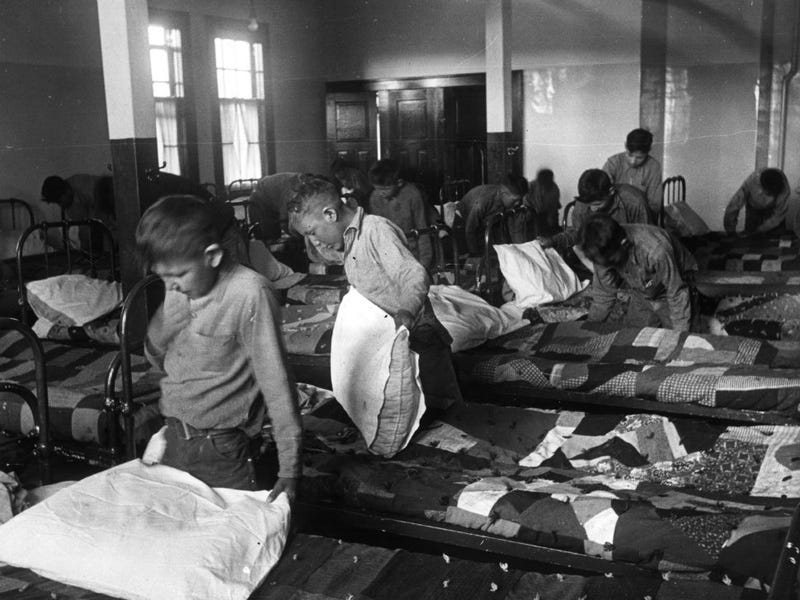
Nearly 200 Native children lie buried at the entrance of the Carlisle Barracks in the “Indian Cemetery” — the first thing you see when entering one of the United States’ oldest military installations. It is a grisly monument to the country’s most infamous boarding school, the Carlisle Indian Industrial School, which opened in 1879 in Carlisle, Pennsylvania, and closed in 1918. Chiseled onto the white granite headstones, arranged in the uniform rows typical of veterans’ cemeteries in the U.S., are the names and tribal affiliations of children who came to Carlisle but never left. Thirteen gravestones list neither name nor tribe; they simply read “UNKNOWN.”
It’s a chilling scene that I was unprepared for when I visited last year on the 100-year anniversary of the school’s closing. And the experience was made even more jarring by the mandatory background check and armed checkpoint I faced just to visit the cemetery and the school’s remnants. The campus is an active military base, and the heightened security measures are due to post-9/11 precautions. The unquiet graves of these young casualties of the nation’s bloody Indian wars lie next to the Army War College, which trains officers for the nation’s longest war, the war on terror.
The cemetery was not supposed to be at the front entrance. It was an accident: In 1927, to make room for a parking lot, the Army dug up the children’s graves and relocated them behind the base — out of sight. Then, in 2001, the back of the base was turned into the entrance to satisfy new security protocols. Now, Carlisle’s deadly past is on full display.
Carlisle, and boarding schools like it, are remembered as a dark chapter in the history of the ill-conceived assimilation policies designed to strip Native people of their cultures and languages by indoctrinating them with U.S. patriotism. But child removal is a longstanding practice, ultimately created to take away Native land. Although Carlisle is located in the East, it played a key role in pressuring the West’s most intransigent tribes to cede and sell land by taking their children hostage.
A century after its closing, however, unanswered questions surround the Carlisle Indian School’s brutal legacy. Secrets once thought buried — why did so many children die there? — are coming to light. And the descendants of those interred are demanding more than just the return of their stolen ancestors.
“The past of Carlisle is really about justice,” says Ben Rhodd, the Rosebud Sioux Tribe’s tribal historic preservation officer. Since April 2016, his office has been pursuing the return of 11 children buried at the Carlisle Indian Cemetery. Even in death, Rhodd explains, Rosebud’s children remain “prisoners of war,” held at a military base and unable to return to their home on the Rosebud Reservation, children who were “hostages taken to pacify the leadership of tribes that would dare stand against U.S. expansion and Manifest Destiny.”

Tuesday, October 15, 2019

Missing Chapter: A new series about hidden histories

How the US stole thousands of Native American children

In our latest episode of Missing Chapter, we explore this long legacy of the forced assimilation of Native American children. And how native families are still fighting back against the impacts today.

For decades, the US took thousands of Native American children and enrolled them in off-reservation boarding schools. Students were systematically stripped of their languages, customs, and culture. And even though there were accounts of neglect, abuse, and death at these schools, they became a blueprint for how the US government could forcibly assimilate native people into white America. At the peak of this era, there were more than 350 government-funded, and often church-run, Native American boarding schools across the US.

Monday, October 14, 2019

Illegal Adoption Scheme


Here and here.
A public official in Arizona has been arrested in connection with charges that he ran a multimillion-dollar scheme in which he smuggled pregnant women from the Marshall Islands to profit from their newborn babies. Authorities say Maricopa County Assessor Paul Petersen's fraudulent adoption enterprise left a trail of forged documents and violated U.S. and international laws.
Petersen operates an adoption law firm. For years, he has connected American families seeking to adopt with women from the Marshall Islands — but state and federal prosecutors say Petersen falsified documents and lied about the mothers' residency so he could enrich himself.
Federal indictment here.
We posted previous coverage of the Marshallese adoption schemes from the Hololulu Civil Beat.

Adoption Attorney Charged in Illegal Adoption Scheme Involving Marshall Island Babies

by Kate Fort

Staggering Adoption Industry Profits

reblog from Musings of the Lamb blog:

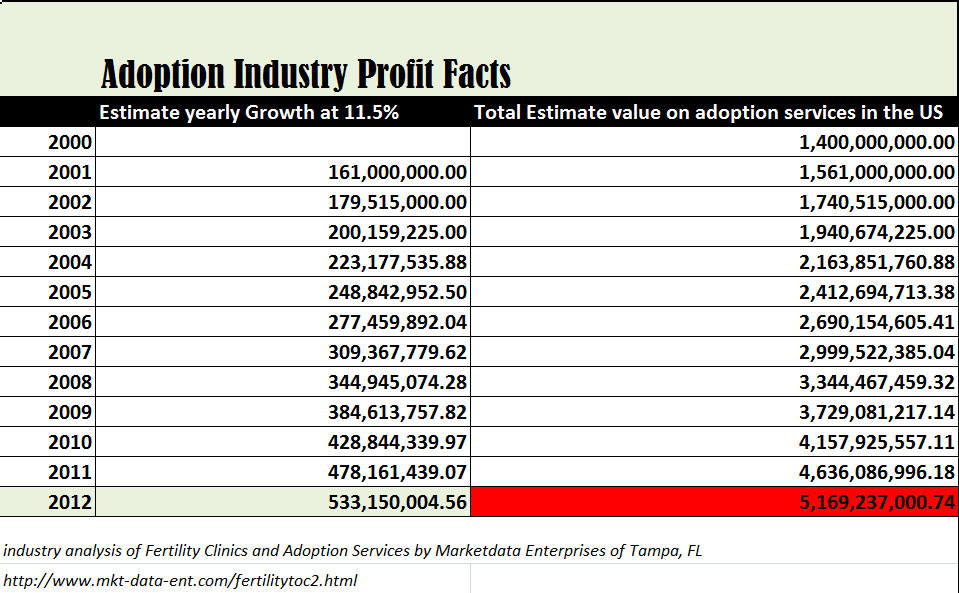
By 2012, Adoption Will be a 5 BILLION Dollar Plus industry

Even the banking and insurance industry has more regulations applied to then than adoption and we know what they do to try and make money at all costs.
An industry analysis of Fertility Clinics and Adoption Services by Market Data Enterprises of Tampa, FL, has placed a $1.4 billion value on adoption services in the US back in’ 99. No other government or private agency has bothered since then. With a projected annual growth rate of 11.5% to 2012, this makes adoption the largest unregulated industry in the US.
Do the math; even if we follow those conservative projections, because the market has exploded since this last study was done making 11.5% is very mild of a percentage, we have a number that is in excess of 5 billion dollars by the end of 2012 with a growth rate of at least a half billion a year and growing.
Adoption is a billion dollar business
Let’s all repeat: NO REGULATIONS PLUS LARGE SUMS OF MONEY EQUALS CLIMATE FOR CORRUPTION. That, folks, is human nature.
http://www.adoptionbirthmothers.com/its-not-about-you-but-it-is-2/#more-3268

Tuesday, October 8, 2019

Dawnland wins EMMY

Documentary co-produced by NAS professor wins Emmy

by Emily Zhang | 10/8/19

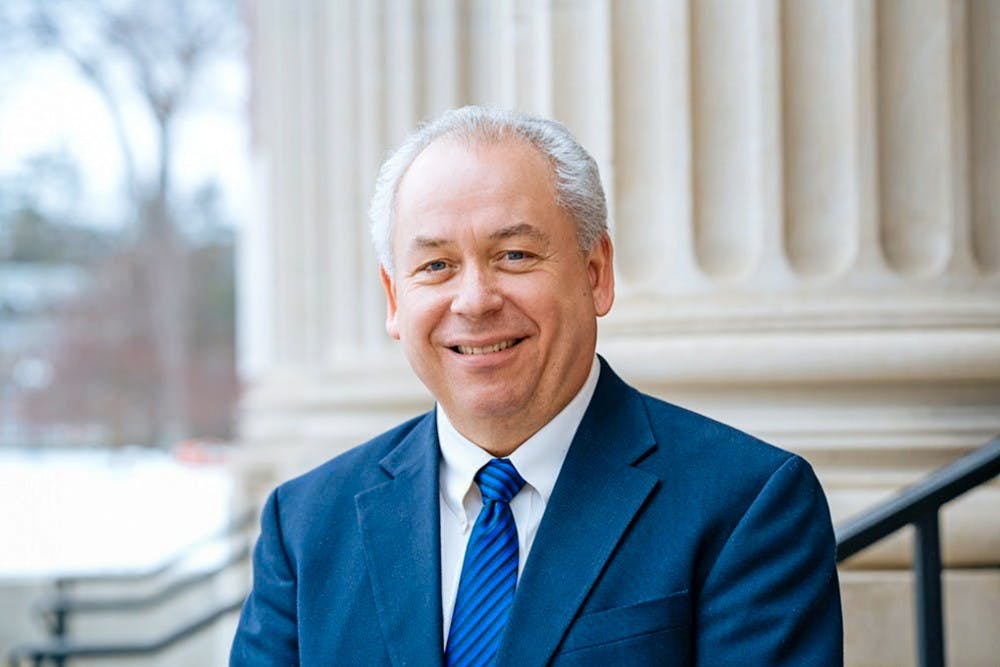
10-8-19-duthu-courtesy-eli-burakian
Duthu began his involvement in the project as a consultant.
Source: Eli Burakian/Courtesy of Dartmouth College
“Dawnland,” a documentary co-produced by Native American studies professor N. Bruce Duthu, recently won the News & Documentary Emmy Award for Outstanding Research.
“Dawnland” tells the story of indigenous child removal in the United States during the 20th century — when child welfare authorities forced Native American children to live in non-Native foster care, adoptive homes or boarding schools. The documentary follows the first so-called Truth and Reconciliation Commission in the United States for the contemporary Wabanaki community in Maine.
Duthu said that he believes “Dawnland” serves as a cautionary tale about “state power being misdirected against vulnerable populations.”

Currently leading a the Native American Studies Domestic Studies Program in Santa Fe, NM, Duthu said he regretted that he was not able to join his team at the awards ceremony in New York City, but he described the ceremony as “wonderful,” adding that he was later told that many Wabanaki people featured in the documentary were present at the ceremony.
 Duthu said that his involvement with the project began when he was brought on as a consultant to help the production team with legal and policy aspects of the federal Indian Child Welfare Act. Later on, as Duthu continued to help the team with research, fundraising and resource connections, he was invited to become a co-producer.
“Dawnland” co-director Adam Mazo said he was introduced to Duthu by Native American studies professor Colin Calloway and expressed his gratitude for having Duthu on the team.
“His way of distilling complex ideas into more easily digestible pieces is super helpful for us, as we are not academics,” Mazo said.
According to Duthu and Mazo, one of the most important accomplishments during the production of “Dawnland” was finding the footage of a U.S. Senate hearing on the Indian Child Welfare Act that occurred in the 1970s. At the hearing, Native American witnesses testified that children were abused and forced into foster homes.
Duthu said that when the team was reading through the transcript of the hearing, they noticed that a senator asked a witness if the light was too bright. That was when the team realized the hearing had actually been videotaped. Following an extensive effort from many members inside and outside of the film team, they finally were able to discover the footage at a local television station in Boston.
“This took a lot of patience from the team, and a lot of hard work,” Duthu said.
Mazo said he was inspired to direct “Dawnland” after he first heard about the Truth and Reconciliation Commission in 2013. He added that this commission was “historic,” as it was the first of its kind in the United States sanctioned by the state and tribal governments. He also noted that “Dawnland” was related to a 2010 documentary he directed, “Coexist,” about forced reconciliation after the 1994 Rwandan genocide.
“We also want to acknowledge genocide in this country’s history,” Mazo said. “We hope [‘Dawnland’] is going to put a greater spotlight on the story of the Wabanaki people and the reality of indigenous child removal that continues in this country today.”
“Dawnland” senior advisor and co-founder of the Akomawt Educational Initiative Chris Newell described “Dawnland” winning an Emmy as a “surreal experience.” A member of the Wabanaki tribe that “Dawnland” documents, Newell said that he believed it was his responsibility to help the story of his community “to be told correctly.”
Newell, who is now involved in multiple educational projects focusing on the education of Native American history, said he valued the opportunity that “Dawnland” provided to tell the story of the Wabanaki people to a larger audience.
“I was just part of a team that helps tell the story, but the story belongs to the people that told their truth and they are the ones that this recognition should really reflect,” Newell said.
Native Americans at Dartmouth co-president Elsa Armstrong ’20 said she watched some “Dawnland” clips in Duthu’s class NAS 30.3, “Native American Literature and Law” last winter. She said she appreciated that the clips were able to show history from an indigenous perspective.
Evan Barton ’20 described Duthu’s teaching as “phenomenal,” saying that Duthu was able to “challenge [students] appropriately” to “inspire creative processes.” Though he has not watched “Dawnland,” Barton said he was really eager to see the film to learn about the impact of child foster care on indigenous communities.
Although Duthu said that he was not a filmmaker and does not currently plan to pursue more filmmaking, he added that he was open to new opportunities.
“I never expected to be involved with something as significant as ‘Dawnland,’ so I am always open to opportunities where I might be able to be helpful,” Duthu said.
“Dawnland” was screened on the Dartmouth campus last October in Loew Auditorium.

Friday, October 4, 2019

Brackeen seek new court hearing

Families Seek A Fresh Court Hearing In A Case Related To The ICWA

US News: Brackeen v. Bernhardt

Families and states seeking to replace the 1978 ICWA (Indian Child Welfare Act) that favoured Native Americans in the foster care system and procedures in terms of an adoption involving native American children want a fresh court hearing. On October 1, the people seeking a fresh hearing, want their problem to be addressed in front of an entire panel of the appeals court judges. The challenge included non-Native American families in a lot of states who have legally adopted or want to adopt Native American Children.

The Choctaw girl case

In a case related to provisions set by the ICWA, the Supreme Court declined to mediate in settling a case on account of a Choctaw girl who had been sent to foster care with a non-Native American family in California after her biological parents were unable to provide for her.
The couple attempted to adopt the young child, infringing upon state laws and the ICWA, in spite of the fact that the state and courts had cautioned them that the Choctaw Nation of Oklahoma had jurisdictional authority and that the objective of family reunification was very important.


The couple was represented by a lawyer who has challenged the tribal jurisdiction in other ICWA cases. The couple declined to let go of the young girl in 2016, regardless of a court request. This resulted in the concerned court giving an order of forced separation of the girl from her foster family.

read 

The Court has asked the federal and tribal parties for response briefs, which are due October 23rd.

State and Individual Parties File for En Banc Review in Brackeen v. Bernhard [ICWA]

by ilpc

Goldwater is attempting dismantling ICWA and tribal sovereignty.

Sunday, September 29, 2019

Indigenous author shares painful memories of residential school

Guelph event organizer Dianne Dance said the turnout shows a sincere wish for reconciliation

Indigenous author shares painful memories of residential school

Guelph event organizer Dianne Dance said the turnout shows a sincere wish for reconciliation

“Dawnland” Wins Emmy Award for Outstanding Research


Published September 29, 2019

DAWNLAND will stream live globally in celebration of Indigenous Peoples’ Day on October 14

BOSTON — The Upstander Project film DAWNLAND won the Emmy® award for Outstanding Research at the 40th Annual News and Documentary Awards this week. DAWNLAND composer Jennifer Kreisberg was also nominated for Outstanding Music at the ceremony hosted by the National Academy of Television Arts and Sciences at Alice Tully Hall at Lincoln Center in New York City on Tuesday, September 24th . Accepting the Emmy® award, codirector and producer Adam Mazo said, “DAWNLAND is a story for the Wabanaki people – the people of the dawn land. Our film presents testimony from Wabanaki people who are being separated from their families, nations, tribes, and communities by Euro-American settlers like me. The greatest recognition belongs to the Wabanaki people who have lived that experience and showed immense courage in telling their stories or holding them in their hearts.”

In DAWNLAND (PBS Independent Lens 2018), viewers witness Wabanaki people revealing their stories to a historic truth commission. The commission’s headline finding is that cultural genocide persists in Maine because the child welfare system continues to remove Native children from their homes and tribes at an alarmingly high rate.

Maine-Wabanaki REACH created the truth commission, both they and the community are at the heart of DAWNLAND. Wabanaki film participants and leaders from REACH, Denise Altvater and Esther Anne, joined the filmmakers on stage in accepting the award. Maine-Wabanaki REACH board member Esther Anne (Passamaquoddy) said, “The recognition of Wabanaki people through DAWNLAND helps Maine-Wabanaki REACH in our work to engage Wabanaki and non-Native people in learning history, understanding intergenerational trauma, and creating paths to healing.”
DAWNLAND co-director Ben Pender-Cudlip said, “The award truly honors everybody who shared their stories with the truth and reconciliation commission. We want to uplift Maine-Wabanaki REACH, who carry the responsibility of seeing through the TRC recommendations, and working toward restoration to Wabanaki and non-Native communities.” Pender-Cudlip, Mazo, Upstander Project learning director Dr. Mishy Lesser, and editor Kristen Salerno share the Emmy® award for Outstanding Research. Lesser said, “This award applauds researchers everywhere, those who scour ignored documents and transcripts for clues that tell a fuller story. We kept digging until we found archival images and hidden information, and appreciate the Academy’s recognition of our effort.”

“In this moment where the notion of fake news seems to dominate it is especially heartening to be honored for the years of journalistic research and fact-checking that our team put into DAWNLAND. We are proud to be part of growing and strengthening field of independent filmmakers who are telling vital underreported stories through ethical cocreation and collaborative practices for and with the communities being documented,” impact producer Tracy Rector (Choctaw/Seminole) added.

A special free global livestream of DAWNLAND will celebrate Indigenous Peoples’ Day on Monday October 14th at 3pm EDT. The filmmakers will be present for a Q & A.
RSVP here
Details for all upcoming screenings here: https://dawnland.org/screenings DAWNLAND can be purchased here:

“Dawnland” Wins Emmy Award for Outstanding Research


Published September 29, 2019

DAWNLAND will stream live globally in celebration of Indigenous Peoples’ Day on October 14

BOSTON — The Upstander Project film DAWNLAND won the Emmy® award for Outstanding Research at the 40th Annual News and Documentary Awards this week. DAWNLAND composer Jennifer Kreisberg was also nominated for Outstanding Music at the ceremony hosted by the National Academy of Television Arts and Sciences at Alice Tully Hall at Lincoln Center in New York City on Tuesday, September 24th . Accepting the Emmy® award, codirector and producer Adam Mazo said, “DAWNLAND is a story for the Wabanaki people – the people of the dawn land. Our film presents testimony from Wabanaki people who are being separated from their families, nations, tribes, and communities by Euro-American settlers like me. The greatest recognition belongs to the Wabanaki people who have lived that experience and showed immense courage in telling their stories or holding them in their hearts.”

In DAWNLAND (PBS Independent Lens 2018), viewers witness Wabanaki people revealing their stories to a historic truth commission. The commission’s headline finding is that cultural genocide persists in Maine because the child welfare system continues to remove Native children from their homes and tribes at an alarmingly high rate.

Maine-Wabanaki REACH created the truth commission, both they and the community are at the heart of DAWNLAND. Wabanaki film participants and leaders from REACH, Denise Altvater and Esther Anne, joined the filmmakers on stage in accepting the award. Maine-Wabanaki REACH board member Esther Anne (Passamaquoddy) said, “The recognition of Wabanaki people through DAWNLAND helps Maine-Wabanaki REACH in our work to engage Wabanaki and non-Native people in learning history, understanding intergenerational trauma, and creating paths to healing.”
DAWNLAND co-director Ben Pender-Cudlip said, “The award truly honors everybody who shared their stories with the truth and reconciliation commission. We want to uplift Maine-Wabanaki REACH, who carry the responsibility of seeing through the TRC recommendations, and working toward restoration to Wabanaki and non-Native communities.” Pender-Cudlip, Mazo, Upstander Project learning director Dr. Mishy Lesser, and editor Kristen Salerno share the Emmy® award for Outstanding Research. Lesser said, “This award applauds researchers everywhere, those who scour ignored documents and transcripts for clues that tell a fuller story. We kept digging until we found archival images and hidden information, and appreciate the Academy’s recognition of our effort.”

“In this moment where the notion of fake news seems to dominate it is especially heartening to be honored for the years of journalistic research and fact-checking that our team put into DAWNLAND. We are proud to be part of growing and strengthening field of independent filmmakers who are telling vital underreported stories through ethical cocreation and collaborative practices for and with the communities being documented,” impact producer Tracy Rector (Choctaw/Seminole) added.

A special free global livestream of DAWNLAND will celebrate Indigenous Peoples’ Day on Monday October 14th at 3pm EDT. The filmmakers will be present for a Q & A.
RSVP here
Details for all upcoming screenings here: https://dawnland.org/screenings DAWNLAND can be purchased here:

Saturday, September 21, 2019

How Do We Mend The Hoop?

REBLOG FROM 2018

By Trace Hentz (Winyan Ohmanisa Waste La Ke)

This is an essay I wrote in the anthology The Lost Daughters: Writing Adoption From a Place of Empowerment and Peace was edited by Amanda H.L. Transue-Woolston, Julie Stromberg, Karen Pickell, and Jennifer Anastasi. (published in 2011)

Years ago I was embarrassed to say I was adopted. I did not feel lucky. I did not have a clue that my adoption hurt me so badly, its tentacles reached into every aspect of my life, even as an adult. My hoop, my connection to my ancestors, was broken by my adoption.
I ached to know my own mother, the woman who created me.
One expert wrote, “Loss of the most sacred bond in life, that of a mother and child, is one of the most severe traumas and this loss will require long-term, if not lifelong, therapy.” (now called toxic stress)
Really?  No one helped me with this. I had therapy twice. The counselling I received in my 20s or 30s concerned my dysfunctional childhood and yet all my issues stemmed from my adoption wound and loss. They missed it or didn't inquire or connect the dots. Why is that?
For close to 20 years, on my own I searched and simply wanted to find answers and the truth. I made calls before I showed up anywhere; I did not disrupt anyone’s life.  If I was invited to meet relatives, I went. In 2011 alone, two cousins have filled giant gaps in my ancestry. Prayers are answered, even the unspoken ones.
I can see how adoption loss can last a lifetime. For some friends, they're stalled with sealed adoption records, not knowing which tribe, and suffer greatly with grief and depression.
For them, I wrote my book as a journalist and adoptee and now I write a blog for other American Indian adoptees, raised by non-Indians.
For those who attempt to open their own adoption, or simply want to understand, I explain many stages, steps I had taken: some good, some hard. 
Sharing stories is how we heal, how we mend the hoop.
Even now there is persistent rampant poverty in Indian Country. Even now it isn’t easy being Indian, on and off the reserves. But it is definitely better to know who you are, which tribe, and not live in a mystery. 
Someone needs to build a bridge for these adoptees. 
Open adoption records will accomplish this.
It's hard to admit but adoptees with Indian blood find out soon enough their reservations are closed to strangers. Without proof, without documents, you’re suspect.
We don’t always get our proof since state laws prevent it.  Just one Minnesota tribe, White Earth, decided to call out to its lost children/adoptees; this made news in 2007.  Just a few adoptees showed up. Why? Adoption records are still sealed in Minnesota.
America’s Indian Adoption Project was not publicized or well known, just like a few more secrets I found out. Congress heard Indian leaders complain in 1974, “In Minnesota, 90 percent of the adopted Indian children are placed in non-Indian homes.”
I was born in Minnesota.
For any adoptee going back to their tribe, this requires a special kind of courage. Adoptees know this. Rhonda, a Bay Mills Tribal member, an adoptee friend of mine, was told early on – be happy, be white.  Ask yourself, how would you react?
When did Indian Country become such a bad place to be from? When did this happen? How did this happen?

My mission is to find these answers and build new bridges... it is time to mend the hoop for all adoptees.

The Hoop symbolizes the never ending circle of life which starts with birth, then goes to maturity, then to old age and death with the completion of the hoop in rebirth here or in the spiritual world. The individual who has his life in order stands in the center of the hoop to see, to understand, and to be guided by the various paths of life around him. The best compliment one can pay an individual is to say that he stands in the center of the hoop of life or that he lives on the correct path of life. http://www.grandfathersspirit.com/Hoop-of-Life-Buffalo-Skull.html

A MUST READ BLOG POST:

#Adoption911 • decolonizing adoption

by Daniel Drennan ElAwar


The experiments aren't the earliest record of abuse; as far back as 1928, Indian schools in Canada were forcibly sterilizing First Nations girls. And as a 2007 Amnesty International report lays out, severe abuse was widespread at Indian schools in both Canada and the U.S., where children were forbidden to speak their language (to "civilize" them) and used in "experiments" that were sometimes fatal: there is ample evidence and testimony, as Amnesty says, of "beating, poisoning, electric shock, starvation, prolonged exposure to sub-zero cold while naked, and medical experimentation, including the removal of organs and radiation exposure."
Source: Canadian Scientists Did Psychic Experiments on First Nations Kids 


MORE:
Fighting toxic stress in children is tough but possible | MIT ...

MDHHS - Trauma & Toxic Stress

Trauma and Its Impact on Children and Their Families . Information about trauma/toxic stress and their impact; the ACEs study & building resilience

European colonizers killed so many Native Americans that it changed the global climate

European settlers killed 56 million indigenous people over about 100 years in South, Central and North America, causing large swaths of farmland to be abandoned and reforested, researchers at University College London, or UCL, estimate. The increase in trees and vegetation across an area the size of France resulted in a massive decrease in carbon dioxide (CO2) in the atmosphere, according to the study. 
University College London researchers estimate that settlers killed 56 million indigenous people, causing farmland to be reforested. That increase in vegetation resulted in a massive decrease in carbon dioxide in the atmosphere.

READ: European slaughter of Native Americans changed the climate, study says - CNN

Thursday, September 19, 2019

How differently the Canadian government engages with Tribal Nations

Somehow the final passage ("royal assent") of this bill in Canada slipped our attention back in June. Initially, we saw it referred to as a "Canadian ICWA", but it seems fair to say that it doesn't quite achieve that level of protection for Native children and families. If nothing else, it illustrates just how differently the Canadian government engages with the tribal nations within its borders compared to the U.S.. We want to add a large caveat, which is that none of us are experts on Canadian law or child welfare.
However, those that are put together a really helpful publication which is available here, and is well worth your read (it made us think about if ICWA would get passing grades):
From the Jurisdiction section of the report:
Why We Give the Bill a ‘D’ on this:
IN A HISTORIC FIRST FOR CANADA, the Bill purports to recognize Indigenous peoples’ inherent jurisdiction. For example, section 8(a) of the Bill affirms “the rights and jurisdiction of Indigenous peoples in relation to child and family services”. This positively worded language is also noted in the Bill’s introduction and summary. Similarly, section 18(1) states that the “inherent right of self-government recognized and affirmed by section 35 of the Constitution Act, 1982 includes jurisdiction in relation to child and family services, including legislative authority in relation to those services and authority to administer and enforce laws made under that legislative authority.” Section 18(2) affirms that this right includes the right to “provide for dispute resolution mechanisms.”
As there are no section 35 cases that recognize an inherent right of self-government for Indigenous Peoples or that have recognized an Aboriginal or Treaty right over child and family services law-making, this is a significant step forward.
This is not, however, a recognition of jurisdiction that removes all federal or provincial oversight, power or intervention. By recognizing jurisdiction over child and family services as a section 35 right, the federal government immediately re-asserts its power to unilaterally infringe or limit that right, a power upheld by court cases such as Sparrow. The legislation sets legal limits in terms of Indigenous laws being subject to Charter and Canadian Human Rights Act and the BIOC. It also sets practical limits in terms of the virtual necessity of negotiating coordination agreements with the federal and provincial governments, and in the glaring absence of any provisions for funding. At best, this could be interpreted as an acknowledgment of concurrent (or shared) jurisdiction, a matter on which Bill C-92 should be more clear.
***
Further, section 23 states Indigenous laws only authoritative if they can be applied in a way that “is not contrary to the best interests of the child.” As previously stated, Indigenous laws have upheld the best interests of Indigenous children for thousands of years. The concern about this limit is how the BIOC doctrine has been interpreted and applied by courts, non-Indigenous governments and decisions makers to apprehend Indigenous children and separate them from their families, communities and territories for the past 50 plus years.

Bill C-92, An Act Respecting First Nations, Inuit and Métis Children, Youth and Families

by Kate Fort

Wednesday, September 11, 2019

The New Normal: DNA & Adoptee Search

I feel like I'm a victim of a witness protection program called closed adoption , though I didn't ask to be... Trace
Reblog from 2014


By Trace L Hentz, Blog Editor

Whenever I have a birthday I think of all the years I searched for my parents. It's true that laws prevented me from ever finding them. Laws didn't stop me. I met my dad in 1995. We did a DNA test to prove paternity. It was 99.9% that Earl was my dad.


(2014) Patricia and I are still finishing up the new anthology CALLED HOME, very important history as a collection of adoptee narratives and the historical truths about adoption in Indian Country.  These voices of adoptees are at the heart of what I do. They are the reason there is a blog AMERICAN INDIAN ADOPTEES.

Right now Karen Vigneault and I are working with about 20 adoptees who are trying to find their families. Because of the adoption laws in the USA, we are seeing the “New Normal” for adoptees is having a DNA test.  They have no choice with the laws not allowing adoptees to have access to our own names, our parent’s names and our tribal nations, and we are still denied our basic rights as human beings and citizens of sovereign nations.

Our adoptive parents who raised us may or may not realize that we NEED information and our ancestry and medical background.  (An adoptee can love more than one set of parents and there is no need to panic!) Adoptees tell me they are afraid to search because of their adoptive parents! That fear has to stop because if you wait, you may never get to meet your mother or father!

One of the adoptees in the new anthology talks about finding new cousins who are trying to figure out who her mother is.

This is the new normal. This is not right but because of the adoption industry and their billion dollar earnings, we adoptees are still at the bottom of the totem pole as far as our rights.

I don’t know how many times I have said to an adoptee do not delay your search. If you do get a name or phone number, make the call. Have a friend with you to keep you calm. Write a set of questions. Just make contact then offer to send a letter explaining what you know about your first family. Send them your phone number so they can call you back.

Give people time to adjust to the truth that you are definitely one of their family members.

If you get your DNA results,  which is the new normal, make contact with cousins who share your DNA! Give them your birth date and let them help you try and figure out how you are all related.

The new normal isn’t fair but we’ll use this until the laws change.

Update: One of the adoptees in the book Stolen Generations is moving to Michigan to start a new life with his parents. He found them using a DNA test. Both his parents were looking for him but didn't know how. Drew found them. He's finally in reunion after 40+ years.

The 2nd Edition of Called Home: The Roadmap has a chapter about using your DNA results to do a court order to open your records.  ICWA has a provision for this. Please read this book.

Ottawa ordered to compensate First Nations children impacted by on-reserve child welfare system


Assembly of First Nations National Chief Perry Bellegarde,
left, and Cindy Blackstock, head of the First Nation Child and Family
Caring Society. The groups filed the original human rights complaint
that led to Friday's ruling. (Canadian Press)


Ottawa must pay potentially billions of dollars in compensation
to First Nations children harmed by the on-reserve child welfare
system, following a ruling Friday by the Canadian Human Rights Tribunal
that also called for payments to some of their parents and
grandparents.

The tribunal ordered the federal government to
pay $40,000 to each child — the maximum allowed under the Canadian Human
Rights Act —  who was apprehended or taken from their homes on reserve,
no matter what the reason.


The
ruling covers all children in the care of the on-reserve child welfare
system at any point from Jan.1, 2006, to a date to be determined by the
tribunal.


'Racism, colonial practices and discrimination'


Cindy
Blackstock, who heads the First Nations Child and Family Caring
Society, said this latest ruling shows Ottawa learned little from what
happened in residential schools and during the Sixties Scoop era.


"They
knew better and did not do better resulting in tragedy for First
Nations children, families and [First] Nations," said Blackstock in a
statement.


"We must demand Canada stop its piecemeal approach to
remedying cross cutting inequalities in First Nations public
services by fully implementing the Spirit Bear plan to end all of the
inequalities once and for all."


READ


++

National Native News Listen

Ottawa ordered to compensate First Nations children impacted by on-reserve child welfare system

Assembly of First Nations National Chief Perry Bellegarde, left, and Cindy Blackstock, head of the First Nation Child and Family Caring Society. The groups filed the original human rights complaint that led to Friday's ruling. (Canadian Press)

Ottawa must pay potentially billions of dollars in compensation to First Nations children harmed by the on-reserve child welfare system, following a ruling Friday by the Canadian Human Rights Tribunal that also called for payments to some of their parents and grandparents.
The tribunal ordered the federal government to pay $40,000 to each child — the maximum allowed under the Canadian Human Rights Act —  who was apprehended or taken from their homes on reserve, no matter what the reason.

The ruling covers all children in the care of the on-reserve child welfare system at any point from Jan.1, 2006, to a date to be determined by the tribunal.

'Racism, colonial practices and discrimination'

Cindy Blackstock, who heads the First Nations Child and Family Caring Society, said this latest ruling shows Ottawa learned little from what happened in residential schools and during the Sixties Scoop era.


"They knew better and did not do better resulting in tragedy for First Nations children, families and [First] Nations," said Blackstock in a statement.


"We must demand Canada stop its piecemeal approach to remedying cross cutting inequalities in First Nations public services by fully implementing the Spirit Bear plan to end all of the inequalities once and for all."

READ

++
National Native News Listen

CLICK OLDER POSTS (above) to see more news

CLICK OLDER POSTS  (above) to see more news

MEGWETCH THANK YOU

HUGE Thank you for visiting this blog and sharing this with your kin. It's appreciated. Contact Trace anytime! Use the form below.

BOOKSHOP

Please use BOOKSHOP to buy our titles. We will not be posting links to Amazon.

Popular Posts

To Veronica Brown

Veronica, we adult adoptees are thinking of you today and every day. We will be here when you need us. Your journey in the adopted life has begun, nothing can revoke that now, the damage cannot be undone. Be courageous, you have what no adoptee before you has had; a strong group of adult adoptees who know your story, who are behind you and will always be so.

OUR HISTORY

OUR HISTORY
BOOK 5: Lost Children of the Indian Adoption Projects