BACK UP BLOG (no longer updating)

This blog was a backup for American Indian Adoptees blog
USE THE SEARCH BAR or SEARCH TOPICS at bottom of this blog

If you need support

Support Info: If you are a Survivor and need emotional support, a national crisis line is available 24 hours a day, seven days a week: Residential School Survivor Support Line: 1-866-925-4419. Additional Health Support Information: Emotional, cultural, and professional support services are also available to Survivors and their families through the Indian Residential Schools Resolution Health Support Program. Services can be accessed on an individual, family, or group basis.” These & regional support phone numbers are found at https://nctr.ca/contact/survivors/ . MY EMAIL: tracelara@pm.me

Search This Blog

Thursday, October 20, 2016

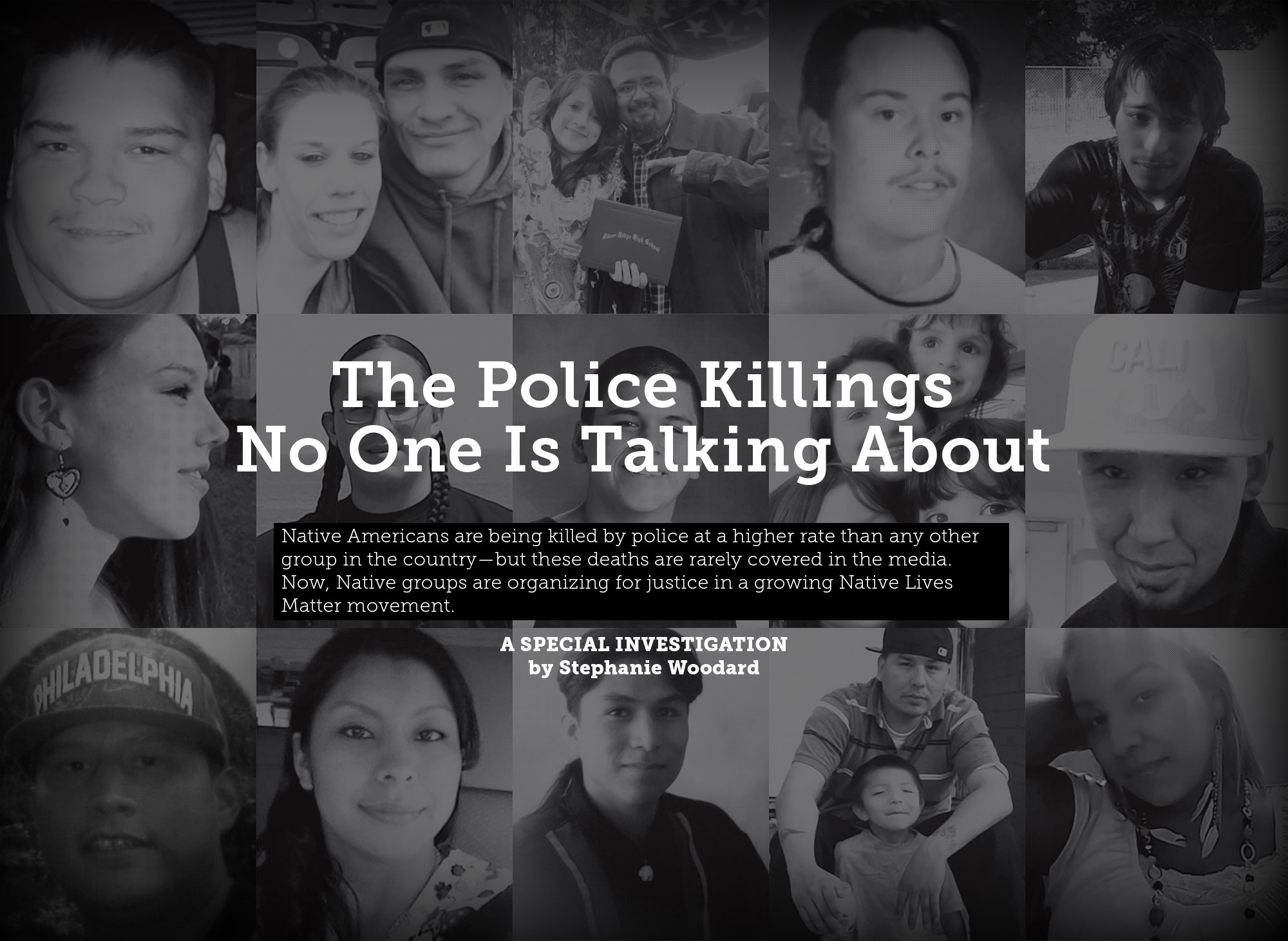
Stephanie Woodard: The Police Killings Noone is Talking About


Native Americans killed by police (L to R) from top: Marcus Lee, Lance McIntire, Daniel Covarrubias, Raymond Eacret, Jessie Lee Rose, Jacqueline Salyers, Mah-hi-vist Goodblanket, Richard Estrada, Jeanetta Riley, Larry Kobuk, Jamie Lee Brave Heart, Loreal Tsingine, Corey Kanosh, Allen Locke, Sarah Lee Circle Bear
Hi Readers,
You may recall Stephanie Woodard for her excellent writing in the anthology TWO WORLDS.
She has reported on adoptees many times.

This new report is just as disturbing. Please read. 

"The Police Killings No One Is Talking About": Native Americans Most Likely to be Killed by Cops

A new investigation by In These Times explodes myths about who is most likely to die at the hands of police by revealing that, compared to their percentage of the U.S. ... Read More →


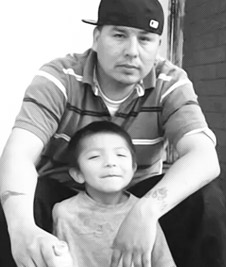
You may recall I wrote about Alan Locke (above), who is a relative in my Lakota Tiyóspaye. Read about him and The Phone Call here.

Tuesday, October 18, 2016

Called Home: The RoadMap

[2nd Ed.] An important contribution to American Indian history told by its own lost children/adult survivors, American Indian and First Nations adoptees and family... Editors Patricia Busbee and Trace L. Hentz are writers and adoptees who reunited with their own lost relatives. From recent news about Baby Veronica, Canada’s 60s Scoop, and history such as Operation Papoose, this book examines how Native American adoptees and their families experienced adoption and were exposed to the genocidal policies of governments who created Indian adoption projects. "Adoptees do need a road map and that is what other adoptees have created," Hentz said about this anthology and book series.

CALLED HOME offers even more revelations of this hidden history of Indian child removals in North America, their impact on Indian Country and how it impacts the adoptee and their entire family. “We have created a body of work, a roadmap for adoptees coming after us. Governments stole the land and stole children. It’s time the world know,” Hentz said.

paperback

The second anthology in the Lost Children of the Indian Adoption Projects Book Series is published by Blue Hand Books in Massachusetts. 

Sunday, October 16, 2016

President Obama Signs Bill For Native Children Commission

President Obama with Native Youth at Standing Rock - AP Photo/Manuel Balce Ceneta
AP Photo/Manuel Balce Ceneta, President Barack Obama held a Native baby during his visit to the Standing Rock Sioux Tribal Nation, in Cannon Ball, N.D., Friday, June 13, 2014. It was his first trip to Indian Country as president and only the third such visit by a sitting president in almost 80 years.

Vincent Schilling |10/14/16 | ICT

U.S. Senators Heidi Heitkamp (D-ND) and Lisa Murkowski (R-AK) are celebrating a long-fought victory after President Barack Obama signed their bill to improve the lives of Native youth by creating a commission on Native Children.

The commission will be called The Alyce Spotted Bear and Walter Soboleff Commission on Native Children, named for the former Chairwoman of Mandan, Hidatsa & Arikara Nation in North Dakota, and for the Alaska Native elder and statesman.

The bill was unanimously passed in the U.S. House of Representatives, after being approved by the Senate last year.


As ICTMN reported, the bill will create a commission to identify the complex challenges facing Native children in North Dakota, Alaska and across the United States by conducting an intensive study.

In a statement from the White House, President Obama said, "Today I am pleased to sign into law S. 246, the "Alyce Spotted Bear and Walter Soboleff Commission on Native Children Act," which will create the Alyce Spotted Bear and Walter Soboleff Commission on Native Children. The Commission is tasked with the important work of undertaking a comprehensive study of Federal, State, local, and tribal programs that serve Native children, and making recommendations on how those programs could be improved. Over the past 8 years, my Administration has been committed to working closely with tribes to strengthen our nation-to-nation relationships and to forge a brighter future for all our children. During my own visits to Indian Country, I have been inspired by the talent and enthusiasm of young people who want nothing more than to make a positive difference in their communities. From the Indian Child Welfare Act to working to return control of Indian education to tribal nations, I am proud of the progress we have made over the past 8 years. I applaud the Congress, and in particular, Senator Heitkamp, for the efforts that made this new law possible."

Heitkamp is thrilled that the President has signed but said now is the time to roll up sleeves and get to work.

“This is just the beginning stages, with a commission is now established we need to make sure this commission is held in a way that achieves results and we measure the success based on outcomes.”
Heitkamp and Murkowski’s efforts and a formal commission will address the overwhelming obstacles Native children face – including levels of post-traumatic stress similar to newly returning veterans from Iraq and Afghanistan dramatically increased risks of suicide, and lower high school graduation rates than any racial or ethnic demographic in the country.

“I am so pleased to see this piece of legislation cross the finish line, creating a commission established in memory of the late Dr. Walter Soboleff, a treasured Alaska Native elder and a champion for Native youth. I can cite many examples of young Native people who are living healthy lives and doing great things for their people. Yet far too many have found themselves in a world of despair,” said Murkowski.

“There is an urgent need for a broad range of stakeholders to come to the table and formulate plans to give every young Native person a fighting chance at a productive life,” she said.

Heitkamp also said Native children were of great concern to both Barack and Michelle Obama.

“I am so gratified that we were able to do this so that this President was able to sign this bill,” said Heitkamp.
Senator Heidi Heitkamp at the Fort Yates Pow Wow.  File Image.
Senator Heidi Heitkamp at the Fort Yates Pow Wow. File Image.

“We have always lived by Sitting Bull's words, ‘Now let's put our heads together and figure out what we're going to do for our children,’” said Heitkamp.
The Commission on Native Children will conduct a comprehensive study of the programs, grants, and resources available for Native children, both at government agencies and on the ground in Native communities, with the goal of developing a sustainable system that delivers wrap-around services to Native children.
For a summary of the bill, click here.
See Related: Bill to Help Native Children Passes Unanimously in House

Read more at http://indiancountrytodaymedianetwork.com/2016/10/14/president-obama-signs-bill-native-children-commission-166108

Saturday, October 8, 2016

Traditional Knowledge


SOURCE: MFNERC’s blog

I first heard the term Traditional Knowledge when I lived up in the Northwest Territories. I lived in a small community of about 500 people called Fort Good Hope. The majority of people are Dene, and probably about a third of them speak their traditional language, Slavey.


A friend of mine, who worked for a land use planning board, told me about Traditional Knowledge and gave me some literature to read when I asked her for more information. While I was reading I became frustrated because I still couldn’t really figure out what it was. This is mostly because, as I came to learn, it is not something that is easy to specify or categorize. Yet, in today’s world most people like things to be definable. Modern influences compel us to put labels on everything.


But reading about Traditional Knowledge, this wasn’t the case and I ended up with many more questions.

I was very lucky to be actually living in a place where I could ask people about Traditional Knowledge, people who lived it in their day-to-day lives. So I didn’t really need a dictionary definition to further understand it, I could just walk down the road. I visited with community members who were living off the land. 

One Elder took me on many boat rides down the Mackenzie River and hikes in the nearby rocks to teach and tell me stories about the history and geography of the area.  Another friend, the Chief of Fort Good Hope at the time, was a very gracious man who was so willing to share much information with me – particularly regarding the seasons of the river, and the importance of the drum.  He was also a residential school survivor who practiced compassion and took part in ceremonies in order to heal, and was not afraid to speak about it to those who were eager to listen.  Through these different experiences and interactions I came to learn that Traditional Knowledge is something one does, rather than simply something one knows. It is a process, and a way of living that is deeply connected with the land. It is a personal relationship with Creation and the natural world. It isn’t linear, but should be viewed as a circle.

As Deborah McGregor says in her 2015 article from American Indian Quarterly entitled “Coming Full Circle”:


Building on prior learning and traditions is never a direct or linear path. Instead, Indigenous science pursues a rather meandering path around things and over obstacles, a roundabout way. In the Western mindset, getting from point A to B is a linear process, and in the Indigenous mindset, arrival at B occurs through fields of relationships and establishment of meaning, a sense of territory, a sense of breadth of the context.

Relationships are key when it comes to Traditional Knowledge, relationships with the Creator, the land, and other people. For those who are interested in learning more about it, the question should not be, What is Traditional Knowledge? It should be, Am I ready to receive Traditional Knowledge?

[please visit their blog for more, including books on this topic]

**

Coming to Manitoba

(Courtesy of bandwidth digital releasing ltd.) Movies! Movies! Movies! Created by Hollywood actor Adam Beach, bandwidth is a mobile movie house releasing Aboriginal and mainstream ‘first-run’ Hollywood feature films in Canada and the United States. And three communities in Manitoba will soon be experiencing bandwidth first hand: Norway House, Brokenhead and Sandy Bay First Nations.

Thursday, October 6, 2016

Cree Nation Welcomes Bill on Customary Adoption


NEMASKA, QC, Oct. 6, 2016 /CNW

The Grand Council of the Crees (Eeyou Istchee) and the Cree Nation Government (GCC(EI)/CNG) are pleased with the initiative of the Québec government, and particularly the Minister of Justice, to have legal effects of customary adoptions clearly reflected in the Civil Code of Quebec through Bill 113 ("An Act to amend the Civil Code and other legislative provisions as regards adoption and the disclosure of information") (Bill 113), tabled in the National Assembly on October 6, 2016.

The Cree Nation welcomes the presentation of this legislation in the National Assembly.  This Bill follows the tabling of similar legislation in 2012 and in 2013, both of which "died on the order paper" with the calling of the provincial elections.

For the Cree of Eeyou Istchee, customary adoption has been practiced for generations and continues to be practiced today. It remains an integral part of Cree culture and identity.

As stated by Dr. Matthew Coon Come, Grand Chief of the GCC(EI) and Chairman of the CNG, the Cree have sought changes to provincial legislation regarding customary adoption since the early 1980s and for almost as long, Québec has committed to doing so in the Civil Code of Québec.

"Now, with this Bill, the Québec government is taking an important step to fulfill that commitment," said Dr. Coon Come.

"The creation of the Working Group on Customary Adoption in Aboriginal communities (Working Group), made up of representatives from Québec, the Inuit and First Nations organizations, including those of the Cree Nation, helped to facilitate important discussions regarding customary adoption.  It was also an opportunity to collaboratively consider how its effects could be reflected in the Civil Code of Québec," he said.

The Cree Nation wishes to underline its support for the collaborative approach among the Indigenous stakeholders, the Québec Ministry of Justice and the Ministry of Health and Social Services in the development of Bill 113. 

"We see Bill 113 as a positive first step in creating a bridge between Indigenous customary adoptions and the provincial adoption regime in order to clarify the legal effects of these adoptions, which have always been recognized in our communities and by our community members," stated the Grand Chief.

"Bill 113 begins to harmonize provincial adoption legislation with Cree Aboriginal and treaty rights in relation to adoption matters and reflects the right of Indigenous Nations and communities to govern affairs regarding their children", continued the Grand Chief.

Ultimately, this legislation will benefit the children and families involved in customary adoptions by helping to facilitate the exercise of parental authorities and responsibilities.

In the words of the Grand Chief, "it is a continuation of the on-going development of the Nation-to-Nation relationship between the Cree Nation of Eeyou Istchee and Québec. This Bill represents another positive and important step forward in the relationship between Quebec and Indigenous peoples, including the Cree Nation."

About the Grand Council of the Crees (Eeyou Istchee):The Grand Council of the Crees (Eeyou Istchee) is the political body that represents the approximately 18,000 Crees of Quebec or "Eeyouch" ("Eenouch" – inland dialect). The Council is constituted of twenty (20) members including: a Grand Chief and Deputy-Grand Chief elected at large by the Eeyouch, the chiefs elected by each of the nine (9) recognized Cree communities, and one (1) other representative elected by each community.

About the Cree Nation Government:The Cree Nation Government (CNG), previously the Cree Regional Authority, was set up by virtue of the signing of the James Bay and Northern Quebec Agreement as the administrative arm of the Cree Nation. It has responsibilities in respect to environmental protection, the hunting, fishing and trapping regime, economic and community development, Cree governance and other matters as decided by the Board of Directors. The Board of Directors of the CNG is the same joint governing body that manages the GCC(EI) and is referred to as "Council/Board".

SOURCE Grand Council of the Crees (Eeyou Istchee)

For further information: Ms. Melissa Saganash, Director of Quebec Relations, Tel.: (418) 691-1111
RELATED LINKS
www.gcc.ca

Wahkohtowin: Cree Natural Law

Monday, October 3, 2016

#60sScoop survivors say birth records 'mysteriously' lost or destroyed

This is amazing series of stories! Stay tuned!

'I was told I don't exist,': survivors search for paper trail to their past

Lori Ann O'Cheek
Sixties scoop survivor Lori O'Cheek was told her adoption records were destroyed in a fire. (Donna Carreiro (CBC))


When Lori Ann O'Cheek went to search for her birth records, she was told her files burned in a fire. When Carla Williams asked a different agency for her birth records, she too was told they burned in a fire. Likewise Trevor Bass. Likewise Jessica Sear.

Wayne Snellgrove, on the other hand, was not told his birth records were destroyed. He was told there were none to begin with.

"I got a very nice letter from Vital Statistics telling me I don't exist," Snellgrove said. "I am nowhere to be found."

Different survivors dealing with different agencies from across Canada facing similar barriers to access their past.

Carla Williams (left) and daughter
Carla Williams (left) leans on her daughter for support as she recalls the abuse in her adoptive home. (Donna Carreiro (CBC))

It is a yet another twist in the evolving legacy of the Sixties Scoop. Survivors, pulled from their Indigenous homes and adopted by white families around the world, now search for their birth and treaty records only to be told they cannot be found.

"There was no record of my adoption, no record of the adoption agency," Lori Ann O'Cheek said. "I just kept getting answers that the agency burned down and that's it."

Carla Williams was told the same thing. She didn't believe it.

"A fire that I don't believe ever happened, that [the child welfare agency] couldn't confirm at all," she said.

Survivors and critics say it is another example of forced assimilation and the federal government's effort to erase their Indigenous identities.

"If we grow up not knowing we're Indigenous and we're entitled to the land and treaties and status, then they don't have to honour those treaties," said Colleen Cardinal, a Sixties Scoop survivor, author and advocate. "They don't have to resource or revenue share."

That's why so many survivors can't find their way home, she said.

"There are so many Indigenous adoptees out there that have no idea what their rights are," Cardinal said. "That they are connected to the land and to status and to treaties."

Lori Ann O'Cheek was a toddler in Camperville, Man, when her mother began to warn her about strangers in the town.
Media placeholder

"She used to warn us if a strange car came onto the reserve, to run as fast as we could," O'Cheek said. "Because kids went missing all the time."

Sure enough, child welfare officials drove up and knocked on their door. Some of her siblings escaped. She did not.

"I tried to run away but I was too young to flee," she said.

She was adopted to a family who moved to Vermont, and she spent the next several years trying to come home.

"I was always running away, just to find somebody I belonged to," she said, adding she was eventually placed in foster care.

Once she found her birth family, she returned to Canada.

To this day, her birth certificate lists her adoptive parents as her parents. Her original birth certificate remains "mysteriously" non-existent.


Former MLA calls for national inquiry

Eric Robinson is a former NDP MLA and was Manitoba's former Aboriginal and northern affairs minister. He said he's "disappointed but not surprised" to hear some survivors can't access their birth records.
"I've heard stories like this for years," he told the CBC. "It's a further violation of these people."
Robinson noted that in 2014, the province attempted to improve access to archived adoption records from before 1999.
But that doesn't help survivors born in other provinces.
"That's why I have long been calling for a national inquiry into the Sixties Scoop," he said. "We need a proper investigation and we need answers."

What needs to be happening?

Residential school cemetery gets heritage status

Janine Windolph, president of the Regina Indian Industrial School commemorative association, at a fence that marks the RIIS cemetery in Regina. Michael Bell / THE CANADIAN PRESS

Along a dusty gravel road on the edge of Regina is a small plot of land surrounded by a rail fence with peeling white paint, weathered teddy bears, flowers and a couple of dream catchers.
There’s just one headstone in the 680-square-metre cemetery for the two children of Rev. A.J. McLeod, the first principal of the Regina Indian Industrial School, belying that dozens of indigenous children from the school are buried there too.
“It’s easy to overlook the cemetery itself. Even when I first came out here, we drove right by,” said Janine Windolph, president of the Regina Indian Industrial School Commemorative Association.
“The site needs to take another step further in basically acknowledging the students that are here and how we can start making it more apparent that this is a scared site for gathering. That’ll all come in time.”
A big step came Sept. 26, when Regina city council voted unanimously to grant the site municipal heritage status. Civic administrators suggested the move after a 2014 land survey found there were potentially 22 to 40 unmarked graves of children in the cemetery.
Windolph said an archeologist for the association identified 36 anomalies, but she said there could be many more children because it was practice at the time to bury several together.
Sakimay First Nations Chief Lynn Acoose, whose grandmother attended the Regina Indian Industrial School, said the heritage designation process has been emotional.

“It’s not only about preserving the memory. It’s not only about preserving the site and the graves. We need to also, from this tragedy, create something powerful and good out of the loss of these children,” said Acoose.
The Regina Indian Industrial School operated between 1891 and 1910. An unknown number of students died there.

Justice Murray Sinclair, who led the Truth and Reconciliation Commission, has estimated at least 6,000 children died at residential schools but it’s impossible to say with certainty.
The federal government stopped recording the deaths around 1920 after the chief medical officer at Indian Affairs suggested children were dying at an alarming rate.
Residential schools were often crowded, poorly ventilated and unsanitary. Children died from smallpox, measles, influenza and tuberculosis. Some were buried in unmarked graves in school cemeteries, while others were listed as “missing” or “discharged.” In some cases, parents never found out what happened.
The Truth and Reconciliation Commission’s offices are now closed and the work has been transferred to the National Centre for Truth and Reconciliation in Winnipeg.
Centre director Ry Moran said the designation in Regina “is just exactly what needs to be happening.”
“It means that one city in particular has really stepped up and honoured the children that are buried in that cemetery,” said Moran.
“And sadly, across this country, there are many, many, many other locations exactly like the one in Regina. So the fact that we’re seeing the city designate this site as a commemorative site, really I think can help encourage other cities and other jurisdictions to take a real hard look at this work that needs to happen across the country.”
Moran said preliminary estimates suggest there could be around 400 burial sites across the country directly associated with a residential school or where residential school children are likely were buried.
He said the centre recently looked at the cemetery associated with the Cecilia Jeffrey Indian Residential School in Kenora, Ont.
“That’s a really good example of a site where we know there’s kids buried there, but it’s heavily overgrown,” said Moran.
“We know that there’s graves likely outside of the cemetery as well, and that’s just one of many examples of a cemetery that’s really been forgotten and a critical part of our history being ignored and disrespected, truthfully.”
The work is not done for Windolph. She would also like to see the Regina cemetery get provincial heritage designation.
She said it marks a pivotal point in history — the time where cultural and identity loss began.
“And so, in order to start our healing journey, we have to go back to that point where this happened. We have to make good out of our past and simply acknowledge it is the beginning of that journey.”

[Mass graves, dead children, no one even knows their name. This is the bloody history of North America... Trace]

Thursday, September 29, 2016

Matthew L.M. Fletcher on TNToT

Sixth Commentary on TNToT — Chapter 5: “Taking Indian Kids Away from Their Homes and Families”


This is the sixth full commentary on “The New Trail of Tears” (TNToT), a book written by Naomi Schaefer Riley (NSR or the author). The announcement post is here.
  • The first commentary, “Framed by a Friend,” is here.
  • The second commentary, “Turning Indian History against Indians,” is here.
  • The third commentary, “Indians are Saudi Arabia, Not Israel (Oh, and Crying Toddlers)” is here.
  • The fourth commentary, “”Indians as Unmotivated, Dependent Victims” is here.
  • Monte Mills’ guest commentary is here.
  • The fifth commentary: “Tearing Down American Indian Educators and Parents” is here.
  • Commentary on NSR’s DAPL column is here.
Chapter 5 is an outrage, with NSR implicitly advocating for the complete eradication of tribal communities because Indian tribes and the federal government have made them unlivable. This chapter deals with the Indian Child Welfare Act and Indian country justice. NSR continues to condemn Indian people for the same dog whistles — they’re lazy, ignorant, and dependent.
ICWA (or, Indian Country is Hell)

TNToT tees up a series of anti-ICWA advocates here, but never really makes the argument for why ICWA is bad. NSR’s goal here is to try to show that Indian country is an unlivable hellhole. NSR believes that “for too many children the best option is be raised elsewhere” [at 146]. TNToT quotes Elizabeth Morris (a vociferous anti-ICWA voicebox for the Christian Alliance for Indian Child Welfare), who hopes that her own children won’t grow up in Minnesota Indian country [at 145]. Morris blames the federal government’s “subsidies” for her perception that Indian families are disintegrating. [at 150] For Morris, the government has “replace[d] the father in the home. . . .” [at 150] Further, “A man does need to feel needed. But the government took care of all that.” [at 150]
Morris is an evangelical Christian who firmly preaches the “drunken Indian” stereotype as fact. She also believes that Indian children should be raised by white families: “If they seriously wanted to protect children, they would have to send them off the rez and give them to white foster homes.” Morris is affiliated with the “Citizens Equal Rights Alliance,” a white nationalist group. These are NSR’s people, leading her down the primrose path to conclude: “[T]he reservation [is] no place for . . . children.” [at 167]

NSR also relies upon Mark Fiddler (the man who wants as many Indian children in foster care as possible: “If anything, there should be more Indian children put into foster care.”). Like Morris, Fiddler condemns Indian parents and reservation homes, referring to a “cycle of dysfunctional parenting.” [at 152] Fiddler also alleges: “And a disproportionately high number of Indian children are in danger every day.” [at 149-50] Foster care in off-reservation homes as a solution to the real problems in Indian child welfare is a really bad idea. I addressed these claims here:
Studies show what should be inherently understood—plucking children out of a community they know and putting them in stranger foster care is actively harmful to kids (there’s a reason Casey Family Programs is putting a billion dollars into reducing the number of kids in foster care). Eighty percent of child welfare removals are due to neglect. Our children do deserve better: better services, better wrap around care, a better understanding of the mental health issues and chemical dependency that plagues their parents. They don’t deserve to be taken from everything familiar—their neighborhood, schools, and extended family—because of system failures in our society.
Opposition to ICWA often comes from the private adoption market, as I wrote here:
Who benefits if ICWA tumbles? As usual, the answer can be found by following the money. Start with the beneficiaries of the $14 billion private adoption market. The adoption industry long has been a foe of ICWA. Conversely, Indian tribes do not profit from the termination of parents’ rights.
ICWA requires the state to seek an Indian family to adopt where possible, but private adoption agencies don’t get paid unless an adoption with a paying family goes through. In both direct placement adoptions and adoptions following failed reunifications with parents, money works against reunification with families and ICWA compliance. Some foster parents are encouraged by private agencies to become foster-to-adopt parents, altering the goal of foster care from reunification to termination for adoption. And being told they will be able to adopt their Indian foster children just as soon as the parents’ rights are terminated creates an adversarial relationship – not one that encourages the stated goal of reunification. In addition, fees charged by private and religious adoption agencies taint direct placement adoption petitions.
There is a candid statement in TNToT about the origins of ICWA: before ICWA, states removed Indian kids because the families were poor: “These standards, of course, would be enough to remove plenty of white children from their homes as well.” [at 149] I’m not sure if NSR is advocating for more foster care for all poor families regardless of race, or if’s an admission that there’s a problem in child welfare more generally.


Indian Country Criminal Justice
NSR also alleges a “serious law enforcement problem” in Indian country. [at 154] She’s pretty late to this ballgame — the Amnesty Report “Maze of Injustice” arrived in 2006, followed by the Tribal Law and Order Act of 2010 and the tribal jurisdictional provisions of VAWA in 2013, and then the Indian Law and Order Commission Report in late 2013.

NSR lays a lot of blame. TNToT blames Indian country schools for not cracking down on Indian kiddos [at 153]; white guilt (I think): “There’s so much guilt about racism, that they don’t want to shine a light on crimes taking place now.” [at 157]; fetal alcohol syndrome [at 158]; tribes for being ineffective [at 164]; the complexity of Indian country criminal jurisdiction (“The jumble of legal jurisdictions has made it all but impossible to adequately police some reservations.”) [at 167]. On that last point, NSR should have read something about tribal-state-local public safety cooperation agreements, which occupies an entire chapter of the Conference of Western Attorneys General handbook on Indian law. Cooperation is the norm.

TNToT offers no solutions whatsoever to these problems (other than, I guess, depopulating Indian country). NSR doesn’t think more power to tribal governments would be effective (“doubtful”) [at 162-63], but doesn’t say why, other than to allege that there would be “less effective policing and prosecution”. [at 164] NSR laments that due to tribal political power, states will never be authorized to be the solution [at 164]. There’s a lot of baloney in TNToT, but even the United States Supreme Court doesn’t buy that states could be a solution:
Even when capable of exercising jurisdiction, however, States have not devoted their limited criminal justice resources to crimes committed in Indian country. Jimenez & Song, Concurrent Tribal and State Jurisdiction Under Public Law 280, 47 Am. U. L. Rev. 1627, 1636–1637 (1998); Tribal Law and Policy Inst., S. Deer, C. Goldberg, H. Valdez Singleton, & M. White Eagle, Final Report: Focus Group on Public Law 280 and the Sexual Assault of Native Women 7–8 (2007)[.]
[United States v. Bryant, 136 S.Ct. 1954, 1960 (2016). If NSR talked to more people than her anti-Indian informants, TNToT would be much better and more intellectually honest.

General Notes:
Statehood for Indian Tribes!!!!
William Allen recommends statehood for Indian tribes, at least the larger ones. [at 167] Well, okay then.

Indian Self-Determination
Ha! I’m laughing at myself because I earlier stated TNToT doesn’t discuss Indian self-determination, well, it’s in Chapter 5 a little bit. Here’s NSR’s take, quoting on William Allen, a Bush I era Civil Rights Commission appointee who apparently last thought about Indian country in 1991 when the Commission published an absolute hackjob on tribal governments: “After [ISDEAA], you began to get a steady stream of people coming back into the reservation, because it came with some pretty targeted federal funding.” [at 167] This sounds like a good thing!
Not for NSR, who then claims in the very next sentence: “Today it’s the most vulnerable people who remain on the reservation. They’re the ones with little education, little sense of what life outside the reservation might offer them, and little ambition.” [at 167] Holy cow! So first there’s a steady stream of professional Indians going back home to administer self-determination contracts (according to Allen), but for NSR the only Indians left in Indian country are ignorant and unmotivated (yes, that’s dog whistle politics again). Maybe TNToT needed a better editor. Aside from this contradicting evidence (Allen is right, NSR just dislikes Indians), NSR still doesn’t get self-determination right, even when she quotes Allen on it.

Indian Country Civil Rights
Still channeling Allen’s 1991 report on civil rights, NSR claims, “No one has made them aware of their rights as American citizens.” [at 167-68] Indian people are not that stupid. NSR sounds like a staffer on the Senate Committee on Indian Affairs c. 1965 before the enactment of the Indian Civil Rights Act. Still can’t take this seriously until NSR acknowledges that Indian tribes and Indian people have property rights.

More: “So the question is who will stand up for the civil rights of individual Indians? Who will say it’s not simply the collective interests of the tribe or the personal interests of tribal leaders that matter?” [at 68] The tribes with tribal judiciaries are doing a pretty good job, better than federal courts, where apparently it’s not a problem when an African-American employee given a promotion is welcomed into his new job with the placement of a hangman’s noose in his office. [PDF] Speaking of tribal judiciaries. . . .

Tribal Courts
For NSR, just bad. “The court systems often can’t guarantee the rights of victims or of defendants.” [at 168] NSR is backed by the National Association of Criminal Defense Lawyers, which testified against the VAWA tribal jurisdictional provisions. [at 163] Finally, NSR relies on an entity not affiliated with the conservative right.
Still, it’s an overbroad statement. I serve on 8 judiciaries, all of which make their laws available and guarantee the right to counsel in cases where jail time is possible. None of the elements complained about by NACDL are present with these tribes. Broad, generalized statements like these are borderline irresponsible, and NACDL knows it.

TNToT includes an argument recited by the Independent Women’s Forum that wants victims to have access to same courts as everyone else [at 163]. So does everyone! Outside of Indian country, assaulted women can turn to their local first responders (even that’s not so great). Not so in Indian country because tribal police (who are the first responders usually) and tribal courts have either no jurisdiction (non-Indians) or limited sentencing authority (Indians). And we already know from the Supreme Court in Bryant that states and feds have failed. Tribes are the only realistic effective justice provider and they’re hamstrung, even with more jurisdiction (I argued this here).

More Biased Sources
Other than NACDL, NSR quotes the same kind of people who are advocates for less government and tend to think liberals are PC Nazis. We get a Walter Olson sighting on page 147. He’s a Cato Institute scholar; tends to get critically important facts about ICWA cases wrong, as I pointed out he did here. There’s a reference to the Independent Women’s Forum, a group heavily funded by Koch-affiliated billionaires and foundations. See also here.

NSR also tells the story of Johnston Moore to criticize ICWA [at 147-48] Moore lost an ICWA case, and began a crusade against ICWA (joining Elizabeth Morris). A blog titled “Ethical Christian Adoption” has pointed out some of the unethical actions of both:
Instead of pushing to make sure that family is involved, Moore has involved himself in FOUR  ICWA cases wanting to deny children permanency with their natural families.   In the case of Veronica Brown (Capobianco), he ignored the numerous ethics violations that were at the start of this case and even the dishonesty of the adoptive parents and biological mother in favor of using this case to overturn ICWA.   A majority of the misinformation that was sent out about this case was through a public relations firm headed by Jessica Munday.     I only bring this up because instead of distancing himself from the case when the lies came out into the open, he decided instead to found an organization with Jessica Munday and Lisa Morris (who runs the Christian Alliance for Indian Child Welfare, a group considered by many natives to be a racist hate group, indeed, a group with its own ethical questions to answer) called the Coalition for the Protection of Indian Children and Families.

More Bigotry

As would be expected, NSR spends some time on the Spirit Lake Nation ICW tragedy from a few years back. There’s not much to say about it other than the federal government stepped in when it went out of control. Where NSR goes off the rails is in her comparison of the tribe to a Muslim community in England that allegedly engaged in mass child abuse.  [at 156-57] This is yet more dog whistle politics, with the added wrinkle of pandering to the Trumpian-era bigotry against Muslim people, too.

Allegations of Tribal Corruption
We’re in the last full chapter, and NSR still keeps alleging tribal corruption without any backing evidence whatsoever, claiming things like tribal social service workers are “incompetent”, there’s no oversight from the state or BIA, court orders are slow, there are different “standards” than state courts, and the judges related to parents [at 159-60]. Still no evidence. Nothing.
Excepting Spirit Lake, which was a real tragedy to be sure (and not unique to Indian tribes as pointed out here: “child abuse scandals happen in state government more“). That horrible scandal has no analogs in Indian country (and hopefully never will).

Adoptive Couple v. Baby Girl
TNToT covers the tragedy of the Baby Girl case, excluding critically important facts that her informants don’t want her to report: 1) Birth Father was an active duty serviceman; (2) Birth Fathers’ due process rights generally prohibit the relinquishment of parental rights by text message; (3) several months delay by the adoptive couple before serving Father of adoption papers; (4) and Baby Girl with her dad for years before forced back to South Carolina.
There’s actually an important and candid admission in TNToT about the case: “If the paperwork had been done correctly, the child would have been with him the whole time. There would’ve been no question about ICWA’s relevance.” [at 146-47]

Larry Long’s Study: “understanding contextual differences in American Indian criminal justice”
NSR really lays blame on Indian men for violence in Indian country. NSR concludes that since 60 percent of the criminal docket in South Dakota federal courts involves Indian defendants, that means most of the crimes are committed by Indians [at 164]. That logic (I should say logical fallacy) was the House Republican minority’s argument against enacting the 2013 VAWA tribal jurisdictional provisions. Ryan Dreveskracht destroyed the notion years ago:
What the House Report did not note is that the SDAG study was limited to the State of South Dakota and used only police prosecution records. This police data, of course, did not include the numerous instances in which on-reservation perpetrators went free due to the very jurisdictional gap indicated above (which, by its nature, excludes non-Indians), where police had refused to investigate the crimes, or where the crimes went unreported. The House Report’s reading of this study has been contradicted by numerous independent reports, including recent studies conducted by the Department of Justice and Amnesty International. Indeed, as noted by the National Congress of American Indians:
Upon analysis, [the SDAG study] supports [the] concern that domestic violence crimes committed by non-Indians are often unprosecuted. The DOJ statistics measure reported assaults. [The SDAG study] compares that to prosecutions, and concludes that most of the defendants in South Dakota are Indians. That is [the] point–non-Indians commit many assaults on Indians, and they are not prosecuted. This is particularly true in South Dakota.
What is more important, who cares if it is eighty-eight percent or thirty-one percent of sexual predators who are allowed to violate Native women and get away scot-free? The fact that House Republicans take the position that Indian rape and violence is tolerable up to some point between those two numbers is absolutely deplorable. Were this the case in any other part of the country, affecting any other racial demographic, such atrocities would surely not be tolerated.
‘Nuff said.
 
[as Matthew pointed out in his critique of this new book TNToT, we have had missionaries and governments and their colonization and destruction long enough on our lands. This book only adds to the racist rhetoric out there, and undermines Indian self-determination and sovereignty... Trace]
Saturday, September 24, 2016

Protest at Goldwater Institute Updated


A photo posted by defendicwa (@defendicwa) on

A photo posted by defendicwa (@defendicwa) on


Group to Protest Goldwater Institute's Anti-ICWA Suit in Phoenix

9/22/16
On Friday, September 23, 2016, a group of Native Americans will be protesting at the Goldwater Institute in Phoenix, Arizona, in response to that organization's legal challenge to the Indian Child Welfare Act (ICWA). Event organizers, known as Defend ICWA, say the protest will fall on the third anniversary of the surrender of Baby Veronica to her adoptive parents, a case that made global headlines after the Cherokee girl's biological father fought to maintain custody in a protracted legal battle that went to the U.S. Supreme Court. The protest is scheduled to begin at 10 a.m., across the street from the Goldwater offices in Phoenix.

Read more at http://indiancountrytodaymedianetwork.com/2016/09/22/group-protest-goldwater-institutes-anti-icwa-suit-phoenix-165868


Thursday, September 15, 2016

California Supreme Court Denies Review in In re Alexandria P. (Choctaw ICWA Case)

NICWA Supports Safe Transition in California ICWA Case

Being a foster parent is a hard, selfless, honorable role. We have great compassion and appreciation for the amazing people who open their homes and lives to vulnerable children at the time when they need love, stability, and support the most. And while we feel deep sympathy for what the Page family is going through during this difficult time, it was regrettable and disturbing to observe the media spectacle witnessed yesterday, which stands in stark contrast to best practice that ensures a child's safe transition in such circumstances.
 
Transitioning a child from a foster care placement to family should be done in a manner that creates the least amount of unnecessary trauma for a child. This is why such matters are kept private--because child development experts and families understand it is in the child's best interest to do so.
 
Court transcripts indicate the Pages were aware since 2011 that their foster daughter had loving relatives wanting to welcome her into their home and reunite her with her siblings, one of whom she will now live with. As with most foster placements, where reunification with siblings and family is the stated objective, the Page family understood her placement was to be temporary.
 
Despite this and numerous court rulings dating back to 2013, they chose to reject the consensus of the court, the county child welfare agency, the child's parent, her court-appointed attorney, and her tribe, who all agreed it was in her best interest to be with her sister and family.
 
Now she is with family. Court documents elaborate on the longstanding and close relationship her relatives have with her; they explain that she has long known them as "family from Utah." These are not strangers. These are family members who she knows well.
 
We understand the difficulty of accepting the temporary nature of foster parenting, but it is imperative we focus on supporting a safe transition. Today, this child is with her sister and other family members who have been waiting five long years to welcome this child into their home.  
 
Read more HERE

Docket here.
Documents and previous coverage here.

SOURCE: Turtle Talk

Wednesday, September 14, 2016

Vancouver Island couple lose appeals to adopt Metis toddler


A British Columbia foster family has lost its fight in the province’s
highest court to adopt a Metis toddler in an emotional saga that has
pitted the importance of indigenous heritage against that of blood
relatives.


The B.C. Court of Appeal has dismissed two appeals launched by the
Vancouver Island couple, who hoped to stop the Ministry of Children and
Family Development from moving the little girl to Ontario to live with
her biological siblings, who she has never met.


The foster mom is Metis while the adoptive parents in Ontario are
not, and the B.C. couple had argued the girl’s aboriginal background
should take precedence. The girl, who is nearly three, has been in the
couple’s care since two days after birth.


But a five-judge panel ruled unanimously in a written decision
released Tuesday that both the couple’s appeals of earlier B.C. Supreme
Court decisions must be dismissed.


“(The foster parents) face an insurmountable hurdle to achieving the
relief sought,” the ruling says. “The adoption scheme in British
Columbia does not provide for adoption of a child by foster parents at
the behest of a court….”


KEEP READING

Sunday, September 11, 2016

Native Americans Descended From A Single Ancestral Group, DNA Study Confirms

Native Americans Descended From A Single Ancestral Group, DNA Study Confirms: For two decades, researchers have been using a growing volume of genetic data to debate whether ancestors of Native Americans emigrated to the New World in one wave or successive waves, or from one ancestral Asian population or a number of different populations. Now, after painstakingly comparing DNA samples from people in dozens of modern-day Native American and Eurasian groups, an international team of scientists thinks it can put the matter to rest: virtually without exception, the new evidence supports the single ancestral population theory.

Native Americans Descended From A Single Ancestral Group, DNA Study Confirms

Native Americans Descended From A Single Ancestral Group, DNA Study Confirms: For two decades, researchers have been using a growing volume of genetic data to debate whether ancestors of Native Americans emigrated to the New World in one wave or successive waves, or from one ancestral Asian population or a number of different populations. Now, after painstakingly comparing DNA samples from people in dozens of modern-day Native American and Eurasian groups, an international team of scientists thinks it can put the matter to rest: virtually without exception, the new evidence supports the single ancestral population theory.

Wednesday, August 31, 2016

One River, Two Canoes

Kristen Carpenter on ICWA in Cato Unbound


Here is “One River, Two Canoes: Peace and Respect in Indian Child Welfare.”

Kristen’s first post in this series is here.

The Indian child is not a blank slate. She is never a fraction of anything. She is Navajo or Hopi, Odawa or Cherokee, born into a fabric of spiritual life, a lineage of cultural practice, a place of individual power and of collective responsibility to the whole. One or two or three generations later – even if her mother, grandmother, and great-grandmother were themselves relocated or adopted – today the Indian child is protected in her personal identity, family life, and tribal citizenship by ICWA.[5]

Tuesday, August 30, 2016

Third Fletcher Commentary on ICWA in Cato Unbound


Here is “A History Lesson“:

An excerpt:
Reformers are still trying to save Indian children by taking them away from Indian families and tribes. Mr. Sandefur would rather force Indian children into state court systems by undoing ICWA, perhaps because they can be more easily plucked from state systems by the private adoption market. There have even been calls to greatly expand the number of Indian children in foster care. Literally no ethical person seeks to put more children in foster care. Studies show what should be inherently understood—plucking children out of a community they know and putting them in stranger foster care is actively harmful to kids (there’s a reason Casey Family Programs is putting a billion dollars into reducing the number of kids in foster care). Eighty percent of child welfare removals are due to neglect. Our children do deserve better: better services, better wrap around care, a better understanding of the mental health issues and chemical dependency that plagues their parents. They don’t deserve to be taken from everything familiar—their neighborhood, schools, and extended family—because of system failures in our society.
Imagine a child welfare proceeding where the judge meets with the parties for two hours before the hearing to engage in problem solving and to brainstorm creative ideas to best serve the child, followed by a formal hearing that may last two or more hours. Compare that to a state court hearing that lasts mere minutes, and where there are systematic financial pressures for “permanency,” in other words, to place children in foster care, terminate parental rights quickly, and adopt them out. It’s not even a comparison.

Prior entries here and here.

[My humble opinion is the billion dollar adoption trafficking industry needs to keep Indian kids in the pipeline to make money - and that is not in the best interest of an Indian child... Trace (adoptee and erased]

CLICK OLDER POSTS (above) to see more news

CLICK OLDER POSTS  (above) to see more news

MEGWETCH THANK YOU

HUGE Thank you for visiting this blog and sharing this with your kin. It's appreciated. Contact Trace anytime! Use the form below.

BOOKSHOP

Please use BOOKSHOP to buy our titles. We will not be posting links to Amazon.

Popular Posts

To Veronica Brown

Veronica, we adult adoptees are thinking of you today and every day. We will be here when you need us. Your journey in the adopted life has begun, nothing can revoke that now, the damage cannot be undone. Be courageous, you have what no adoptee before you has had; a strong group of adult adoptees who know your story, who are behind you and will always be so.

OUR HISTORY

OUR HISTORY
BOOK 5: Lost Children of the Indian Adoption Projects