BACK UP BLOG (no longer updating)

This blog was a backup for American Indian Adoptees blog
USE THE SEARCH BAR or SEARCH TOPICS at bottom of this blog

If you need support

Support Info: If you are a Survivor and need emotional support, a national crisis line is available 24 hours a day, seven days a week: Residential School Survivor Support Line: 1-866-925-4419. Additional Health Support Information: Emotional, cultural, and professional support services are also available to Survivors and their families through the Indian Residential Schools Resolution Health Support Program. Services can be accessed on an individual, family, or group basis.” These & regional support phone numbers are found at https://nctr.ca/contact/survivors/ . MY EMAIL: tracelara@pm.me

Search This Blog

Tuesday, August 23, 2016

Getting Serious about #ICWA in Minnesota


Series of Articles on ICWA in the Minnesota Star Tribune

Minnesota wrestles with a system that has put more American Indian children in foster care than any other state in the nation.

Part I here.

Elaine Brown lives in fear of child protection workers.


Part II here.


Charts on the foster care disparities in Minnesota here.

Small piece on Minnesota Indian Women’s Resource Center here.

Monday, August 22, 2016

Indigenous Canadians taken from homes as children get day in court #60s Scoop

Class-action lawsuit brought against Canadian government by survivors of ‘Sixties Scoop’ to be heard in court after years of appeals and delays
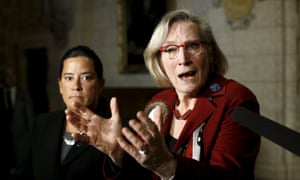
canada indigenous affairs minister
Canada’s indigenous affairs minister, Carolyn Bennett. A spokeswoman for her said: ‘Our government believes that negotiation, rather than litigation, is the preferred route.’ Photograph: Chris Wattie/Reuters
After years of delay, thousands of indigenous Canadians who were forcibly removed from their homes as children are finally getting their day in court.
An Ontario superior court judge will on Tuesday hear arguments in a summary judgment motion for a class-action lawsuit brought against the Canadian federal government by survivors of the episode, known as the “Sixties Scoop”.
Around 16,000 indigenous children were taken from their families and communities, and put up for fostering or adoption by mostly non-indigenous families across Canada and the United States – often without the consent of their parents. Some were sent as far away as New Zealand and Australia.
Survivors and their families say the forced removal robbed the children of their cultural identity and caused an emotional rift that has been felt through generations.
The lawsuit was launched in February 2009 by two survivors, including Marcia Brown Martel, the class action’s representative plaintiff, who was just four when she was removed from her family home on the remote Beaverhouse First Nation near Kirkland Lake, Ontario. She spent time in foster care before being adopted into non-indigenous family.
Tuesday’s hearing comes after seven years of delays that were mostly due to appeals by the federal government, which has fought the class-action since it was launched.
It is estimated some 16,000 on-reserve children were removed from their homes by Ontario’s child welfare services between 1965, when the federal government signed an agreement with the province to extend its welfare programs to reserves and 1984, when the provincial government incorporated protections regarding cultural identity into law.


The episode has drawn comparisons to similar chapters in other countries: in Australia, thousands of Indigenous children were systematically removed from their families and communities between 1910 and 1970. In 2008, then prime minister Kevin Rudd formally apologized to the surviving members of the “Stolen Generations”. In the US, the Indian Child Welfare Act was introduced in 1978 to counter the disproportionate removal of Native American children.
The current class-action suit in Canada centres on whether Ottawa had the obligation to take steps to preserve and protect the cultural identity of the thousands of on-reserve children who were placed in non-aboriginal foster care or adoptive homes over that 20-year period. The federal government denies that claim.
Jeffery Wilson, a lawyer for the plaintiffs, said that a ruling in the suite would be the first of its kind in the western world.
“No First Nations case yet to this day has asked the question as to whether or not the loss of identity is an actionable wrong. Aboriginal title to property has been litigated, aboriginal title to identity has not,” he told the Guardian.
Last week, in an open letter to Justin Trudeau, five indigenous leaders called on the prime minister to commit to resolving the issue without further delay.
“Few things matter more than acknowledging and righting historic, and ongoing, wrongs affecting children,” they wrote.
“This moment is an opportunity for Canada to put an ugly legacy behind us, for the government to take steps to reform its conduct so that the injustice does not continue and build a better future for all.”
In the summary judgment proceedings on Tuesday, the plaintiffs will argue they have enough evidence to avoid going ahead with a full trial.
The federal Liberals, who have made renewing the relationship with indigenous Canadians a priority, have signaled they are open to seeking a resolution outside the court system.
In a statement on Monday, a spokeswoman for indigenous affairs minister Carolyn Bennett said: “Our government believes that negotiation, rather than litigation, is the preferred route. We remain open to resuming negotiations to explore options for redress outside of court.”
The class-action is seeking C$85,000 ($65,601) per person in damages. Similar lawsuits have been filed in the provinces of British Columbia, Manitoba, Alberta and Saskatchewan.
Last year, the province of Manitoba issued a formal apology for the Sixties Scoop. Saskatchewan is expected to follow suit.

Adoption Contracts: Living Hell


RELINQUISHMENT AGREEMENT BETWEEN CATHOLIC CHARITIES
AND A BIRTHMOTHER
Know all men by these present: That_____________ the undersigned, being the parent of _____________, a minor child born in the state of ________on the ___day of_____, 19--  being unable to adequately provide or care for said minor, hereby surrender the custody of said minor child to Catholic Social Service________ a child welfare agency duly authorized under the laws of the state of ______ to care for, maintain or place children in family homes for care or adoption; and I also hereby relinquish to said agency all rights to every kind or nature which I may have to the custody services, earnings, or control whatsoever, over said minor child and hereby consent to the adoption of said child by any person or persons deemed by said child welfare agency to be fit and proper as adoptive parents. To the best of my knowledge said child _____ was/was not born out of wedlock.  [Signatures, Witnesses, acknowledgement, date. This relinquishment has been duly recorded.]  NOTE: bottom of page: “The parent or surviving parent of a child, or the mother of a child born out of wedlock, may relinquish the child to a child welfare agency licensed to place children for adoption by a written statement signed before 2 witnesses and acknowledges before a representative of the child welfare agency. No such relinquishment shall be valid unless a copy be approved by and filed with the State Department of Social Security and Welfare.

By Trace Hentz (author of One Small Sacrifice) (the following was written for my memoir)

Many adoptees have not seen the relinquishment contract, when a mother sells hands her baby to the church. I found this contract sample on the internet.
           
Catholic Charities Social Services handled me back in 1956, though their typical contract doesn’t exactly specify secrecy. I don’t recall seeing or reading any original contract in my adoption file in 1979. It may have been in there but at age 22, I was too young to know its importance.
           
 “Know all men by these present…” Men wrote this decree and decided this for me, not even knowing me? Had religions invented a moral code just for women? The rules of SIN (seven deadly ones) were apparently handed down by an infallible Pope (directed by God) to his holy men like Jesus who spread the word to cardinals, bishops and ordained priests, all of them men.
            
Wait, it’s not complicated. I just wanted to know my name, my identity, my tribe. It has nothing to do with religion.
             
Who might invent this torture and sell it so convincingly and completely, and a few centuries later, still get away with it. It boils down to this: Sacrifice your baby and save your reputation. Who might write such an edict affecting the innocent?
           
 Apparently these holy white men.
            
 It took me years to comprehend and recognize the depth of strength needed to heal this misery. I prefer not like to think of myself (or any baby) as disposable.
           
 Raised Roman Catholic, I could see myself boxed in - knowing what I’m doing is evil (opening my own adoption file), wanting to know more, committing egregious sins, potentially hurting people – especially my moms and dads, and I’m violating someone else’s privacy, exposing the secret that I am alive so that others might be exposed and judged. Great! By all accounts, I risk eternity in hell.
             
All true, but I’d do it again. To unlock my Wisconsin and Minnesota adoption records meant taking serious legal risk. In other words, my illegal search could get me thrown in jail. Phone calls, letters, a potential lawsuit, all my attempts could get me locked up. Back then it looked possible to break through America’s barrier of secrecy.
          
I used to think of my adoption as an accident, like a derailed train car sunk in mud and muck. I could barely see the river where it happened, let alone the wrecked car, or where my disease, disconnect and blocked memories had submerged. I was living in a daze, not really knowing what happened that I happened. I’m talking numb, almost completely.
           
To top it off, my search meant I’d face my birthmother. I’d risk rejection a second time. This was most terrifying, even after hell and prison. Whatever her reason, what lead her to abandon me, I had no clear explanation after reading my adoption file. I had no idea where to find her or ifI should find her. I didn’t know if she was shamed into silence like other birthmothers.
             
Obviously, there are more questions than answers when it comes to adoption. There are many more variations now: open-closed, kinship-stranger, transtribal-transracial, or national-international.
             
For adoptees, it’s either: interested-not interested, searching-reunited, hope-full or hope-less.  

book cover photo ONE SMALL SACRIFICE (using the last name DeMeyer)
Adoption secrecy is like poison. It will get you sooner or later.

Saturday, August 20, 2016

Fletcher (again) on #ICWA in Cato Unbound


Here is “A Civics Lesson.”

An excerpt:
In legal analysis, facts matter, and so it is time to return to the war on facts in this series. Mr. Sandefur still tries to attack ICWA in the Alexandria P. matter, even though California law that applies to all children would have Lexi back with her relatives, an outcome all parties excepting the foster parents wanted and prepared for. Along the way, Mr. Sandefur incorrectly states that the Mississippi Band of Choctaw Indians was involved when in fact it was the Choctaw Nation of Oklahoma. Mr. Olson incorrectly assumes that the Shoalwater Bay Tribe had interfered in In re T.A.W. when in fact the non-Indian parent filed the appeal asserting ICWA claims; the tribe is not a party to the case and opposes the non-Indian parent, who served time in prison for robbery and whom the tribal court found to have engaged in domestic violence. One could read the courts’ opinions to find these facts, except in one case, Baby Girl. Here, Mr. Sandefur forgets that the Cherokee dad was an active duty serviceman served with adoption papers immediately before his deployment to an active war zone without the advice of counsel. These are facts the Supreme Court majority also chose to ignore. Conversely, the South Carolina Supreme Court’s opinion addressed all these facts in reaching the opposite outcome. Facts, in law, matter.

All of the cases discussed in this series are complicated cases with difficult fact patterns, and perhaps no one case can vindicate or condemn the ICWA. Consider Mr. Olson’s reference to In re M.K.T. He seems to argue that the case is about a Cherokee father who tried to relinquish his tribal membership in order to avoid ICWA’s application, but the Cherokee Nation stubbornly refused to yield. The facts are more complicated and actually highlight how ICWA could have been useful if the parties had complied initially. The Cherokee father signed the tribal membership relinquishment form without the advice of counsel. The foster parent brought him the form while he was in prison (recall here the incarcerated parent that Mr. Olson accidentally champions by attacking the tribe in T.A.W.), bringing a notary along to cement the deal. The father later testified that he did not understand the legal ramifications of his relinquishment under tribal law, and that no one informed him that there was an Indian family available or anything else about the state of his child. All ICWA requires is the basic procedural right for Indian parents to seek the advice of counsel and to give knowing consent before a judge before their parental rights are terminated. The coercion of an imprisoned father into signing away his rights is a strange fact pattern on which to rest any conclusions about ICWA. Had the Cherokee father access to legal advice in the first instance like the public policy grounding ICWA supports, the case likely would never have been litigated, let alone reached the Oklahoma Supreme Court. The same was true for Baby Girl, where counsel for the adoptive couple failed to properly notify the tribe at the inception of the adoption process, and Alexandria P., where the foster couple fought against the wishes of all other parties to the case and against the best interests of Lexi.

In conclusion, ICWA stands up to scrutiny. Because of the treaty tradition, federal statutes like ICWA, and modern tribal governance, 21st century American Indian people know who they are and where they come from. Modern tribal governance is a triumph of the rule of law over years and years of American greed and bigotry. Indian tribes exist to preserve their homelands, including Anishinaabeki, allowing contemporary Indian people to access sacred sites and to know where their ancestors are buried. Indian tribes encourage their people to learn their languages, including Anishinaabemowin, and cultures.  Indian children are learning their histories and languages, rather than being delivered to assimilationist boarding schools or shipped out to non-Indian families. Anishinaabe children are learning mino-bimaadiwin, the principle holding that all beings are connected and that actions of people have consequences on all. And because tribes are working to protect children, rather than treat them as cogs in a state bureaucratic hell or chattel to be bartered through the private adoption market, Indian children have a place to turn for help. Tribal law – inaakonigewin – speaks for itself.
My previous entry in this series is here.
Kristen Carpenter’s entry is here.

Friday, August 19, 2016

ICWA: Federal judge to issue order fixing '48-hour hearings'

RAPID CITY JOURNAL

Three years after Native American families filed a lawsuit against state officials over the handling of cases involving their children, the end of a phase was imminent Wednesday as lawyers from both sides made final arguments in Rapid City federal court.
Attorneys for the plaintiffs said the Seventh Circuit Court, state Department of Social Services and Pennington County State’s Attorney’s Office have made no fundamental changes in Native American children’s temporary custody hearings despite a federal judge’s findings in March of 2015.
Chief Judge Jeffrey Viken, of the South Dakota District Court, at the time found that local court procedures violated Native people’s rights. This included not advising parents they had a right to contest the state’s petition for temporary custody and not requiring the state to present sworn testimony from a live witness.
Viken had asked the defendants to offer recommendations on how the emergency removal hearings, or "48-hour hearings," can be fixed. The judge wanted to use this as a guide for an order he will be issuing, but on Wednesday said he has not received any recommendations.
Defense lawyers for the Seventh Circuit Court and State’s Attorney’s Office told Viken their clients have already instituted changes since his 2015 findings. The DSS’s attorney, meanwhile, said the department has always respected Native rights in the removal process.
Among the issues Viken is expected to address in his forthcoming order is whether the federal court will appoint a monitor to watch over the custody hearings, as requested by the plaintiffs. Viken did not say when his order will be released.
An issue that will be taken up in future hearings is the plaintiffs’ claim that the DSS has failed to train its workers on the requirements of the Indian Child Welfare Act.

****
VIDEO
RAPID CITY, S.D. (KOTA TV) - U.S. District Court Judge Jeffrey Viken expressed dismay Wednesday that he has received no help from Pennington County officials drafting a court order to address shortcomings he identified in certain proceedings involving Native American children.
Plaintiff's attorney Stephen Pevar.

Seventeen months ago Judge Viken found that Indians were denied protections guaranteed under the constitution -- and the Indian Child Welfare Act – in certain hearings.

The proceedings, known as "48 hour hearings" are held to determine if the state has the right to temporary child custody.
In a suit brought by the Oglala Sioux and Rosebud Sioux Tribes, Viken found, among other things, that Native American parents were denied the right to representation by an attorney and are not afforded the chance to cross examine Department of Social Services staffers recommending the taking of their child.
Today the courts have so far not adhered to the bulk of Viken's interpretations -- nor changed much of the way they handle 48 hour hearings.
Plaintiff's attorneys called Pennington County States Attorney Mark Vargo to the stand and asked why he hadn't complied.
Vargo also said he felt his office was complying with the Indian Child Welfare Act. He said that Viken had not issued a formal ruling directing him to change procedures and that if the judge did, he would comply.
“The only issue in today's hearing was what remedies should just federal court issue in order to get the defendants to stop violating the rights of the plaintiffs,” said plaintiff attorney Stephen Pevar. “In a previous ruling he had found that the defendants were violating federal rights in seven different respects.”
Viken repeatedly said on Wednesday that he wanted the defendants, which includes the Department of Social Services, to suggest remedies. He said it was difficult for federal judges to craft write these without guidance.
But he was very clear. He said he is going to issue rules that the courts and the D.S.S. will have to follow.
He also said from the bench that it was not unlikely that this case, involving overlapping responsibilities of state and federal courts, is headed for appeal.

Thursday, August 18, 2016

ONGOING: Watching the Feds

As a reservation NDN descended from exiles who went to war against the U.S. Government, I've been under surveillance by the Feds my entire life. I was born at an old military fort on tribal land: Fort Yates, North Dakota, on the Standing Rock Sioux Reservation. I grew up around other old military forts on reservations that were formerly prison camps. Fort Sisseton, South Dakota, on the Lake Traverse Reservation. Fort Totten, North Dakota, on the Spirit Lake Nation Reservation. It’s funny what a child is able to normalize. Until I went off to college, I never realized the depth and breadth of how unusual my upbringing was from the typical American youth. Sure, I watched Saved By the Bell, but I had no idea that the national park I played at was named for a man, General Sully, who slaughtered hundreds of innocent, unarmed Dakota and Lakota men, women and children in a little known ambush called Whitestone Hill. In a fury of bloodthirsty hatred, the soldiers even killed my ancestors’ dogs and horses, and burned their winter rations.

The military installations that surrounded us were not put in place to protect or assist my ancestors. They were put there to contain us. The U.S. Government and its agents massacred and imprisoned my People. We were enemies of the state. Thanks to corrupt government officials who withheld treaty promised rations, my ancestors were starving and forced to fight for their survival in the Minnesota Uprising of 1862, also known as The Dakota Conflict. At its end, 38 of our warriors were hung in Mankato under orders from Abraham Lincoln, everyone’s favorite President, in the largest mass execution in U.S. history. We were outlawed from our own Minnesota homelands. Governor Ramsey placed a bounty on our scalps, our "red skin." Some of us were shipped off to prison in Iowa, where soldiers forced Dakota men to watch as they raped their wives, sisters and daughters. Some were marched naked through the snow to Crow Creek, South Dakota. Others ran to Sitting Bull for protection, or escaped to Canada.

Outsiders read these stories at a comfortable distance. To me, history is alive. These people are my grandmothers and grandfathers. Genocide is personal. It’s my story and the story of every Native.
My great great grandfather was hauled off to an asylum for being disobedient (a bad NDN). He died there, from a ‘head wound.’ They stole my father away to boarding school when he was only 4. He was still nursing at his mother’s breast. These actions have had a profound effect on my family and oh boy, does the government know my family well. Like other Rez NDNs, the government keeps thorough records of my bloodlines' births, deaths, land holdings, and whereabouts. They know our genealogy better than we do. Like the Jews during the holocaust, I am assigned a number. It will follow me my entire life.

I went away to school and studied their laws as well. I know the history of lies and deceit; the trail of broken treaties left behind. I know the destruction of our lifeways continues to this day, as I see my relatives struggle in abject poverty, which has manifested within our communities as a direct result of the Federal government's actions and inaction. I've seen the oil spills on tribal lands that are never cleaned up. I've witnessed Federal agencies hamstringing Tribes so they're unable to actualize economic development, provide adequate health care, foster care and law enforcement, yet it is the Tribal leadership who is called into question during congressional hearings. Our suffering is not for show. If justice is real, Congress should indict itself.

The NDN knows their games. We’ve watched politicians fly in and out of our territories for photo ops during election season only to disappear once it’s over. We’ve seen the insidious workings of governmental organizations like COINTELPRO, who labored tirelessly to tear down Red Power and the American Indian Movement. Leonard Peltier, a Native political prisoner, fellow Dakota, and elder, remains behind bars despite calls from Nelson Mandela and many others, for his release. We see the black cars and agents at protests today.

I cannot shut my eyes to these things. I cannot forget the theft of our lands and resources, and the ongoing destruction of Mother Earth perpetrated by government-protected corporations, or how they removed us from our hunting grounds and natural, healthy gathering places where food was medicine, and replaced it with poison that gives my People diabetes and cancer. I will not forget how they outlawed our sacred ceremonies, kidnapped our children to ‘kill the Indian, save the man,’ nor the young women on Reservation lands who’ve appeared before me in tribal court, scared for their lives against non-Native women beaters who continue to be protected by loopholes in federal law and more empty promises yet to be implemented.

So forgive me if I don't trust the government. Pardon me if I choose not to get into bed with the establishment that committed genocide against my People and continues to commit it here and abroad against other Indigenous Nations to this day. There is something in us that they do not have and that they greatly fear. I, for one, will never surrender.

Ruth Hopkins (Sisseton Wahpeton & Mdewakanton Dakota, Hunkpapa Lakota) is a writer, blogger, biologist, activist and judge.

SOURCE http://indiancountrytodaymedianetwork.com/2016/08/09/watching-feds?utm_content=buffer7fe37&utm_medium=social&utm_source=twitter.com&utm_campaign=buffer

Friday, August 12, 2016

Priscilla Sharp: Tips for Families Searching for Adoptees

click: Tips for Families Searching for Adoptees [Update 4/2016]


We are encouraging Native American and First Nations adoptees to contact Karen Vigneault (see our blog reference section above for her email) and please contact Priscilla Sharp as well.. she has helped many adoptees I know... Trace

Monday, August 8, 2016

PERFECT STORM: A ‘Revolution’ in Canada’s Aboriginal Child Welfare System

logo-chronicle (2) 

By Devon Ziminski
Written By Chronicle Of Social Change


Recent legislative action addressing the severely adverse outcomes that First Nations children face in Canada’s child welfare system has led to a national discussion.


Earlier this year, the Canadian Human Rights Commission issued a decision against the government in a 2007 lawsuit filed by the First Nations and Family Caring Society and the Assembly of First Nations. The tribunal ruled that the federal government discriminated against tens of thousands of vulnerable First Nations children by providing less money for welfare services on reserves – referred to as reservations in the U.S. – than elsewhere in Canada.

The ruling has captured the nation’s spotlight because of Canada’s troubled past with Aboriginal peoples, and its urgency is heightened by the disproportionate overrepresentation of First Nations children in the Canadian child welfare system.
“Aboriginal peoples” is a collective name for the native inhabitants of North America and their descendants. Canadian law recognizes three groups of Aboriginal peoples: Indians, commonly referred to as First Nations people, Métis and Inuit.

Nearly half of the 30,000 children and youth in foster care across Canada are Aboriginal children, even though Aboriginal peoples account for only 4.3 percent of the Canadian population.

“In the U.S., African American kids are overrepresented. In Canada, its First Nations children,” said Josh Kroll, a project coordinator with the Northern American Council on Adoptable Children (NACAC). NACAC promotes and supports permanent families for children and youth in the U.S. and Canada.

While the overrepresentation of Aboriginal children clearly exists, comparing the rates of Aboriginal children in foster care across the country is challenging because the population rates, economic conditions and community supports vary in each province.

“There is overrepresentation in each province but it is different,” Kroll said. The percentage of Aboriginal children in child welfare systems reaches 60 percent to 78 percent in some provinces and territories.
While Canadian policy acknowledges cultural differences between mainstream society and Aboriginal culture, these tensions have escalated to legal action.

“With the Inuit populations in Canada, there are profound challenges,” said Rita Soronen, president and CEO of the Dave Thomas Foundation for Adoption in the U.S. and Canada. The Dave Thomas Foundation is a nonprofit organization dedicated to finding permanent homes for children in foster care.

Historically, Canada has had a challenging relationship with First Nations people. Many struggles relating to child welfare in Aboriginal communities are perpetuated by poverty, community isolation and a lack of social services. An inaugural First Nations summit led by the Federal Minister of Indigenous Affairs will be held in fall 2016 to address these issues.
First Nations Child and Family Caring Society Executive Director Cindy Blackstock speaks about the Canadian Human Rights Tribunal regarding discrimination against First Nations children in care. Assembly of First Nations National Chief Perry Bellegarde looks on.
First Nations Child and Family Caring Society Executive Director Cindy Blackstock speaks about the Canadian Human Rights Tribunal regarding discrimination against First Nations children in care. Assembly of First Nations National Chief Perry Bellegarde looks on. Photo: Adrian Wyld for The Canadian Press


In the recently ruled upon lawsuit, Cindy Blackstock,  executive director of First Nations and Family Caring Society, argued that the support the federal government provides for child welfare on reserves is significantly lower than the support provincial governments give to children off reserves.

The Canadian Human Rights Tribunal began hearings for the case in 2013, and on January 26 of this year ruled that the underfunding was discriminatory, leading to a major refocusing of Canadian child welfare policy. The government’s own documents say the underfunding for welfare on reserves ranges between 22 and 34 percent.

The ruling confirming the discrimination will require hundreds of millions in financial reparations to First Nation communities and secure child welfare as a top policy priority. Political agendas have shifted, and now the question is, “Who should be running child welfare for First Nation people in Canada?” said Irwin Elman, Ontario’s provincial advocate of child welfare.
Each Canadian province and territory has its own child welfare policies and legislation in place, making blanket national policies challenging to enact or enforce.

Ontario, for example, has 48 different agencies that deliver child protection services. Six of the 48 are First Nations-designated agencies, and are run by First Nations people. This allows these agencies to have some leniency to practice child welfare in a way they say is more culturally appropriate for their community.

Aboriginal child welfare agencies work in various ways, with some being fully delegated agencies authorized under provincial child welfare laws to provide a full range of services, while others are non-delegated agencies with voluntary mandates to provide services to Aboriginal people.
However, children who enter the child welfare system have to go through the provincial legal system, regardless of whether they reach the system through a First Nations or other agency.
First Nations legal operations must adhere to Canadian law, but First Nations leaders want to reclaim control of their children. Elman said these communities are exerting the sentiment that “we should determine our services and how we protect our kids.”

In the future, First Nation communities might have their own court system for dealing with child welfare issues, as opposed to going through the traditional Canadian system.
“There is a sense of urgency for First Nation people as their children are being put into a colonial system that isn’t working for any child, let alone for First Nation kids,” Elman said.

One of the emergent themes from recent discussions is the potential movement towards a “nation-to-nation discussion, as in the First Nation people to Canada discussion,” Elman said.
Although two separate welfare systems have never been tried before, “the government is open to exploring that,” Elman said.

Despite an overall anxiety about what to do, this issue is “the number one priority, and a priority at every level in government,” Elman said. “It is a huge question with heavy context.”
Besides the tribunal ruling there have been other efforts on behalf of the indigenous population, but many “believe those kids have gotten the short end of the stick,” Soronen said.

A Truth and Reconciliation Commission final report released by the federal government mid-2015 highlighted a “policy of cultural genocide” within Canadian borders. The report described Canada’s residential schools as “part of a coherent policy to eliminate Aboriginal people as distinct peoples and to assimilate them into the Canadian mainstream against their will.”

The residential school policy removed indigenous children from their homes in attempts to assimilate them into Canadian society. The policy resulted in countless deprivations and abuses inflicted on thousands of children, as well as the loss of language, community cohesion and cultural knowledge and skills.

“The Truth and Reconciliation Commission report uncovered publicly that there is a lot of damage that has been done to three-to-four generations of First Nation people in our country,” Elman said.
And just last week, Alberta’s Child and Youth Advocate Del Graff released a report outlining the systemic issues he says are failing indigenous families, according to Edmonton CBC News.
In the report, “Voices for Change,” Graff said there is “something wrong” with the child welfare system.

The report also outlines many systemic problems that contribute to the high numbers of indigenous children in the system. Graff said many reports have documented how Aboriginal people have been underserved by child welfare systems, but despite recent calls to action the situation has “actually gotten worse.”

While the obstacles facing First Nations children are not new, a perfect storm of events has launched child welfare to the forefront.

“There’s a revolution going on in Canada about Aboriginal child welfare,” Elman said.

Friday, August 5, 2016

Fletcher on ICWA at Cato Unbound


Here is “Limit Government Intrusion in Indian Families’ Lives.” This essay is part of a series of online essays at Cato Unbound on the Indian Child Welfare Act.

Excerpts:
The Indian Child Welfare Act (ICWA) restricts government intervention in Indian families’ lives, imposes important obligations on the government that benefit both children and parents when it does interfere, and limits the ease by which private entities profit from government action.
And:
Alexandria P. is a story of how foster parents created an adversarial relationship with a child’s family, disregarding the goal of reunification, and then created a perfect storm of anti-Indian media sentiment when they lost. Some facts should be made clear, in case they are not: Lexi knew and regularly visited her Utah family – her sisters and her aunt and uncle – and she always knew she was a foster child. From the beginning, the California foster couple was the only party to contest Lexi’s placement with her relatives. The state of California, the Choctaw Nation, her relatives, her father, and Lexi’s own counsel all agreed that the placement with her relatives was absolutely in her best interest. Not once did any court disagree.
Finally:
Casual racism against American Indians is alive and well. In this hostile racial climate, it shouldn’t be surprising that Indian parents in South Dakota argue that “there’s this collective belief that Native people can’t take care of their own children.” The critique that ICWA improperly routes Indian children to their relatives’ homes instead of non-Indian homes is a critique that takes advantage of racial animus against Indian people and comes dangerously close to an allegation that Indian parents and tribal communities are inherently inferior (others have outright denounced the Goldwater Institute’s goals for this reason). Indian people love their children the same as everyone else. ICWA, the gold standard in child welfare, is there to support Indian families against governments that too often devalue them.

Thursday, August 4, 2016

What we've known a long time

By Trace L. Hentz
 
First, do no harm. That is the doctor’s creed. Doctors are part of a larger group I call The Adoption Industry. Their group includes clergy, politicians, academics, psychology-types, social workers, lawyers and adoption agencies made up of similar people. Apparently this group lacks historians. If they had historians, they’d know adoption hurts the adoptee. Statistics don’t lie. Adoptees are among the highest population in psychiatric care. If it hurts, it harms.
 
The mental health of Native babies and children who go through adoption with non-Indian parents has been documented in studies for decades. Suicides, arrests and addictions are common and adoptees have known this pain a long time. The Indian Child Welfare Act of 1978 was supposed to end the harm to Indian children by placing them with other family members. Sadly, that still isn’t happening.
 
My friend Stephanie Woodard wrote in Indian Country Today, here (Dec. 1, 2012) about South Dakota’s ICWA violations:
 
“The ICWA directors found that the latest information shows South Dakota is not only taking a disproportionate number of children into custody, it is also failing to ensure that they stay with their tribes, despite ICWA provisions requiring that tribes have a say in their children’s placement. As of July 2011, they said, Native American foster homes sat empty while nearly 9 out of 10 Indian children in state foster care were in non-Native homes.
 
“The ICWA directors also noted the state’s tendency to equate “poverty” with “neglect,” which in turn results in more seizures of Native American children: “South Dakota’s rate of identifying ‘neglect’ is 20 percent higher than the national average,” they wrote.
 
“The group also found disturbing information on the fate of children once they left the (social care) system. Some youngsters are reunited with their families or adopted; or they may turn 18 and “age out.” But from 1999 to 2009, the “other” category—children who died, ran away or were transferred to correctional or mental-health facilities—grew from 6.9 percent to 32.8 percent….”
 
In two conversations, two different birthmothers in Minnesota confirmed what I was thinking about harm to the adoptee. One mother found her son was harmed emotionally by his adoption and is in treatment for addictions. Then an adoptee friend shared her brother, also an adoptee, is homeless and drug addicted. Her family doesn’t know what to do, other than hope and pray he finally gets mental health counseling for adoption issues and not get prison-time.
 
This mental health crisis has been building for decades! I sought counseling twice in my life, and even though it wasn’t focused on adoption, it helped me recover my self-esteem. Doing research for my book One Small Sacrifice changed me the most and healed what I call “the wound.” (There are adoptees who say they were not harmed, not all, but some.)
 
The truth that adoption harms and hurts Native children is something we’ve known a long time. But this truth never seems to reach our adoptive parents ears. They were not told by Adoption Professionals they’d need to prepare for our adoptee issues and get us help early.
 
Propaganda by the Adoption Industry would prefer we don’t speak the truth. Adoptees have known that a long time, too.

Monday, August 1, 2016

Who’s On The Bus to Toronto?!

Join us to support the beginning of the class action suit.
FREE TRANSPORTATION to Toronto August 23, 2016 for the rally and class action proceedings. Please register your pick up.
Poster-Osgood-Rally, indigenous adoptee, sixties scoop

Departure: Amnesty International, 312 Laurier Avenue East, Ottawa K1N6P8
Departure Time: 12:30 am (midnight).
Travelling to Toronto with stops in:
Kingston @ 2:40am
Belleville @ 3:20am
Oshawa @ 4:30am
Leaving from Toronto back to Ottawa 3:00pm
Or email info@indigenousadoptee.com to schedule your pick up location!

WEBSITE

What if “the vocal adoptees” are right?

By Trace Hentz (American Indian Adoptees editor)

It's summer and I know that many of you are busy doing summer things.

THIS post is one you need to read.
HERE
The question remains, how can anyone understand their feelings, because, to them, adoption is beautiful.  Some even say it is redemptive.  Our societal response is to not recognise the feelings of being an only, otherness, rejection, abandonment, feelings of loss, because adoption created you a new family.  It’s all good now.  Move on. When any of those feelings came to the forefront; whether it is a feeling of abandonment, low self-worth, loss of their biological roots, culture, country, language, lack of racial and/or genetic mirroring – whatever needed processing, can’t be explained to people who can’t conceive you having them. Society has chosen the miracle of adoption narrative, because, in it – everyone wins.
So, when natural feelings come up, how can you expect others to get it?

Thursday, July 28, 2016

Walker signs two bills into law

Gov. Bill Walker signed HB 200 on Tuesday morning at the offices of Bristol Bay Native Corporation in Anchorage.
Walker signs two bills into law


Gov. Bill Walker has signed into law bills intended to help foster youths and ease adoption in Alaska.
Among other elements, House Bill 200 implements portions of the Indian Child Welfare Act that ease the adoption process for tribal members adopting a child of the same tribe. The bill also allows up to four legal proceedings involved in adoption cases to be combined under the purview of one judge.
House Bill 27, sponsored by Rep. Les Gara, D-Anchorage, is a foster care reform bill that requires the state Office of Children’s Services to make greater efforts to work with tribal and Alaska Native organizations, and perform more in-depth searches to determine whether a relative may be able to care for a child.
Children may stay in the foster care system through age 21 (instead of 18) in order to avoid homelessness, according to one provision in the bill.
The bill calls for children to stay in their current schools (if possible), and it states that one of the duties of the Alaska Department of Health and Social Services is to recruit foster parents and adoptive parents.
Walker added both bills to the agenda of the first special session when they failed to pass the Legislature in regular session.
The signing of HB 200 took place at the Anchorage offices of Bristol Bay Native Corporation, while the signing of HB 27 took place at the University of Alaska Anchorage.

Wednesday, July 27, 2016

I'm not an incident

When did you learn you were adopted? What was your relationship like with your adoptive family when you were growing up?
READ HERE

August 23 RALLY #60sScoop

Check out the event on Facebook here and please share with anyone who might want to come.

Date: August 23
Time: 8:15 a.m.
Place: Osgoode Hall, 130 Queen St. W., Toronto (northeast corner of University Ave. and Queen St.)

Tuesday, July 26, 2016

Honoring Abourezk #ICWA

Tribal Organization Honors Abourezk For Work Done In Senate

•  July 25, 2016
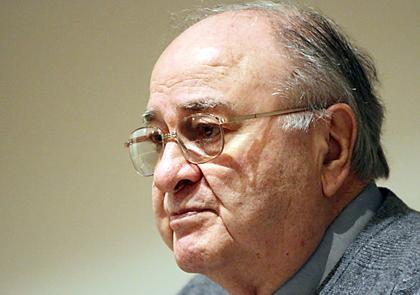
James Abourezk
A tribal organization is honoring a U.S. Senator from South Dakota for legislation he pushed through Congress forty years ago.   
The Tribal Interior Budget Council gathered in Rapid City earlier this month, and recognized Former Senator James Abourezk.
Officials say he was instrumental in passing key legislation that fostered tribal self-governance.
James Abourezk was a one term U.S. Senator.  But during his time in congress he was able to pass several laws boosting tribal sovereignty.
Abourezk authored much of the Indian Child Welfare Act, the Indian Self-Determination Act and the Indian Religious Freedom Act.
He says being honored by tribal members means a great deal to him. Abourezk says much of the inspiration for the laws he helped create came from his childhood.
“I was born and raised on the Rosebud reservation," Abourezk says. "And I ran around and played with Indian kids all the time. And there was a lot of racism, probably including me, back in those days against Indians. And I snapped out of it when I was in college. I understood now what I was doing was demeaning Indians and I should not have—I should never have done it but I’ve gotten over that now.”
Abourezk was also instrumental in increasing the amount of money associated with the Black Hills treaty land claim, which tribal nations still haven’t accepted.
Gay Kingman is the Executive Director of the Great Plains Tribal Chair Association. She says, decades after leaving office, Abourezk still calls her to comment on current legislation…
“He continued to advocate for Indian people, and he represented many of the tribes and the people. He still calls me now and then. He’ll call and, I know he’s in failing health now—he’s of an age—but he’s still very strong,” Kingman says.
Former Senator James Abourezk was unable to attend the Tribal Interior Budget Council ceremony held to honor his work due to health issues. His son Charlie read from a prepared statement in Rapid City.   Charlie then accepted a gift on behalf of his father.
“He’s still got it, I hope he doesn’t try to keep it,” James Abourezk says.
Abourezk was both a U.S. Representative and Senator for most of the 1970’s.

LISTEN HERE

Monday, July 25, 2016

After Alcatraz #ICWA

9 Laws and Programs Passed for Indians After the Occupation of Alcatraz

7/24/16
As of 1969, Congress had passed 5,000 laws for Indians. The effects of the laws had been to reduce the role of Indian tribal leaders and enhance the power of federal officials to regulate Indian people and their lives. The Indian occupation of Alcatraz Island in 1969 set the stage for the development of positive Indian programs. We were against the “ations”—relocation and termination.

Read more at http://indiancountrytodaymedianetwork.com/2016/07/24/9-laws-and-programs-passed-indians-after-occupation-alcatraz-165218

Sunday, July 17, 2016

Goldwater lawsuit is a fight for the soul of tribal nations

Navajo Nation President: Separating Navajo Children from Their Parents & Families is Devastating


Navajo Nation President Begaye provides strong words during opening address
Published December 12, 2015

ALBUQUERQUE—During the opening banquet for Navajo Division of Social Service and Casey Family Program’s Navajo Child Work Session in Albuquerque on Monday, Navajo Nation President Russell Begaye called for the absolute protection of Navajo children in his support of the Indian Child Welfare Act (ICWA).
“There is nothing more devastating than seeing a Navajo child being taken from their parents. The connection that exists between a child and their parent is strong. It’s a sacred bond. In our support of the ICWA, we are protecting the connection between children, their parents and siblings,” President Begaye said.
Last week, President Begaye delivered a letter to Secretary of Health and Human Services Sylvia Burwell asking for her to support ICWA in enforcing that state courts investigate and verify the enrollment of Native American children in cases regarding custody and foster care.
President Begaye talked about the boarding school era in the history of American Indians to emphasize the historical trauma caused by the separation of Indian children from their families, culture and language. Both President Begaye and his brothers attended boarding school as young men.

“Imagine your identity being erased. Imagine not being able to see your mother and father. Imagine knowing you have family but not being able to see them. The separation is too much,” he said. “Now imagine children who are separated from their families and cultures for the entirety of their lives."

On July 7th of this year, ICWA came under fire when the Goldwater Institute filed a proposed class-action lawsuit in federal district court in Arizona challenging the constitutionality of ICWA and the Bureau of Indian Affairs (BIA) guidelines that strengthen this legislation.
The Goldwater lawsuit has sparked a national discussion questioning the purpose of ICWA.  It is the position of the Navajo Nation that tribes, states and partners do everything they can to advocate for this legislation which protects tribe’s connection to Native American children.
President Begaye said the lawsuit portrays the lifeways of Native Americans as being insignificant while also portraying tribal communities as substandard.  For non-Natives, the lawsuit could be interpreted as compelling.

“It makes you think about the issue in the questions it raises,” he said. “Rather than go down that road, we, as Native Americans, need to know that we are just as good as anybody else.”

The Goldwater lawsuit is a fight for the soul of tribal nations, he said. It challenges the equality of tribal nations against non-tribal paradigms of societal standards not based in traditional culture or knowledge.

“Our traditional ways nurture our children and foster environments that are conducive to the success of our children. Navajo culture inherently protects the future generations as it does the elders.”
President Begaye expressed his gratitude to all departments in attendance, as well as the Health Education and Human Services Committee and Law & Order Committee delegates, for coming together to support and address the importance of ICWA in keeping Navajo children with Navajo families.  He called for the Nation’s continued support of ICWA and for tribes to stand against the Goldwater Institute’s lawsuit, which questions the constitutionality of the Act.

“Native Americans are just as good as any other society on earth. We love our families and will stand with them,” he said. “We need to make sure that every Navajo child in state custody or foster care doesn’t have to go through life wondering who they are or who their parents are.”

During the following morning’s agenda, Vice President Jonathan Nez presented a welcoming address to the work session that supported President Begaye’s position while also supporting positive, healthy families and homes on the Nation. The vice president also extended gratitude to the partners who organized the conference.

Regarding the Goldwater Institute’s lawsuit, Vice President Nez supports the need for all tribal nations to come forth with strong messages supporting ICWA.  He said there is a the need for the Nation to develop a strong strategy in combating the Goldwater Institute’s messaging and media campaign.

“What they are doing is chipping away at the sovereign rights of Native Americans which can eventually extend beyond ICWA,” Vice President Nez said. “What the Goldwater Institute is doing is wrong.”

Both President Begaye and Vice President Nez voiced support of ICWA and the protection of Indian children by keeping them with Native American families.

Saturday, July 16, 2016

Cindy Blackstock, Canada's Warrior for Children

Globe and Mail Article on Cindy Blackstock


Here.
“What I saw were children being systemically removed from these communities. And I’d go to these communities, and there was no running water, and people would wonder why the kids weren’t clean, and I’d think maybe someone should do something about the water. We would see the multigenerational impacts of residential schools, and there are no mental-health services that are culturally appropriate. So there were all these layers of inequality and I started to realize it was the system, in many cases, that was creating conditions where families were not going to be successful in caring for their kids. And nobody was really holding the system to account.”

[use the search bar on this blog for more about Cindy and her work... Trace]

CLICK OLDER POSTS (above) to see more news

CLICK OLDER POSTS  (above) to see more news

MEGWETCH THANK YOU

HUGE Thank you for visiting this blog and sharing this with your kin. It's appreciated. Contact Trace anytime! Use the form below.

BOOKSHOP

Please use BOOKSHOP to buy our titles. We will not be posting links to Amazon.

Popular Posts

To Veronica Brown

Veronica, we adult adoptees are thinking of you today and every day. We will be here when you need us. Your journey in the adopted life has begun, nothing can revoke that now, the damage cannot be undone. Be courageous, you have what no adoptee before you has had; a strong group of adult adoptees who know your story, who are behind you and will always be so.

OUR HISTORY

OUR HISTORY
BOOK 5: Lost Children of the Indian Adoption Projects