BACK UP BLOG (no longer updating)

This blog was a backup for American Indian Adoptees blog
USE THE SEARCH BAR or SEARCH TOPICS at bottom of this blog

If you need support

Support Info: If you are a Survivor and need emotional support, a national crisis line is available 24 hours a day, seven days a week: Residential School Survivor Support Line: 1-866-925-4419. Additional Health Support Information: Emotional, cultural, and professional support services are also available to Survivors and their families through the Indian Residential Schools Resolution Health Support Program. Services can be accessed on an individual, family, or group basis.” These & regional support phone numbers are found at https://nctr.ca/contact/survivors/ . MY EMAIL: tracelara@pm.me

Search This Blog

Thursday, December 17, 2015

First Nations Child Poverty, TRC

[PDF] FIRST NATIONS CHILD POVERTY

M Brittain, C Blackstock - 2015
... Non-Aboriginal peoples refers to persons who do not self-identify as Métis, Inuit or First Nations.
Reserve(s) refers to lands reserved for Indians pursuant to the Indian Act. ... An Indian advisory committee to non-Indians who are making the real decisions is not good enough. ...

First Five Recommendations of Canada’s TRC Report Involve Child Welfare


CBC story here.

Recommendations/Calls to Action here.
Child welfare
1. We call upon the federal, provincial, territorial, and Aboriginal governments to commit to reducing the number of Aboriginal children in care by:
i. Monitoring and assessing neglect investigations.
ii. Providing adequate resources to enable Aboriginal communities and child-welfare organizations to keep Aboriginal families together where it is safe to do so, and to keep children in culturally appropriate environments, regardless of where they reside.
iii. Ensuring that social workers and others who conduct child-welfare investigations are properly educated and trained about the history and impacts of residential schools.
iv. Ensuring that social workers and others who conduct child-welfare investigations are properly educated and trained about the potential for Aboriginal communities and families to provide more appropriate solutions to family healing.
v. Requiring that all child-welfare decision makers consider the impact of the residential school experience on children and their caregivers.
2. We call upon the federal government, in collaboration with the provinces and territories, to prepare and publish annual reports on the number of Aboriginal children (First Nations, Inuit, and Métis) who are in care, compared with non-Aboriginal children, as well as the reasons for apprehension, the total spending on preventive and care services by child-welfare agencies, and the effectiveness of various interventions.
3. We call upon all levels of government to fully implement Jordan’s Principle.
4. We call upon the federal government to enact Aboriginal child-welfare legislation that establishes national standards for Aboriginal child apprehension and custody cases and includes principles that:
i. Affirm the right of Aboriginal governments to establish and maintain their own child-welfare agencies.
ii. Require all child-welfare agencies and courts to take the residential school legacy into account in their decision making.
iii. Establish, as an important priority, a requirement that placements of Aboriginal children into temporary and permanent care be culturally appropriate.
5. We call upon the federal, provincial, territorial, and Aboriginal governments to develop culturally appropriate parenting programs for Aboriginal families.
 

Wednesday, December 16, 2015

All who died at residential schools should be named, bodies located


The commission that has spent the past five years trying to learn the truth about abuses of children at the former Indian residential schools says it is time for the names of all of those students who died, and the locations of their burials, to be known.

The final report of the Truth and Reconciliation Commission (TRC) was made public on Tuesday. Its main findings – including the determination that what happened behind the walls of the church-run schools amounted to cultural genocide – were released last spring along with a list of 94 “calls to action” to address ongoing problems. What is being put forward now is thousands of pages of contextual details, historical data and voices of survivors.

One section is devoted to the commission’s assertion that the students who perished in the institutions must be identified and their remains located.
Keep Reading

First Nations Solutions: Remove parents, not kids

Manitoba First Nation's Solution To Foster Care Crisis: Remove Parents, Not Kids

  SOURCE


Heidi Cook
Foster care has become a crisis on Manitoba's aboriginal reserves, where many children removed from their homes are also removed from their communities, winding up in urban centres like Winnipeg. But the northern Misipawistik Cree Nation is trying a radical new solution — let the kids stay and make the parents leave.

"Ours is one approach and not a complete one, but a step towards reducing the number of children taken into custody," Misipawistik councillor Heidi Cook tells the Huffington Post Canada, noting the additional need for housing and poverty reduction programs. "Our policy is not to place blame on the parents because we recognize that our community and our people are still dealing with the intergenerational impacts of colonization, residential schools, and hydro development. We want to give parents the opportunity to seek help and to make families stronger in the end."

Derek Nepinak, grand chief of the Assembly of Manitoba Chiefs, has compared the current system to residential schools, telling CBC that "[Child and Family Services (CFS)] carries on the tradition of taking children away from their network, from their parents and their community network, and imposing a different way of thinking."

According to the Globe and Mail, "nearly 90 per cent of the more than 10,000 children in care are native." However, due to living conditions on many reserves, it's a challenge to license foster homes while meeting provincial standards.

"One thing that makes foster care difficult is the housing requirements, i.e. separate bedrooms, when adequate housing is a crisis on nearly every reserve in the country," Cook says. "Census data will show you how many of our houses have multiple families or generations living together, are overcrowded or in need of major repairs."

The result is vulnerable children being shipped to the city and placed with foster families, group homes or even hotels.  This became an even greater concern last week when a 15-year-old aboriginal girl was violently sexually assaulted in downtown Winnipeg.  Both the girl and her alleged teenage attacker were staying at the Best Western Charter House under CFS care.  It was the same hotel where Sagkeeng teen Tina Fontaine had been placed by CFS before she was found murdered last August.

The Manitoba government pledged to remove all foster children from hotels within two months, while Nepinak announced the Assembly of Manitoba Chiefs is hiring a family and child advocate and demanded "fundamental changes to the system."

"Certainly the sad incident that happened in Winnipeg with the kids being put up in the hotel proves that alternative approaches are needed and it feels timely for us to try this," Cook says.

In March 2015, the Misipawistik chief and council passed a resolution declaring that parents from the 1,100-person northern reserve will be asked to leave when child services become involved due to reports of abuse or neglect. A care worker will be sent to the homes to look after the children.

"The disruption and trauma felt by children who may be removed from their homes, separated from their siblings or removed from the community altogether is not an acceptable practice, when the child has done nothing wrong," the resolution read in endorsing "a policy of parent removal in family interventions" effective immediately. The parents or guardians will only be allowed to return once all child-welfare conditions have been met. 
"The reasoning is to prevent undue disruption in children's lives but also to focus on prevention," Cook explains. "Our CFS workers can place support workers in the home to temporarily alleviate a situation rather than being forced to apprehend. It makes it easier for families to be reunited quicker. Parents can seek help or otherwise do what they have to without worrying about where their kids are or what's happening with their home. That is the intention anyway."

Cindy Blackstock, of First Nations Child and Family Caring Society of Canada, told APTN she agrees this could be a helpful change. "Child removal at the best of times is really disruptive, so the more you can keep things normal for a child in their own family home with their brothers and sisters, access to extended family members, the same school and having even access to your pets, the better it is for the child."

Removing problem parents from their own home is possible because the Indian Act legislates that reserve land is held collectively, giving Misipawistik council "the authority to determine the occupancy of [band-owned] homes." The council will not be responsible for finding accommodations for the removed parents or guardians, but are working on support systems for them which will be key to making this new approach work.

But Misipawistik isn't the first band to try this. The Winnipeg Free Press reported that another northern Manitoba First Nation, the Nisichawaysihk near Nelson House, instituted this policy back in 2002, reducing child apprehensions.  Their success prompted the CFS to bring the idea forward to the Misipawistik council, and who knows where it might go next?

According to Statistics Canada, almost half of all Canadian children in foster care are aboriginal, despite representing only four per cent of the population.

"I posted our resolution on Facebook to share with our community and it kind of took off, lots of people made positive comments and suggested that it could be done in other places so I'm sure there will be more who will try it," Cook says.

[Solutions like this will change the world...Children must be our top priority always... Trace]

Sunday, December 13, 2015

VICTORY!!! Federal Judge Dismisses Anti-ICWA Suit


TWO WORLDS, first person narratives of adoptees before ICWA
By Suzette Brewer | ICT 12/11/15


On Thursday a federal judge in the Eastern District of Virginia dismissed a suit challenging both the constitutionality of the Indian Child Welfare Act and the new federal guidelines that were implemented last February by the Bureau of Indian Affairs, citing a lack of subject matter jurisdiction and standing in the case.

Last May, the Alexandria, Virginia-based National Council for Adoption (NCFA) and Surprise, Arizona-based Building Arizona Families (BAF), filed suit against Secretary of the Interior Sally Jewell and Assistant Secretary – Indian Affairs Kevin K. Washburn, claiming that ICWA “violates the birth parents’ rights to due process under the Fifth Amendment by interfering with their ability to direct the upbringing of their ‘Indian’ children.”

The complainants, represented pro bono by Washington, D.C., attorney Lori Alvino McGill and her husband Matthew McGill, also took issue with the new guidelines saying that they impose “significant” burdens on state agencies and adoption firms in seeking to place Indian children with ICWA-compliant homes. The guidelines, which do not carry the force of law, were published in the Federal Registry in February after a vigorous collaboration between the tribes and the federal government to improve compliance and enforcement of the federal statute enacted in 1978 to protect the cohesion of Indian families.

But United States District Judge Gerald Bruce Lee dismissed the suit, ruling among other things, that the plaintiffs lack standing; the guidelines are not subject to trial because they do not create legal rights and obligations; the guidelines are non-binding; and that the guidelines “do not commandeer” state entities. Additionally, Judge Lee held that the plaintiffs had not demonstrated any authority to support their claims under due process, equal protection or the Indian Commerce Clause.

According to legal experts across the country, the ruling was significant because the court not only dismissed on a lack of standing, but also addressed the merits of the case in explicit detail. For example, even if guidelines were legally binding on state courts, Judge Lee ruled that neither the guidelines, nor ICWA violated any of the claimed constitutional rights asserted by the plaintiffs.

“[The dismissal] is a big win for ICWA and Indian country,” said Chrissi Nimmo, Senior Assistant Attorney General for the Cherokee Nation, the nation’s largest Indian tribe. “The Court found that the adoption industry plaintiffs failed to put forth a ‘plausible’ claim, and reiterated the long standing legal precedent that laws based on tribal membership are not race-based and instead apply because of the unique political status of tribal members.”

The National Indian Child Welfare Association (NICWA), who had submitted an amicus brief in the case, also applauded the decision.

“We’re pleased at the outcome of this case. The court resolutely rejected not simply the National Council for Adoption and others’ standing, but more significantly, the court rejected the very foundation of their constitutional arguments,” said Dr. Sarah Kastelic, executive director of NICWA.

“Because their constitutional arguments are very similar to those in the other coordinated federal court litigation brought forth by well-resourced, anti-ICWA opponents, it bolsters our belief that these cases will also be found without merit, and that our Native children will continue to benefit from the hard-fought protections that ICWA affords.”

Please visit Indian Country Today Media Network for continued coverage of the Indian Child Welfare Act.
Follow Suzette Brewer on Twitter @suzette_brewer

Read more at http://indiancountrytodaymedianetwork.com/2015/12/11/federal-judge-dismisses-anti-icwa-suit-162743
 
Related:  BIA Releases New ICWA Guidelines
Related: War of Words: ICWA Faces Multiple Assaults from Adoption Industry 

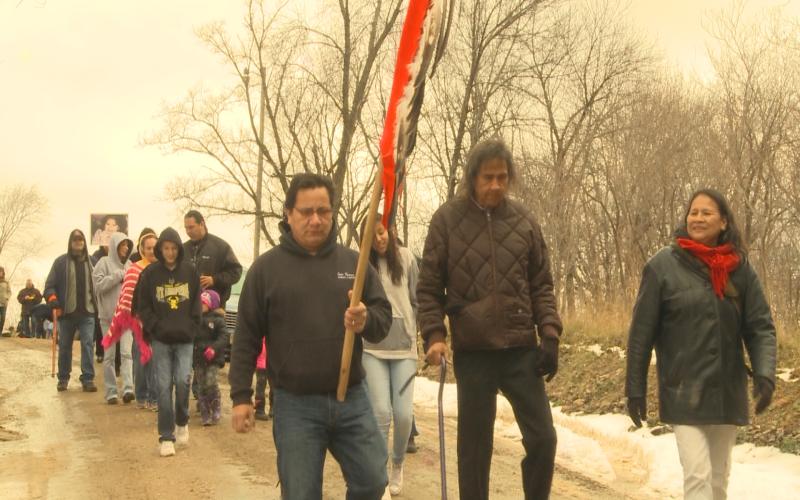
Annual march honors Native American children in foster care

SIOUX CITY, Iowa (KTIV) -
For 13 years, a walk through the streets of Siouxland has brought together the community to honor a special group of people.
"The March To Honor Lost Children" recognizes Native American children and other children tribal members say have been lost to foster care and adoption.
There are three children who have been honored throughout the years who died under foster care.
Larissa Star and Hannah Thomas died about 15 years ago.
Nathaniel Saunsoci was a 20-month-old who died in 2006.
He sustained severe head injuries while living in a foster home in South Sioux City.
Wednesday, was a day of remembering those three children and others in the foster care and adoption system.
The morning began with a prayer of hope for a group of people looking to bring awareness about the issue of Native American children who are "lost" in the adoption or foster care system.
"Somebody is going to see this today, a child is going to look at this, a child who feels abandoned and isolated and they're going to see this group. And it's going to make them feel good," said Frank LaMere, organizer of the March to Honor Lost Children.
LaMere has organized the event since the beginning and he says some children who aren't with their biological families will see this and hopefully reconnect with them.
One family hoping to reconnect with their loved one through the march was Delphine O'Connor and her son Michael.
Delphine says her granddaughter Maria Helena Flores was taken into foster care nearly 20 years ago.
She says during that time, an injury caused Maria to become quadriplegic.
"I would consider her lost as one of the lost children and in our family since we don't have that contact with her and I relate to that to a lot of our families out there right now," said Michael O'Connor, a member of the Yankton Sioux Tribe.
Maria's story was just one of many shared by the marchers Wednesday morning.
Organizers say this wasn't only a day to remember those who are lost, but also for future generations.
"There's still disproportionate numbers of our children in foster care," said LaMere. "Disproportionate numbers of our children are being adopted. And I think that we need to be vigilant, elevate the discussion."
For the marchers, spreading that message is just one step in their efforts to make change.
There were multiple stops for the marchers along their route Wednesday.
Two of them included the Siouxland Center for Active Generations and the Woodbury County Courthouse.
There were prayers for the children at each stop.
The cold weather did not prevent people from out-of-town from coming to support the cause.
There were people who traveled from Oklahoma City, Des Moines and other areas outside Siouxland to raise awareness.
One man came from Omaha to be a part of the march.
"I feel like people look over this like people look over this a lot," said Peter Janda, an Omaha, Nebraska resident. "I mean it's kinda sad to see what's happening and seeing what's happening to these children and I think that people should take a stand."
Janda says the march signifies so much more than just going on a walk and that it was important for him to participate.

Wednesday, December 9, 2015

Tribes do know best! Rest in Peace, Warrior John Trudell


[click links in tweets]

Saturday, December 5, 2015

The SCARY Culture of Adoption (and the Real ID ACT...)

AMERICAN INDIAN ADOPTEES: The SCARY Culture of Adoption (and the Real ID ACT...:    In March 2007, I gave two workshops on the Culture of Adoption here in western Massachusetts...


This is a repost from this blog but the READ ID ACT is making news again. Adoptees should be very concerned. I am... ...Trace

Thursday, December 3, 2015

Residential School Survivors: graphic testimony (WARNING)


South Dakota Boarding School Survivors detail Sexual Abuse


The Dakota expression for child, wakan injan, can be translated as “they too are sacred,” according to Glenn Drapeau, Ihanktonwan Dakota and a member of the Elk Soldier Society on the Yankton Sioux Reservation in South Dakota.
“To us, children are as pure as the holy, moving energy of the universe,” he says, “and we treat them that way.”

When Native children arrived at Holy Rosary Mission, founded in 1888 at Pine Ridge to help in the religious conversion of the Oglala Lakota, nuns staffing the school described them as having good “morals” and giving “a tenth of the trouble white children cause,” Raymond A. Bucko wrote in Lakotas, Black Robes, and Holy Women (University of Nebraska Press, 2000). Nevertheless, corporal punishment was meted out regularly at Holy Rosary—“apparently without scruple,” according to Bucko—and a primary goal of the school was to cut the children off from their parents, their language and their culture.

Across the nation, in both the secular and church-run schools the federal government required Native children to attend from the late 1800s to the 1970s, the goal was assimilation—“kill the Indian to save the man” was their motto—seemingly at any cost. Court documents filed over the last several years in lawsuits against the boarding schools in South Dakota allege that as recently as the ’70s Native students were beaten, whipped, shaken, burned, thrown down stairs, placed in stress positions and deprived of food. Their heads were smashed against walls, and they were made to stand naked before their classmates. Untold numbers of children died over the century during which the residential schools flourished: some while en route to the institutions or at the schools themselves, and others of exposure and starvation while trying to escape, according to several sources, including the Boarding School Healing Project  [www.boardingschoolhealingproject.org/]. Native parents forced to part with their children came to understand they might never see their youngsters again, and if they did, the children had often become strangers to their own people.

As a cost-saving measure, the federal government eventually turned much of the boarding-school system over to churches, primarily the Catholic Church, which used it to help expand its empire throughout the West. Churches, abbeys, convents and monasteries were built on or near reservations, and religious orders were founded and flourished.

Recent court settlements reveal that the education the Church offered Native children featured not just brutal corporal punishment but also rampant sexual abuse. Some 400 Native ex-students in the Northwest and Alaska recently shared in a copy66-million settlement with the Jesuits’ Oregon Province for  abuse suffered at schools in that region. Canada has set aside copy.9 billion for payments to survivors of its residential schools; more than 20,000 ex-students have submitted claims.
In South Dakota, 100-some former students of the state’s half-dozen so-called Indian Missions have sued the Catholic Dioceses of Sioux Falls and Rapid City since 2003. They’ve also made claims against the religious orders that ran the mission schools and Blue Cloud Abbey, in Marvin, South Dakota, which provided priests and is the final resting place of several alleged predators. They charge that priests, brothers, nuns and lay employees at these institutions raped, sodomized and molested them, often for years. Court documents, including testimony and Church records filed during the lawsuits’ initial phases, contain accusations of bizarre, violent and humiliating sexual abuse, along with the horrific physical abuse described above.

In 2010, South Dakota legislators discussed the Church’s difficulty defending against these many suits and passed a statute—written by a Church attorney and submitted as a “constituent bill”—blocking anyone over 40 from suing an institution, such as the Catholic Church, for childhood sexual abuse, though they may still sue individual perpetrators. (The South Dakota statute of limitations for physical abuse has long expired for the former students.) Since virtually all the Native plaintiffs are over 40 and some of the alleged perpetrators are dead, many observers, including Robert Brancato, director of the South Dakota chapter of Survivors Network of Those Abused by Priests, have accused the legislature of targeting the Native cases. “The law was designed both to make things difficult for Native Americans and to help the Church,” says Brancato. In March 2011, a judge applied the statute to throw out 18 of the South Dakota boarding-school cases; the plaintiffs in those cases have filed appeals with the state’s Supreme Court.
Mary Jane, Patricia and Howard Wanna


Below, former students recall their experiences.
Howard Wanna, 60, is an enrolled member of the Sisseton Wahpeton Oyate, whose homeland straddles North and South Dakota. He has terminal lung cancer and recently celebrated what doctors tell him will be his last birthday.
Wanna and several siblings entered Tekakwitha Orphanage, in Sisseton, South Dakota, around 1956. Despite the institution’s name, there were few orphans among the approximately 150 American Indian children housed there at any one time. Some had been taken from their parents for reasons that were not fully; others, like the Wanna children, were placed there by desperately poor parents who believed the priests and nuns they revered would care for and educate their offspring.
When Wanna lived at Tekakwitha, the wooded, estate-like complex included a Southwest Mission-style church; the Papoose House, a nursery for children ranging in age from newborns to five-year-olds; dormitories for boys and girls aged 6 to early teens, with nuns and priests living upstairs; and a separate house for the priest in charge, John Pohlen.

Here is Wanna’s story:
“When I first arrived at Tekakwitha at age four or five, the nuns and priests seemed welcoming, as though they wanted me to think of the place as my home. This friendliness went on for several weeks. Then one day, Father Pohlen came to the Papoose House, where I was living, and took me by the hand. He led me to the church, where we went behind the altar to a little room that had nothing in it but a chair.
“Father Pohlen sat me down, unzipped his pants, took his penis out, and began to wipe it on my face and lips. I was terrified. I didn’t know what was happening. In later sessions, sometimes behind the altar and sometimes at his house, suddenly I’d be choking and something would be running out of my mouth. He’d also turn me around and rape me, hurting me badly as he used his hands to grip my hair, neck, or shoulders.
“He rotated among about five of us younger boys, which left me with such confused emotions. On days it wasn’t my turn, I was so grateful, yet I felt terrible that one of my little friends was suffering. I also dreaded the fact that my day was coming again soon. Worst of all, I had no one to turn to, not even God, because God’s representative on earth was the one hurting me.
“Soon a nun began to abuse me as well, placing me under her gown and rubbing my little hands between her legs. This was something the nuns did to other children there, too. It was horrifying, not just because of what she was doing but because it was dark and I couldn’t breathe. Other abuse included beating us with sticks, hoses, and even a metal shovel.
“The cruelty was strangely inventive. At bath time, we’d line up, a line of naked girls and a line of naked boys, which was embarrassing to begin with. We’d take turns jumping into a laundry tub and being scrubbed—scratch, scratch, scratch—with a stiff brush you’d use for floors. We’d then hop out of the tub with scrapes all over our bodies.
“Once, after I tried to run away, I had to wear a dress for a while, and when we went outdoors I was tied to a tree.
“Tekakwitha was a very quiet place. You’d think with all those children, there’d be noise and laughing. But so many of us were being abused and simply didn’t talk. We were too frightened. It was like a horror movie in which people walk by each other but can’t communicate.
“As the years went by, my abuse lessened, probably because I wasn’t a cute little toy anymore, but also because I became more outspoken. I remember being told I was a smart-ass. When I was 8 or 9—we had no sense of time, because at Tekakwitha there were no markers, like birthday celebrations—my mother got wind of what was going on and came and ranted and raged. I heard they told her something like, ‘Take the little bastards,’ and we left.
“My adulthood was one hell of a struggle. But I fought through my failures and obstacles, went to college, and owned a restaurant and a construction company.
“[I believe] the Church caused the drinking and other problems former students experience. As a result, the tribe must sponsor chemical-dependency, suicide-prevention, anger-management, and many other programs, which is an enormous economic burden. At Sisseton Wahpeton, we just had three suicides, all youngsters in their 20s, and this happens frequently. Why? It’s the result of how we elders were treated as children—an effect that continues through the generations.
“I often wonder how so many pedophiles ended up at Native American schools. Father Pohlen was not only a pervert; he also hired the worst of the worst, which meant none of the Tekakwitha staff would protect us from the others. How did he find them? Is there someone in the Church you can call to request problem priests and nuns? Was there a dual plan to hurt Native Americans while taking care of the pedophiles? Was this genocide? It’s so confusing, but it’s also just plain evil.
“When the orphanage was demolished in 2010 [because of Environmental Protection Act issues], my relatives and I went to watch. Suddenly, during the demolition, we saw three eagles circling overhead, rising up and flying down low repeatedly for about 45 minutes. They had come to take home the spirits of the children. It was so awesome.
“I have sued the Church over my abuse, but because of my cancer I’m going to die with this on my mind, well before any chance of receiving justice. The people we looked up to most as children failed us. God’s servants blocked our power and took away our spirits. But we’ll get ’em back. By telling our stories, we’re opening a door, and we’re not going to let it shut until we’re done with them. No amount of compensation can cure us or absolve them, but we want our day in court. We want the public to hear what was happening to many Native American children in this country while non-Native people lived peacefully in their cities and towns and on their farms. Millions don’t know what we went through, and they need a quick history lesson. It’ll be a hard one, but it’s a fact.”
Mary Jane Wanna Grotto


In 1946, when she was just three months old, Mary-Catherine Renville, 65, of the Sisseton Wahpeton Oyate, was taken from her mother for reasons that remain unclear and placed in Tekakwitha Orphanage. After Tekakwitha, which went through junior high, she was sent to a boarding school in Nebraska.
Here is Renville’s story:
“All I remember of my earliest years at Tekakwitha was being hungry and a punishment that consisted of being placed in a dark crawl space. When I was 6, they moved me from the Papoose House for babies to the main building so I could start school. The nuns there would take us to their private quarters and do things to our bodies that even at that young age I knew were not right.
“The next year, a teenaged boy raped me. He said if I told, he’d bring other boys, and they’d all rape me. I was so frightened that I never did say anything.
“When I was 8 or 9, Father Pohlen placed me with a Michigan family. I understood it was a tryout for being adopted by them. I have a memory of being told to go get Vaseline, then returning to the room to find the boys and men in the family waiting for me. This lasted for a summer.
“I didn’t know where to turn or who to tell. Father Pohlen had placed me with the family, so I couldn’t confide in him, and the nuns were so cold—they didn’t care about our feelings and showed us no affection. They wanted our souls and to teach us to fear God. Sometimes they’d whip us, holding us with the left hand while using the right to beat us with a rubber hose. None of the adults in my life ever noticed anything about me: whether I’d sustained injuries because of the rapes or mistreatment or if I was afraid.
“When I was about 10, Father Pohlen placed me with a Spanish-speaking dentist, who wanted to teach me his language so I could speak it once he and his wife adopted me and took me to their country. Instead, he raped me and said he wanted to continue his ‘affair’ with me, though I mustn’t tell his wife. After several weeks, I was returned to the orphanage. Again, I never said anything to Father Pohlen or the nuns, other than that I didn’t want to learn Spanish or live with that man. I’d learned that to protect myself I shouldn’t say much.
“We did have good times. At Christmas, we each received a shoebox full of nuts and candy and oranges and another box with trinkets and a doll. Most of us girls traded the dolls for food. We did that because the Mother Superior used to force us to simulate sex with a large doll before abusing us, so we were scared of dolls. Can you imagine putting the fear of dolls into a child’s mind?
“The Nebraska boarding school where I went to high school subjected us to similar physical violence, though no sexual abuse. We all continually tried to escape. We weren’t trying to get home, because we didn’t know where that was. We were completely disoriented. We just took off and took our chances in the world, hitchhiking down the road. Then they’d find us and bring us back.
“As an adult, I’ve been a traveler. I’ve lived in 14 states, mostly waitressing, because it’s a job you can get quickly. I’d always move on, though. I think I was searching for family. I eventually had three children, who were taken from me or I gave up. I don’t know where my boys are, though I keep in touch with my girl. Now, I’m back living on my reservation, which sometimes feels like a foreign country, though I’m related to half the people here.
“What I want to do is talk about Tekakwitha. They took away our sense of belonging to anyone, our opportunities to develop relationships. They kept us off-balance by sending us here and there without warning. But they could never take away the truth: that what they were doing was wrong. I want everyone to know what happened to us there.”
St. Pauls Building, Marty, South Dakota


As Sherwyn Zephier, 54, drives to his job at Ihanktonwan Community College, in Marty, South Dakota, where he is the adult education director and teaches math, science, English, art history, and other subjects, he passes the derelict buildings of what was St. Paul’s Indian Mission. During the 1960s and 1970s, he was a student at the Catholic-run school, where children were required to board during the nine-month school year, even though many, like Zephier, were from the surrounding community, the Yankton Sioux Tribe.

Here is Zephier’s story:
“The priests’ and nuns’ keys jangled as they walked, so we knew when they were coming. Everyone in the dorm would quiet down, because you never knew what they’d do. Sometimes they’d bring high school students or more priests and brothers to hold our arms and press our bodies against a metal pole in the center of the room. Then they’d beat us with straps and a two-by-four with handles, which they called the ‘board of education.’
“There were also regular whippings at noon. One day, my older brother, Loren, created a commotion at midday so just that once we little ones escaped the whipping. Because we showered together in one large room, we could always see that many of us were bruised black, blue and purple. The beatings were so frequent, we adapted to the pain and got used to living that way.
“The nuns were as vicious as the priests—real brutes. I remember getting caught in the barbed wire around the top of the little boy’s playground. I’d seen Loren go by and had tried to go over the fence to get to him. Once the nuns got me untangled, I got quite a beating. At night, they’d pretend they’d left us, then stand in the dark corners of the dorm room, eerie in their hooded robes.
“The school was essentially a prison, with every door locked and total control of the children. We went in supervised groups from one secured place to another: to lunch, play, church, the dorm, and so on. Even if you managed to get out of a dorm room or classroom, you couldn’t run far, because at the end of each corridor was a locked floor-to-ceiling gate. The windows were covered with bars or chain-link grates, and the campus had barbed wire everywhere—along sidewalks and even around the church itself.
“As children, we didn’t know their policy was to de-Indianize us. We only knew we enjoyed one another’s company and would play games, such as ‘migs,’ or marbles, that involved phrases in our language. Another student would inevitably run and ‘tell Sister,’ and I would get a beating. At the time, they never explained my infraction. Just recently, the reality hit me hard: it was because I had so frequently spoken my language with my playmates. I suddenly understood why those snitches, often from more assimilated families, ‘told’ and why I was punished so often.
“Another aspect of assimilation was taking away ribbon shirts and other culturally related clothes. Every year, I looked forward to wearing clothing my mother spent most of the summer sewing to make me look proud and colorful for school. But once I got there, those items were removed, and instead I wore clothes that were drab and not even mine.
“The child-molesters would come and go, as the Church rotated them among the Indian missions. We children stood by each other as best we could, but for a child, it was a disturbing, sickening place to be. I have often wondered, where did the nuns and priests learn those things?
“My class, 1975, was the last to graduate from St. Paul’s Indian Mission, which then passed to tribal control and became Marty Indian School. At our commencement, a medicine man, Pete Catches, was allowed for the first time to fill his sacred pipe on the altar and pray with us.
“There’s beauty in our traditional ways. There’s honor, honesty—no lies, no judgment, no exaggeration. It’s the true experience of life. There’s no interpreting of someone else’s words, and no one else interpreting your experience. No one can tell you what is good or bad. That’s where the Church confused a lot of our people, conditioning them to think the traditional way of prayer was evil, the devil’s way. And if you didn’t believe them, they’d beat you.
“After I filed my lawsuit against the Church—with the blessings of my most revered supporter and hero, my father—I started talking about my experience to sisters, brothers and cousins who had also attended St. Paul’s. It was a relief to sit with them—to share and to cry. We knew what we experienced was unfathomable to others.”
Funding for this story was provided by the George Polk Program for Investigative Reporting.

Read more at http://indiancountrytodaymedianetwork.com/2011/07/28/south-dakota-boarding-school-survivors-detail-sexual-abuse-42420

Wednesday, December 2, 2015

New research findings from Casey Family Programs

ICWA Research
Measuring Compliance with the Indian Child Welfare Act. This brief was developed as a resource for states that seek to document compliance with the Indian Child Welfare Act (ICWA).

Improving compliance

Available research, though limited, indicates inconsistent and varying degrees of state compliance with ICWA requirements and sanctions. To address these potential shortcomings, the Department of the Interior has proposed new regulations that would ensure more consistent ICWA implementation in all states — ultimately improving outcomes for American Indian children.


Placement Patterns
Placement Patterns for American Indian Children Involved with Child Welfare. This research brief examines the extent to which the placement patterns of American Indian children in out-of-home care are aligned with the placement preference provisions outlined in ICWA.

We invite you to explore these resources by clicking on the links above or visiting www.casey.org.

Tuesday, December 1, 2015

1676 and Beyond Video Presentation

By Trace Hentz (adoptee and author of One Small Sacrifice)

What has changed?

What hasn't changed?

In the last 400+ years, everything changed.

Indigenous First Nations People (500+ Tribes) went from self-governing sovereign nations, each with their own hereditary chiefs and vast hunting territories which provided them a sense of freedom few of us will ever realize.

Today most reservations are Third World concentration camps. (There are exceptions with some successful tribes who have chosen unique economic methods like gaming and enterprise to uplift and financially support their communities.)

What happened 400+ years ago? Why is this important?  The governments who operated as conquerors wrote numerous treaties and made promises they never intended to keep. Those written promises were not worth the paper they were written on. Those governments led by a Great White Father were not honorable. They were thieves.

Taking children was part of that.

Taking children was traumatizing to entire tribes.

Taking away a future generation left little hope. It ultimately meant the end of entire communities of First Nations people who had no control over what was happening in their own traditional territory.

What most adoptees know is something happened and we had no control over it. But as adults we can take back our control and move forward. We need to find the truth and our names to do that.

We can go home. And we should make every effort to do so.

A few weeks ago, I attended this talk 1676 and Beyond here in Massachusetts. I learned so much about the area where I live now. I live in Pocumtuck Territory. I live near a massacre site called Great Falls. I pray every day for those murdered people and the aftermath and genocide of the Pocumtuck and other tribes in this vicinity.

Everything changed here in 1676.


Another History LESSON on Pilgrims & The Origins of Thanksgiving


Please watch this talk. It's important.

Monday, November 30, 2015

Separating Children from their Tribal Culture

Op-Ed On ICWA from Reps. Cole & McCollum


From The Hill Congress Blog:
Prior to the passage of the Indian Child Welfare Act (ICWA) in 1978, it had become apparent that Native American children were systematically being taken from their homes and either put up for adoption or placed in foster care. The rate at which Native American children were taken was especially alarming to tribal nations that depend on their youth to preserve a truly unique heritage. Further, the disproportionate rate of these separations raised suspicions that they were based less in decisions about the well-being of children and perhaps more about separating youth from their tribal culture. In a repeat of the forced boarding school era, tribal nations were once again being told that to save their children, they had to be removed from their communities and cultures.

Thursday, November 19, 2015

Aboriginal Health in the Aftermath of Genocide

Genocide and the intergenerational trauma that it produces have had a demonstrable effect on the health and wellbeing of Aboriginal peoples.


Excerpt:
The federal government worked closely with mainline Canadian churches, who were together responsible for running most schools until the 1950s. The Catholic Church ran approximately 60 percent, the Anglicans about 30 percent, with the Presbyterian, Methodist, and United Churches running most of the remainder. From 1920 until the 1950s, attendance for children aged five to sixteen was compulsory (Milloy, 1999; Miller, 2004, p. 84; MacDonald, 2007).At least 150,000 children passed through 125 institutions, the last of which closed only in 1996. There are approximately 75,000 Survivors alive today, and many face a myriad of social, economic, and other problems as a result of their experiences, on which this chapter later focuses.
A number of recent studies allege that genocide occurred within the IRS system, claims which this chapter supports (Chrisjohn and Young, 1997; Grant, 1996; Neu and Therrien, 2003; Woolford, 2009; Powell, 2011). The term genocide was coined in 1944 by Raphael Lemkin, who described it as “a coordinated plan of different actions aiming at the destruction of the essential foundations of the life of national groups, with the aim of annihilating the groups themselves” (1944, pp. 27-28). 

The 1948 United Nations Genocide Convention, which flowed from Lemkin’s efforts, defines genocide as follows:
Any of the following acts committed with intent to destroy, in whole or in part, a national, ethnical, racial or religious group, as such:
   (a) Killing members of the group:
   (b) Causing serious bodily or mental harm to members of the group;
   (c) Deliberately inflicting on the group conditions of life calculated to bring about its physical destruction in whole or in part;
   (d) Imposing measures intended to prevent births within the group;
   (e) Forcibly transferring children of the group to another group.


If you can't access this paper, I can send it to you. Email me: tracelara@pm.me

Wednesday, November 18, 2015

Saints and Strangers: Natives on the set (Nov. 22, 23)


Queypo, Trujillo, Means on the set of 'Saints & Strangers.' Courtesy National Geographic Channel.

“Saints & Strangers” is a four-hour, two-night movie event billed as the “real true story of the Mayflower passengers, the founding of Plymouth and their relationship with the Native Americans.” The film, produced by Sony Pictures Television with Little Engine Productions, will air November 22 and 23.


Natives on the Set! Means, Trujillo, Queypo Filming Mayflower Movie in South Africa


National Geographic Channel has released the first photos from the set of Saints & Strangers, a film that tells a more accurate version of the Mayflower/Pilgrims story, and three Native American actors are prominently showcased.

In the still, Kalani Queypo, Raul Trujillo, and Tatanka Means are featured in costume; the trio play, respectively, Squanto, Massasoit, and Hobbamock.

"Saints & Strangers isn’t your grandmother’s Thanksgiving pilgrims story," according to Yahoo News. "National Geographic Channel’s upcoming original four-hour movie event digs deep into Plymouth lore, telling the sometimes-harsh, often-uplifting tale of 101 men, women, and children who crossed the fearsome Atlantic Ocean to settle into the New World."

The three-month shoot is still underway in South Africa. Tatanka Means tells ICTMN that the target premiere date of the four-hour movie event is in November. "The language we will be speaking is Western Abenaki (Eastern Algonquian)," he adds, "and it's being taught by dialect coach and speaker Jesse Bowman Bruchac."


Trujillo (Apache, Comanche, Pueblo and Tlascalan) is one of Indian country's most accomplished actors, having appeared in the films The New World, Apocalypto, Cowboys & Aliens and Riddick. He's also a regular on TV, having appeared in recurring roles on acclaimed series True Blood, Da Vinci's Demons, and Salem. Means (Oglala Lakota, Omaha, Navajo) is known for his co-starring role in Tiger Eyes, and his recurring appearances on Banshee and The Night Shift. Queypo (Blackfeet, Native Hawaiian) can be seen in Slow West, a 2015 Sundance Grand Jury Prize winner. Non-native co-stars include Vincent Kartheiser (Mad Men), Ron Livingston (Band of Brothers) and Ray Stevenson (Rome).

Read more at http://indiancountrytodaymedianetwork.com/2015/07/30/natives-set-means-trujillo-queypo-filming-mayflower-movie-south-africa-161249

CLICK OLDER POSTS (above) to see more news

CLICK OLDER POSTS  (above) to see more news

MEGWETCH THANK YOU

HUGE Thank you for visiting this blog and sharing this with your kin. It's appreciated. Contact Trace anytime! Use the form below.

BOOKSHOP

Please use BOOKSHOP to buy our titles. We will not be posting links to Amazon.

Popular Posts

To Veronica Brown

Veronica, we adult adoptees are thinking of you today and every day. We will be here when you need us. Your journey in the adopted life has begun, nothing can revoke that now, the damage cannot be undone. Be courageous, you have what no adoptee before you has had; a strong group of adult adoptees who know your story, who are behind you and will always be so.

OUR HISTORY

OUR HISTORY
BOOK 5: Lost Children of the Indian Adoption Projects