BACK UP BLOG (no longer updating)

This blog was a backup for American Indian Adoptees blog
USE THE SEARCH BAR or SEARCH TOPICS at bottom of this blog

If you need support

Support Info: If you are a Survivor and need emotional support, a national crisis line is available 24 hours a day, seven days a week: Residential School Survivor Support Line: 1-866-925-4419. Additional Health Support Information: Emotional, cultural, and professional support services are also available to Survivors and their families through the Indian Residential Schools Resolution Health Support Program. Services can be accessed on an individual, family, or group basis.” These & regional support phone numbers are found at https://nctr.ca/contact/survivors/ . MY EMAIL: tracelara@pm.me

Search This Blog

Tuesday, January 27, 2015

Brewing Controversy: Genetic Testing and Tribal Identity

Why many Native Americans have concerns about DNA kits like 23andme

Havasupai man in front of sweat lodge, 1924 ( NPS/Flickr )
The genetic sequencing company 23andMe recently tapped into its vast bank of data to release a study on genetic origins, producing the biggest genetic profile of the United States ever conducted—big, but nowhere near complete.

Out of more than 160,000 genomes, only 3 percent of 23andMe customers who authorized their data for the study were black, compared with the approximately 14 percent of the United States population who identifies as such. And while the paper traced what percent of white, black, and Latino customers’ ancestry led back to Native Americans, there were no users, as far as the paper reported, who self-identified as native people.

There are a lot of reasons for this. The service isn’t free, and not everyone wants—or can afford—to shell out $99 to learn about their ancestry. But when it comes to Native Americans, the question of genetic testing, and particularly genetic testing to determine ancestral origins, is controversial.
In the past decade, questions of how a person's genetic material gets used have become more and more common. Researchers and ethicists are still figuring how how to balance scientific goals with the need to respect individual and cultural privacy. And for Native Americans, the question of how to do that, like nearly everything, is bound up in a long history of racism and colonialism.

* * *
In many ways, the concerns that Native Americans have with genetic testing are the ones most people have: Who will be using this data, and for what?
 
Today, DNA can tell us a little about a lot of things, from disease risks to ancestral history. But ultimately it’s pretty limited. In fact, 23andMe was recently chastised by the FDA, which claimed the company was overselling the predictive power of their test for medical use. But in the future, that same little sample of DNA could be used for purposes that haven't even been dreamed up yet. People might be okay with their DNA being used to research cures for cancer, or to explore their own genetic history, but balk at it being used to develop biological weapons or justify genocide.

These are questions that anyone who gives their genetic material to scientists has to think about. And for Native Americans, who have witnessed their artifacts, remains, and land taken away, shared, and discussed among academics for centuries, concerns about genetic appropriation carry ominous reminders about the past. “I might trust this guy, but 100 years from now who is going to get the information? What are people going to do with that information? How can they twist it? Because that’s one thing that seems to happen a lot,” says Nick Tipon, the vice-chairman of the Sacred Sites Committee of the Federated Indians of Graton Rancheria, an organization that represents people of Coast Miwok and Southern Pomo descent.

Another reason many tribes struggle with a scientist asking for a DNA sample involves the DNA collection process. Namely, that it requires removal of some piece of the body. In the living, this may seem simple: a swab of the cheek or a quick blood sample. But for scientists who want to study historical DNA, they have to remove a piece of the dead body. It’s a small piece, but DNA analysis is almost always destructive. This, again, isn’t a specifically tribal issue, as Tipon points out. “How would current people feel if their great-great-grandfathers were dug up and their bones were destroyed during testing to prove a theory?” he asked. “Rest in peace means forever, not to be disturbed, not to be studied, unless they consented to that.”

Some of the questions geneticists seek to answer are also provocative among Native Americans. The first is the issue of migration: Where did different people come from? Who colonized the United States first? Where did they go once they arrived? These are questions that archaeologists and geneticists are really interested in because they help paint a picture of how migrations patterns occurred in the United States before white settlers arrived, and how European settlement changed things.
But figuring out where your ancestors came from becomes complicated when it entails a legacy of exclusion of displacement. Tribes each have important cultural histories, that include their origin stories. Many of their histories say that the tribe came from the land, that they arose there and have always lived there. And many of them have more modern histories that include white settlers challenging their right to live where they did. 

So to many tribal people, having a scientist come in from the outside looking to tell them where they’re “really” from is not only uninteresting, but threatening. “We know who we are as a people, as an indigenous people, why would we be so interested in where scientists think our genetic ancestors came from?” asks Kim Tallbear, a researcher at the University of Texas at Austin, the author of Native American DNA: Tribal Belonging and the False Promise of Genetic Science, and a member of the Sisseton-Wahpeton Oyate tribe.

Tallbear says that from her perspective, researchers offering to tell tribes where they’re from doesn’t look any different than the Christians who came in to tell them what their religion should be. “Those look like very similarly invasive projects to us,” she said. Tribes haven’t forgotten the history of scientists who gathered native skulls to prove that native people were less intelligent, and thus less entitled to the land they lived on than the white settlers. To them, these genetic questions of origin look pretty similar.
KEEP READING

Monday, January 26, 2015

Broken: Trauma Bonding? #flipthescript #validvoices


trau·ma   
A serious injury or shock to the body, as from violence or an accident. An emotional wound or shock that creates substantial, lasting damage to the psychological development of a person, often leading to neurosis. An event or situation that causes great distress and disruption. 


By Trace Hentz (adoption survivor)

After many years, in many quiet moments, I recognize that adoption has affected me very deeply.   
In my case, the day my mother left me, how she never came back, my world changed.  All I knew as this newborn baby was my own mother was not holding me, nursing me, talking to me. I was devastated by that. Broken. Part of my brain shut down. That pain was too much.

That very early experience needed to be processed as stress and trauma much later as an adult.  No one explained this to me, not even a doctor. As an adult I understand that a church/adoption agency places an infant with new parents and society says this is good and permanent. Good? Good for who?

Years pass and I accept this happened to me and my early trauma scars me.  

This monumental loss of my mother cracks me open and I am left to survive it, or not.  No one explains that I need to grieve this. I figure it out.  After years pass, I finally understand.  This experience affected me in complex ways.  This pain has layers and layers and layers.

But for others to tell me adoption was good for me? What? Or how I need to accept this is "adoption." Accept it? Are they kidding?  My scars are invisible but they are there. I know they are there.

How Catholic Charities took possession of me, handled me, first placing me in an orphanage then foster home, with no regard for my physical health, or my trauma-ridden emotional body, this speaks to the inhumanity of child trafficking and the traumatic consequences of adoption for the infant.  This speaks to the inhumanity of the deadly colonization of Indigenous people whose children were taken from them, calling us stolen generations. This speaks to a society that only sees what it wants to see.
Once adopted, you’re erased, an outsider, a stranger to your own nation, lands and people. I prefer to think of my younger self as brainwashed.

The bonding I had made with those mystery foster parents was also broken. How Catholic Charities and other churches and adoption agencies did this to millions of babies has consequences. This leaves millions of adoptees in the state of trauma, a stranger being raised by strangers, and a stranger to your first family.

Adoption is a cruel and inhumane way to treat an infant. A very sick society would do this.  And removing me from my own mother affected me in ways that are now measured and defined as post-traumatic stress disorder, or reactive attachment disorder, or severe narcissistic injury...and this explains how I was unable to bond with my adoptive parents.

What’s Trauma Bonding? What is Complex PTSD? (traumaanddissociation.wordpress.com) 


"When a mother is forced to choose between the child and the culture, there is something abhorrently cruel and unconsidered about that culture. A culture that requires harm to one's soul in order to follow the cultures prescriptions is a very sick culture indeed. This 'culture' can be the one a woman lives in, but more damning yet, it can be the one she carries around and complies with within her own mind....." -- Women Who Run With The Wolves by Clarissa Pinkola Estes 


Wednesday, January 21, 2015

The bizarre ESP experiments conducted on aboriginal children without parental consent

January 16 Washington Post

Canada’s residential schools for aboriginal children were places of hunger, isolation and misery. Children as young as 3 were separated from their families and became wards of the state.

In the 1940s, the children were also, as more and more evidence is revealing, the unwitting subjects of bizarre, cruel and unethical experimentation.

A recently uncovered experiment reveals the depths of the access given to so-called researchers seeking to find evidence that aboriginal children, by dint of their race, had extrasensory perception, also known as ESP, or a “sixth sense.”

Fifty children at the Indian Residential School in Brandon, Manitoba, became the subjects of a series of tests that sought to establish a new measure for identifying ESP and also to find evidence of supernatural abilities of “primitive” people.

As was typical for the time, there was no parental consent. But the children, ranging from ages 6 to 20, likely participated “willingly,” as the study claims, eager for candy that might stave off their persistent hunger.

The study was conducted for researchers at what was then known as the Duke Parapsychology Laboratory; the findings were published in the Journal of Parapsychology in 1943.

“The bare fact that American Indians have shown ESP ability is not surprising enough to deserve great emphasis,” the study’s author wrote.

The study was recently uncovered by Maeengan Linklater, an aboriginal community worker, who forwarded it to  Ian Mosby, a researcher at McMaster University.

KEEP READING

Saturday, January 17, 2015

Trauma Change Resilience


Trauma can be incurred in many different ways. This is only now becoming understood. Our culture has trauma and abuse that is often not recognized. There is, of course, too the sort that is obviously heinous and ugly. It can all impact the general well-being of those subjected to it.
As a social worker working with “the seriously mentally ill” for many years, I never came upon someone who didn’t have fairly severe traumas in their histories. Yes, I can say those who I encountered who were in that particular labeled segment had a solid 100% rate of trauma in their histories. Mental illness in large part is a reaction to trauma. It’s quite simple really. When we start listening to people’s stories of pain rather than numbing them out and effectively silencing them with neurotoxic drugs we will start healing them. Until then people will remain broken. One of the most basic needs for a wounded human being to heal is to be seen. Recognized. Validated. Yes.

There is a drive to not only survive but to thrive.
 
A very beautiful and profound talk and message.


Without appropriate care and integration trauma changes both our bodies and minds for many years and sometimes for our entire lives. Right now the mental health system knows virtually nothing about how to care for people who have been traumatized and in fact often traumatizes them further. It’s downright dangerous to subject a traumatized person to most social services. This is a tragedy that has to end.
The woman in the above video is not alone in knowing how to approach those traumatized. We need this sort of empathic and loving care system wide.

See also: Mental illness, addiction & most chronic physical illness is the result of childhood loss & trauma

More posts on trauma, PTSD and recovery.

Recovery stories too, right here — people get better all the time

Friday, January 16, 2015

Indiana OBC rights to access underway

READ HERE
Indiana records for adoptions between 1941 and 1993 are sealed.
State law requires written consent from a birth parent and adoptee to release identifying information, but all adoptions from Jan.1,1994 and on are open, unless a birth parent files a "non-release" form with the state.
If lawmakers approve this idea, it would make Indiana the 14th state to make its sealed adoption records open to adult adoptees.
The idea now heads to the full senate for consideration.

National Council for Adoption ICWA 101 Webinar: January 22


Here.

ICWA 101: Understanding and Implementing the Indian Child Welfare Act

An exciting new webinar for Adoption Professionals on Understanding and Implementing ICWA.

National Council For Adoption presents the National Indian Child Welfare Association's Addie Smith in a discussion highlighting key provisions of the Indian Child Welfare Act (ICWA). This presentation will focus specifically on ICWA’s requirements related to private and public adoptions. Tips on effective implementation of the law and best practices when working to protect Native children and families will be covered.
ICWA 101 will be the second edition of NCFA’s Foundations of Adoption, a series designed to provide up-to-date best practice training on the essentials of adoption.
Join us Thursday, January 22nd at 2pm EST for a two hour presentation with time for questions and answers with our esteemed presenter. Registration cost is $35 for NCFA Members and $40 for the Public. $15 for CEU.

About the Presenter

Adrian (Addie) Smith is trained in both law and social work. She has worked in numerous capacities on the front lines with children and families in the mental health, child welfare, and juvenile justice systems. As a government affairs associate at the National Indian Child Welfare Association (NICWA), Addie works closely with tribes, tribal organizations, and mainstream child advocacy organizations to develop and promote policy that supports the well-being of American Indian and Alaska Native children and families and strengthens tribal child welfare and children’s mental health systems. In this role she also works closely with tribes, states, and the federal government to promote improved Indian Child Welfare Act compliance and implementation. She monitors court decisions that affect American Indian and Alaska Native children and families, provides consultation to attorneys, and, when appropriate, works with partner organizations on litigation strategy and amicus briefs.


Webinar Archive

Webinars in this archive may have been recorded. For more information on a webinar session, contact Erin Bayles at ebayles@adoptioncouncil.org or 703-299-6633.

Thursday, January 15, 2015

Indigenous Adoptees Gathering August 2015

The Ottawa IAG Committee has chosen a beautiful campsite about 40 minutes out of Ottawa that has rustic cabins, a rec hall,a full kitchen, a gated pool and plenty of outdoor space for games & cultural activities. that will include sweat lodges, sharing circles and many more.

cabinfield campaerial campfire

There is room for tent trailers and also traditional tents for camping.

This event will be open to  Indigenous Adoptees/ Foster Care Survivors and their immediate family members.

Stay Tuned for more updates as  fundraise and plan for a fun memorable gathering in 2015!


Wednesday, January 14, 2015

Going Home


By Trace Hentz


Maybe it is too much to expect for our adoptive parents to understand that we (adoptees) have our own biology and our own lifepath to follow.  Even if they raise us and give us EVERYTHING, they cannot and will not ever replace our family of origin. They simply can't.


We adoptees should not be "expected" to remain their child our entire life. We simply can't.


"Going home" will not be easy for adoptive parents to hear or accept. That is not what was promised - if they raised us, if loved us, they somehow believe that is the equivalent of property, ownership, meant for a lifetime.


Sad to say, adoption is not that. It's only temporary.


Laura Klunder in Seoul. She had her adoption case number tattooed on her arm.

Credit
Mark Neville for The New York Times


READ:


Why a Generation of Adoptees Is Returning to South Korea


By MAGGIE JONES


A movement raises soul-searching questions about international adoption.


Going Home

By Trace Hentz

Maybe it is too much to expect for our adoptive parents to understand that we (adoptees) have our own biology and our own lifepath to follow.  Even if they raise us and give us EVERYTHING, they cannot and will not ever replace our family of origin. They simply can't.

We adoptees should not be "expected" to remain their child our entire life. We simply can't.

"Going home" will not be easy for adoptive parents to hear or accept. That is not what was promised - if they raised us, if loved us, they somehow believe that is the equivalent of property, ownership, meant for a lifetime.

Sad to say, adoption is not that. It's only temporary.


Laura Klunder in Seoul. She had her adoption case number tattooed on her arm. Credit Mark Neville for The New York Times
READ:

Why a Generation of Adoptees Is Returning to South Korea

By MAGGIE JONES

A movement raises soul-searching questions about international adoption.


Going Home

By Trace Hentz

Maybe it is too much to expect for our adoptive parents to understand that we (adoptees) have our own biology and our own lifepath to follow.  Even if they raise us and give us EVERYTHING, they cannot and will not ever replace our family of origin. They simply can't.

We adoptees should not be "expected" to remain their child our entire life. We simply can't.

"Going home" will not be easy for adoptive parents to hear or accept. That is not what was promised - if they raised us, if loved us, they somehow believe that is the equivalent of property, ownership, meant for a lifetime.

Sad to say, adoption is not that. It's only temporary.

Laura Klunder in Seoul. She had her adoption case number tattooed on her arm. Credit Mark Neville for The New York Times
READ:

Why a Generation of Adoptees Is Returning to South Korea

By MAGGIE JONES

A movement raises soul-searching questions about international adoption.


Going Home

By Trace Hentz

Maybe it is too much to expect for our adoptive parents to understand that we (adoptees) have our own biology and our own lifepath to follow.  Even if they raise us and give us EVERYTHING, they cannot and will not ever replace our family of origin. They simply can't.

We adoptees should not be "expected" to remain their child our entire life. We simply can't.

"Going home" will not be easy for adoptive parents to hear or accept. That is not what was promised - if they raised us, if loved us, they somehow believe that is the equivalent of property, ownership, meant for a lifetime.

Sad to say, adoption is not that. It's only temporary.

Laura Klunder in Seoul. She had her adoption case number tattooed on her arm. Credit Mark Neville for The New York Times
READ:

Why a Generation of Adoptees Is Returning to South Korea

By MAGGIE JONES

A movement raises soul-searching questions about international adoption.


Going Home

By Trace Hentz

Maybe it is too much to expect for our adoptive parents to understand that we (adoptees) have our own biology and our own lifepath to follow.  Even if they raise us and give us EVERYTHING, they cannot and will not ever replace our family of origin. They simply can't.

We adoptees should not be "expected" to remain their child our entire life. We simply can't.

"Going home" will not be easy for adoptive parents to hear or accept. That is not what was promised - if they raised us, if loved us, they somehow believe that is the equivalent of property, ownership, meant for a lifetime.

Sad to say, adoption is not that. It's only temporary.

Laura Klunder in Seoul. She had her adoption case number tattooed on her arm. Credit Mark Neville for The New York Times
READ:

Why a Generation of Adoptees Is Returning to South Korea

By MAGGIE JONES

A movement raises soul-searching questions about international adoption.


Going Home

By Trace Hentz

Maybe it is too much to expect for our adoptive parents to understand that we (adoptees) have our own biology and our own lifepath to follow.  Even if they raise us and give us EVERYTHING, they cannot and will not ever replace our family of origin. They simply can't.

We adoptees should not be "expected" to remain their child our entire life. We simply can't.

"Going home" will not be easy for adoptive parents to hear or accept. That is not what was promised - if they raised us, if loved us, they somehow believe that is the equivalent of property, ownership, meant for a lifetime.

Sad to say, adoption is not that. It's only temporary.

Laura Klunder in Seoul. She had her adoption case number tattooed on her arm. Credit Mark Neville for The New York Times
READ:

Why a Generation of Adoptees Is Returning to South Korea

By MAGGIE JONES

A movement raises soul-searching questions about international adoption.


Tuesday, January 13, 2015

First Nation woman's plea to locate adopted brother goes viral

SOURCE

After a decade of searching, Natashia Francois hopes Facebook post will bring answers

Jan 12, 2015 Maggie Moose, CBC News

Natashia Francois has spent half her life not knowing she had an older sibling and the other half trying to find him. The 27-year-old mother of four, from Nelson House First Nation, found out she had an older brother more than 10 years ago.
“I was surprised. I was shocked. I didn’t expect to hear that I had an older brother,” she said.
Francois's mother, Maria Goretti Bighetty, was just 15 when she gave up her son Christopher. Before she passed away, she told her daughter that she attempted to find for him but nothing came out of it.
All Francois knew about her brother is that Christopher Bighetty was born in Winnipeg on July 16, 1979.  This past May Natashia filled out an adoption registry form and last month she found out her brother's adoption was finalized in Ontario.
Natashia recently took to social media to help her in this search, with a post which has garnered over 1,500 shares. In the photo she is seen holding up a sign saying, ”I'm trying to locate my brother who’s birth name is Christopher Basil Bighetty."
So far she has got word from a man in Calgary claiming to know of a Christopher Bighetty who recently moved from Ontario, but he has not gotten back to her with any more information.
Francois recently lost her mother, father and a brother, fuelling her desire to connect with her long lost brother.
“It would be such a great blessing for him to be with us after so many years of wanting to find him. And for the day to come would mean the world and so much more to our family," she said.

Monday, January 12, 2015

50 Reasons: Why are you so angry #adoption

I am angry about lots of things like the list above...Trace

Adoptees, Why Are You So Angry?

I asked one simple question, “WHY ARE YOU ANGRY?” over 50 adoptees chimed in. Here are their responses:
...Because anger gives me energy to handle all the hurts, if I were to just feel my sadness I would fall into a depression. A bit of anger helps me keep my head above water to fight for adoptions laws to change for adoptions to be open, ethical and more support services. I work in adoptions because I am angry with people not doing adoptions correctly and I want to be a part of the solution and help change, influence those around me. I am angry because I did not get a say, my loss was and still not validated. I still don’t get a say. Reunion 24 years. Adoptive parents died 20 years ago; yet I cannot unadopt myself. I cannot legally be my mother’s daughter or my father’s daughter. This makes me angry that I do not have the same self-determination than non-adoptees.


...My parents adopted me, and then treated me like shit. People always ask me “Why did they adopt you?” It’s the million dollar question. The closest I could come to was that I was a lemon for them and they had buyer’s remorse. For some reason I still hung on, from the fringes and it wasn’t until I read this page that it occurred to me that I could simply let go and just walk away from the pain of being an outcast in my adoptive immediate family. I haven’t yet let go, and maybe I won’t but it really sucks to feel like you were rejected twice and still feel a connection to people who for all intents and (insensitive) purposes…don’t want me. It does give me some measure of comfort that at some point, should I chose to I can decide to divorce my family and just be me, not defined by them and all that I endured as their “Mistake.”

Many Blessings to all, and thanks for reading!
Pamela Jones AKA @freesimplyme
http://www.facebook.com/howdoesitfeeltobeadopted
For any adoptees who read this that would like to be added to this poll, feel free to email me at adopteeinrecovery@gmail.com

Friday, January 9, 2015

Turtle Talk: Adoptive Couple v. Baby Girl #BabyVeronica

SOURCE

Baby Girl Materials, A Work in Progress . . .(will be updated)


Veronica with her parents Robin and Dusten Brown
Primary Sources
SCOTUS Opinion
Amicus Briefs in Adoptive Couple v. Baby Girl 
Birth Father and Cherokee Nation Briefs
South Carolina Opinion

Cases that cite Adoptive Couple v. Baby Girl
In re S.B.C. (Mont. 2014) (terminating father’s parental rights in an involuntary proceeding)
Native Villiage of Tununak v. State (Alaska 2014) (holding that the adoption preferences of ICWA didn’t apply if the preferred placement didn’t “formally” move to adopt the child)
In re J.S. (Mont. 2014) (applying the “continued custody” reasoning to a guardianship)
In re Elise W. (Cal. App. 2014)(discussing whether the case would change notice requirements when a parent never had custody)(unpublished case out of California’s First District)
In re T.S. (Okla. App. Ct. 2014)(discussing when active efforts must start, in light of 1922 and 1912(d))

Law Review and Bar Journal Articles
Jane Burke, The “Baby Veronica” Case: Current Implementation Problems of the Indian Child Welfare Act
Kristen Carpenter & Lori Graham, Human Rights to Culture, Family, and Self-Determination: The Case of Adoptive Couple v. Baby Girl
Christopher Deluzio, Tribes and Race: The Court’s Missed Opportunity in Adoptive Couple v. Baby Girl
Shreya A. Fadia, Adopting “Biology Plus” in Federal Indian Law: Adoptive Couple v. Baby Girl’s Refashioning of ICWA’s Framework
Harvard Law Review, Indian Child Welfare Act — Termination of Parental Rights — Adoptive Couple v. Baby Girl
Jessica Di Palma, Adoptive Couple v. Baby Girl: The Supreme Court’s Distorted Interpretation of the Indian Child Welfare Act of 1978
Carrie Garrow & Michelle E. Hollebeke, Adoptive Couple v. Baby Girl: A Summary
Alyosha Goldstein, Possessive Investment: Indian Removals and the Affective Entitlements of Whiteness
Robert S. Ingram III, Charleston Adoptive Couple Impacts Federal Adoption Law: Supreme Court of the United States Clarifies Parental Rights Under ICWA
Dustin C. Jones, Adoptive Couple v. Baby Girl: the creation of second-class Native American parents under the Indian Child Welfare Act of 1978
Jack Trope, Understanding the Supreme Court’s decision in Adoptive Couple v. Baby Girl
Marcia Zug, Two-And-A-Half Ways to Destroy Indian Law
Marcia A. Zug, The Real Impact of Adoptive Couple v. Baby Girl: The Existing Indian Family Doctrine is Not Affirmed, but the Future of the ICWA’s Placement Preferences is Jeopardized

Wednesday, January 7, 2015

Tuesday, January 6, 2015

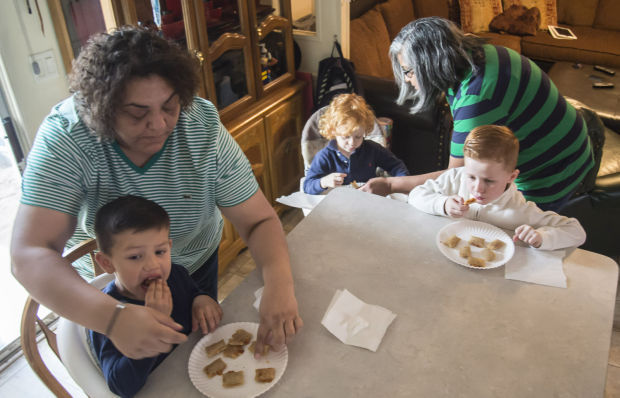
Tucson couple win national adoption award


Milissa Mace and Catalina Garcia have been together long enough that they finish each other’s sentences, and they embody the axiom that opposites attract.


As parents to four boys, Mace’s warmth and outgoing nature are complemented by Garcia’s quiet and receptive approach.


When it comes to discipline, “we balance it out, so that way there’s not a good mom and a bad mom. We’re even,” Mace said.


 This year, the couple of 20 years received the national Angels in Adoption award for opening their home to more than a dozen foster children from the Pascua Yaqui reservation and the Tucson area,

four of whom they have adopted.


Mace and Garcia, who is a member of the Pascua Yaqui Tribe, said they were humbled and honored by the award. “Being acknowledged makes us really proud of who we are,” Mace said. In September, the couple traveled to Washington, D.C., to receive their award, making tourist stops between meeting with legislators and adoptive families. They were among 127 national recipients of the award, given annually by the nonprofit Congressional Coalition on Adoption Institute in Washington.


read more: Tucson couple win national adoption award


CLICK OLDER POSTS (above) to see more news

CLICK OLDER POSTS  (above) to see more news

MEGWETCH THANK YOU

HUGE Thank you for visiting this blog and sharing this with your kin. It's appreciated. Contact Trace anytime! Use the form below.

BOOKSHOP

Please use BOOKSHOP to buy our titles. We will not be posting links to Amazon.

Popular Posts

To Veronica Brown

Veronica, we adult adoptees are thinking of you today and every day. We will be here when you need us. Your journey in the adopted life has begun, nothing can revoke that now, the damage cannot be undone. Be courageous, you have what no adoptee before you has had; a strong group of adult adoptees who know your story, who are behind you and will always be so.

OUR HISTORY

OUR HISTORY
BOOK 5: Lost Children of the Indian Adoption Projects