BACK UP BLOG (no longer updating)

This blog was a backup for American Indian Adoptees blog
USE THE SEARCH BAR or SEARCH TOPICS at bottom of this blog

If you need support

Support Info: If you are a Survivor and need emotional support, a national crisis line is available 24 hours a day, seven days a week: Residential School Survivor Support Line: 1-866-925-4419. Additional Health Support Information: Emotional, cultural, and professional support services are also available to Survivors and their families through the Indian Residential Schools Resolution Health Support Program. Services can be accessed on an individual, family, or group basis.” These & regional support phone numbers are found at https://nctr.ca/contact/survivors/ . MY EMAIL: tracelara@pm.me

Search This Blog

Saturday, December 3, 2011

Movie Review: The Italian (5 STARS)


MOVIE TRAILER is not available


I was asked to introduce this movie THE ITALIAN at Common Ground, the 3rd Middletown International Film Festival on November 10th at the Russell Library in Connecticut. After the movie, I explained that I was also placed in an orphanage then foster care before I was adopted. I told them this movie is based on a true story.

This feature movie is everything I hoped it would be - truthful, complex and forthright.

The setting, a Russian orphanage, is exactly as I imagined, with children parenting each other, the older ones creating a system of providing for the younger ones (by any means necessary, including prostitution) and a corrupt bureaucracy that sells the younger children (let's not call them orphans because they do have parents) to rich buyers who they solicit to adopt.

What unfolds is Vanya (age 6) is slated to be sold to a rich Italian couple and is paraded to them exclusively.

Soon after he has an encounter with a friend's mother; the women is looking for her son from the same orphanage who was adopted to Italy.

You can see clearly how this mother's visit infects all the children with hope and possiblities, especially Vanya.

What happens?

Vanya goes looking for information to find his mother. First he has to learn to read and then find his file locked in a safe. And after a chase and many tense moments, Vanya actually finds her, his mother.

The light on his face - and the shine that returns to his eyes - is why I highly recommend this film.

For anyone interested in the topic of international adoption, this movie will shape attitudes to close such orphanges worldwide, end all international adoptions, treat all children with more respect, address poverty, allow women to keep their babies and children (even unmarried) and educate potential adopters who need to recognize these children were made into orphans by goverments and religions.

The moral of this story: unite children with their families.


MY RATING: 5 STARS


Read more:

http://zuguide.com/The-Italian.html

Vanya Solntsev (played by child actor Kolya Spiridonov), an abandoned young boy living in a rundown orphanage in a small Russian village, rebels when he learns that he is about to be adopted by a rich Italian couple. After getting help to read his personal file, Vanya sets off to find his birth mother. Directed by Andrei Kravchuk.

Categories: Drama, Family. Year: 2005.


ANOTHER CLIP: http://youtu.be/FBGjBvXknNw

Russia, Lenfilm, 2005.


Drama.

Writer Andrei Romanov and director Andrei Kravchuk constructed this ingenious, tragicomic tale of a desolate, decaying orphanage in the Russian countryside that sells abandoned kids to prosperous Western Europeans. The adults running the operation live in a haze of greed and alcoholic self--pity; the fatalistic elder orphans are thugs and hookers who accept crime and brutality as their only option in life. In this Dickensian world, nine--year--old Vanya is adopted by an Italian family. With a loving family and freedom in a new country on the horizon he is the envy of his fellow orphans. Yet rather than accept this new life, Vanya flees in search of his birth--mother and the truth of his past. A dual--award winner at the Berlin Film Festival and the 2005 Russian submission for the Best Foreign Language Film Oscar, The Italian is an elegant and poignant allegory for the moral crisis of Russia's new post--communist generation.


Cast: Nikolay Spiridonov, Marya Kuznetsova, Nikolay Reutov, Yury Itskov, Denis Moiseenko, Andrey Elizarov, Aleksandr Sirotkin, Vladimir Shipov, Polina Vorobjeva, Olga Shuvalova, Dmitry Zemlyanko, Darya Lesnikova, Rudolf Kuld.


Director Andrey Kravchuk.


The Italian - Итальянец

It's a pretty tall order to ask a six-year-old to suddenly take on responsibility for his own life. The questions facing Vanya are really tough: does he want to live a comfortable life as an adopted child of a loving family in Italy? After all, for an abandoned Russian child like Vanya it really doesn't sound like a bad option. Serene life under the Mediterranean sun is awaiting him. But the boy longs to find his own mother, so he decides to set off in search of her. But before he can begin, Vanya must learn to read the file that holds the information he needs to find her. He embarks on his quest--and encounters a mysterious and dangerous world. The world of children is a universe with its own laws; a realm in which sometimes one's heart speaks louder than one's intellect. (YOUTUBE)

Movie Review: The Italian (5 STARS)


MOVIE TRAILER is not available


I was asked to introduce this movie THE ITALIAN at Common Ground, the 3rd Middletown International Film Festival on November 10th at the Russell Library in Connecticut. After the movie, I explained that I was also placed in an orphanage then foster care before I was adopted. I told them this movie is based on a true story.
This feature movie is everything I hoped it would be - truthful, complex and forthright.
The setting, a Russian orphanage, is exactly as I imagined, with children parenting each other, the older ones creating a system of providing for the younger ones (by any means necessary, including prostitution) and a corrupt bureaucracy that sells the younger children (let's not call them orphans because they do have parents) to rich buyers who they solicit to adopt.
What unfolds is Vanya (age 6) is slated to be sold to a rich Italian couple and is paraded to them exclusively.
Soon after he has an encounter with a friend's mother; the women is looking for her son from the same orphanage who was adopted to Italy.
You can see clearly how this mother's visit infects all the children with hope and possiblities, especially Vanya.
What happens?
Vanya goes looking for information to find his mother. First he has to learn to read and then find his file locked in a safe. And after a chase and many tense moments, Vanya actually finds her, his mother.
The light on his face - and the shine that returns to his eyes - is why I highly recommend this film.
For anyone interested in the topic of international adoption, this movie will shape attitudes to close such orphanges worldwide, end all international adoptions, treat all children with more respect, address poverty, allow women to keep their babies and children (even unmarried) and educate potential adopters who need to recognize these children were made into orphans by goverments and religions.
The moral of this story: unite children with their families.

MY RATING: 5 STARS

Read more:
http://zuguide.com/The-Italian.html
Vanya Solntsev (played by child actor Kolya Spiridonov), an abandoned young boy living in a rundown orphanage in a small Russian village, rebels when he learns that he is about to be adopted by a rich Italian couple. After getting help to read his personal file, Vanya sets off to find his birth mother. Directed by Andrei Kravchuk.
Categories: Drama, Family. Year: 2005.


ANOTHER CLIP: http://youtu.be/FBGjBvXknNw
Russia, Lenfilm, 2005.

Drama.
Writer Andrei Romanov and director Andrei Kravchuk constructed this ingenious, tragicomic tale of a desolate, decaying orphanage in the Russian countryside that sells abandoned kids to prosperous Western Europeans. The adults running the operation live in a haze of greed and alcoholic self--pity; the fatalistic elder orphans are thugs and hookers who accept crime and brutality as their only option in life. In this Dickensian world, nine--year--old Vanya is adopted by an Italian family. With a loving family and freedom in a new country on the horizon he is the envy of his fellow orphans. Yet rather than accept this new life, Vanya flees in search of his birth--mother and the truth of his past. A dual--award winner at the Berlin Film Festival and the 2005 Russian submission for the Best Foreign Language Film Oscar, The Italian is an elegant and poignant allegory for the moral crisis of Russia's new post--communist generation.

Cast: Nikolay Spiridonov, Marya Kuznetsova, Nikolay Reutov, Yury Itskov, Denis Moiseenko, Andrey Elizarov, Aleksandr Sirotkin, Vladimir Shipov, Polina Vorobjeva, Olga Shuvalova, Dmitry Zemlyanko, Darya Lesnikova, Rudolf Kuld.

Director Andrey Kravchuk.

The Italian - Итальянец
It's a pretty tall order to ask a six-year-old to suddenly take on responsibility for his own life. The questions facing Vanya are really tough: does he want to live a comfortable life as an adopted child of a loving family in Italy? After all, for an abandoned Russian child like Vanya it really doesn't sound like a bad option. Serene life under the Mediterranean sun is awaiting him. But the boy longs to find his own mother, so he decides to set off in search of her. But before he can begin, Vanya must learn to read the file that holds the information he needs to find her. He embarks on his quest--and encounters a mysterious and dangerous world. The world of children is a universe with its own laws; a realm in which sometimes one's heart speaks louder than one's intellect. (YOUTUBE)
Movie Review: The Italian (5 STARS)

MOVIE TRAILER
Link: http://youtu.be/HLLeeqGhrUM

I was asked to introduce this movie THE ITALIAN at Common Ground, the 3rd Middletown International Film Festival on November 10th at the Russell Library in Connecticut. After the movie, I explained that I was also placed in an orphanage then foster care before I was adopted. I told them this movie is based on a true story.
This feature movie is everything I hoped it would be - truthful, complex and forthright.
The setting, a Russian orphanage, is exactly as I imagined, with children parenting each other, the older ones creating a system of providing for the younger ones (by any means necessary, including prostitution) and a corrupt bureaucracy that sells the younger children (let's not call them orphans because they do have parents) to rich buyers who they solicit to adopt.
What unfolds is Vanya (age 6) is slated to be sold to a rich Italian couple and is paraded to them exclusively.
Soon after he has an encounter with a friend's mother; the women is looking for her son from the same orphanage who was adopted to Italy.
You can see clearly how this mother's visit infects all the children with hope and possiblities, especially Vanya.
What happens?
Vanya goes looking for information to find his mother. First he has to learn to read and then find his file locked in a safe. And after a chase and many tense moments, Vanya actually finds her, his mother.
The light on his face - and the shine that returns to his eyes - is why I highly recommend this film.
For anyone interested in the topic of international adoption, this movie will shape attitudes to close such orphanges worldwide, end all international adoptions, treat all children with more respect, address poverty, allow women to keep their babies and children (even unmarried) and educate potential adopters who need to recognize these children were made into orphans by goverments and religions.
The moral of this story: unite children with their families.

MY RATING: 5 STARS

Read more:
http://zuguide.com/The-Italian.html
Vanya Solntsev (played by child actor Kolya Spiridonov), an abandoned young boy living in a rundown orphanage in a small Russian village, rebels when he learns that he is about to be adopted by a rich Italian couple. After getting help to read his personal file, Vanya sets off to find his birth mother. Directed by Andrei Kravchuk.
Categories: Drama, Family. Year: 2005.


ANOTHER CLIP: http://youtu.be/FBGjBvXknNw
Russia, Lenfilm, 2005.

Drama.
Writer Andrei Romanov and director Andrei Kravchuk constructed this ingenious, tragicomic tale of a desolate, decaying orphanage in the Russian countryside that sells abandoned kids to prosperous Western Europeans. The adults running the operation live in a haze of greed and alcoholic self--pity; the fatalistic elder orphans are thugs and hookers who accept crime and brutality as their only option in life. In this Dickensian world, nine--year--old Vanya is adopted by an Italian family. With a loving family and freedom in a new country on the horizon he is the envy of his fellow orphans. Yet rather than accept this new life, Vanya flees in search of his birth--mother and the truth of his past. A dual--award winner at the Berlin Film Festival and the 2005 Russian submission for the Best Foreign Language Film Oscar, The Italian is an elegant and poignant allegory for the moral crisis of Russia's new post--communist generation.

Cast: Nikolay Spiridonov, Marya Kuznetsova, Nikolay Reutov, Yury Itskov, Denis Moiseenko, Andrey Elizarov, Aleksandr Sirotkin, Vladimir Shipov, Polina Vorobjeva, Olga Shuvalova, Dmitry Zemlyanko, Darya Lesnikova, Rudolf Kuld.

Director Andrey Kravchuk.

The Italian - Итальянец
It's a pretty tall order to ask a six-year-old to suddenly take on responsibility for his own life. The questions facing Vanya are really tough: does he want to live a comfortable life as an adopted child of a loving family in Italy? After all, for an abandoned Russian child like Vanya it really doesn't sound like a bad option. Serene life under the Mediterranean sun is awaiting him. But the boy longs to find his own mother, so he decides to set off in search of her. But before he can begin, Vanya must learn to read the file that holds the information he needs to find her. He embarks on his quest--and encounters a mysterious and dangerous world. The world of children is a universe with its own laws; a realm in which sometimes one's heart speaks louder than one's intellect. (YOUTUBE)
Movie Review: The Italian (5 STARS)

MOVIE TRAILER
Link: http://youtu.be/HLLeeqGhrUM

I was asked to introduce this movie THE ITALIAN at Common Ground, the 3rd Middletown International Film Festival on November 10th at the Russell Library in Connecticut. After the movie, I explained that I was also placed in an orphanage then foster care before I was adopted. I told them this movie is based on a true story.
This feature movie is everything I hoped it would be - truthful, complex and forthright.
The setting, a Russian orphanage, is exactly as I imagined, with children parenting each other, the older ones creating a system of providing for the younger ones (by any means necessary, including prostitution) and a corrupt bureaucracy that sells the younger children (let's not call them orphans because they do have parents) to rich buyers who they solicit to adopt.
What unfolds is Vanya (age 6) is slated to be sold to a rich Italian couple and is paraded to them exclusively.
Soon after he has an encounter with a friend's mother; the women is looking for her son from the same orphanage who was adopted to Italy.
You can see clearly how this mother's visit infects all the children with hope and possiblities, especially Vanya.
What happens?
Vanya goes looking for information to find his mother. First he has to learn to read and then find his file locked in a safe. And after a chase and many tense moments, Vanya actually finds her, his mother.
The light on his face - and the shine that returns to his eyes - is why I highly recommend this film.
For anyone interested in the topic of international adoption, this movie will shape attitudes to close such orphanges worldwide, end all international adoptions, treat all children with more respect, address poverty, allow women to keep their babies and children (even unmarried) and educate potential adopters who need to recognize these children were made into orphans by goverments and religions.
The moral of this story: unite children with their families.

MY RATING: 5 STARS

Read more:
http://zuguide.com/The-Italian.html
Vanya Solntsev (played by child actor Kolya Spiridonov), an abandoned young boy living in a rundown orphanage in a small Russian village, rebels when he learns that he is about to be adopted by a rich Italian couple. After getting help to read his personal file, Vanya sets off to find his birth mother. Directed by Andrei Kravchuk.
Categories: Drama, Family. Year: 2005.


ANOTHER CLIP: http://youtu.be/FBGjBvXknNw
Russia, Lenfilm, 2005.

Drama.
Writer Andrei Romanov and director Andrei Kravchuk constructed this ingenious, tragicomic tale of a desolate, decaying orphanage in the Russian countryside that sells abandoned kids to prosperous Western Europeans. The adults running the operation live in a haze of greed and alcoholic self--pity; the fatalistic elder orphans are thugs and hookers who accept crime and brutality as their only option in life. In this Dickensian world, nine--year--old Vanya is adopted by an Italian family. With a loving family and freedom in a new country on the horizon he is the envy of his fellow orphans. Yet rather than accept this new life, Vanya flees in search of his birth--mother and the truth of his past. A dual--award winner at the Berlin Film Festival and the 2005 Russian submission for the Best Foreign Language Film Oscar, The Italian is an elegant and poignant allegory for the moral crisis of Russia's new post--communist generation.

Cast: Nikolay Spiridonov, Marya Kuznetsova, Nikolay Reutov, Yury Itskov, Denis Moiseenko, Andrey Elizarov, Aleksandr Sirotkin, Vladimir Shipov, Polina Vorobjeva, Olga Shuvalova, Dmitry Zemlyanko, Darya Lesnikova, Rudolf Kuld.

Director Andrey Kravchuk.

The Italian - Итальянец
It's a pretty tall order to ask a six-year-old to suddenly take on responsibility for his own life. The questions facing Vanya are really tough: does he want to live a comfortable life as an adopted child of a loving family in Italy? After all, for an abandoned Russian child like Vanya it really doesn't sound like a bad option. Serene life under the Mediterranean sun is awaiting him. But the boy longs to find his own mother, so he decides to set off in search of her. But before he can begin, Vanya must learn to read the file that holds the information he needs to find her. He embarks on his quest--and encounters a mysterious and dangerous world. The world of children is a universe with its own laws; a realm in which sometimes one's heart speaks louder than one's intellect. (YOUTUBE)
Movie Review: The Italian (5 STARS)

MOVIE TRAILER
Link: http://youtu.be/HLLeeqGhrUM

I was asked to introduce this movie THE ITALIAN at Common Ground, the 3rd Middletown International Film Festival on November 10th at the Russell Library in Connecticut. After the movie, I explained that I was also placed in an orphanage then foster care before I was adopted. I told them this movie is based on a true story.
This feature movie is everything I hoped it would be - truthful, complex and forthright.
The setting, a Russian orphanage, is exactly as I imagined, with children parenting each other, the older ones creating a system of providing for the younger ones (by any means necessary, including prostitution) and a corrupt bureaucracy that sells the younger children (let's not call them orphans because they do have parents) to rich buyers who they solicit to adopt.
What unfolds is Vanya (age 6) is slated to be sold to a rich Italian couple and is paraded to them exclusively.
Soon after he has an encounter with a friend's mother; the women is looking for her son from the same orphanage who was adopted to Italy.
You can see clearly how this mother's visit infects all the children with hope and possiblities, especially Vanya.
What happens?
Vanya goes looking for information to find his mother. First he has to learn to read and then find his file locked in a safe. And after a chase and many tense moments, Vanya actually finds her, his mother.
The light on his face - and the shine that returns to his eyes - is why I highly recommend this film.
For anyone interested in the topic of international adoption, this movie will shape attitudes to close such orphanges worldwide, end all international adoptions, treat all children with more respect, address poverty, allow women to keep their babies and children (even unmarried) and educate potential adopters who need to recognize these children were made into orphans by goverments and religions.
The moral of this story: unite children with their families.

MY RATING: 5 STARS

Read more:
http://zuguide.com/The-Italian.html
Vanya Solntsev (played by child actor Kolya Spiridonov), an abandoned young boy living in a rundown orphanage in a small Russian village, rebels when he learns that he is about to be adopted by a rich Italian couple. After getting help to read his personal file, Vanya sets off to find his birth mother. Directed by Andrei Kravchuk.
Categories: Drama, Family. Year: 2005.


ANOTHER CLIP: http://youtu.be/FBGjBvXknNw
Russia, Lenfilm, 2005.

Drama.
Writer Andrei Romanov and director Andrei Kravchuk constructed this ingenious, tragicomic tale of a desolate, decaying orphanage in the Russian countryside that sells abandoned kids to prosperous Western Europeans. The adults running the operation live in a haze of greed and alcoholic self--pity; the fatalistic elder orphans are thugs and hookers who accept crime and brutality as their only option in life. In this Dickensian world, nine--year--old Vanya is adopted by an Italian family. With a loving family and freedom in a new country on the horizon he is the envy of his fellow orphans. Yet rather than accept this new life, Vanya flees in search of his birth--mother and the truth of his past. A dual--award winner at the Berlin Film Festival and the 2005 Russian submission for the Best Foreign Language Film Oscar, The Italian is an elegant and poignant allegory for the moral crisis of Russia's new post--communist generation.

Cast: Nikolay Spiridonov, Marya Kuznetsova, Nikolay Reutov, Yury Itskov, Denis Moiseenko, Andrey Elizarov, Aleksandr Sirotkin, Vladimir Shipov, Polina Vorobjeva, Olga Shuvalova, Dmitry Zemlyanko, Darya Lesnikova, Rudolf Kuld.

Director Andrey Kravchuk.

The Italian - Итальянец
It's a pretty tall order to ask a six-year-old to suddenly take on responsibility for his own life. The questions facing Vanya are really tough: does he want to live a comfortable life as an adopted child of a loving family in Italy? After all, for an abandoned Russian child like Vanya it really doesn't sound like a bad option. Serene life under the Mediterranean sun is awaiting him. But the boy longs to find his own mother, so he decides to set off in search of her. But before he can begin, Vanya must learn to read the file that holds the information he needs to find her. He embarks on his quest--and encounters a mysterious and dangerous world. The world of children is a universe with its own laws; a realm in which sometimes one's heart speaks louder than one's intellect. (YOUTUBE)
Movie Review: The Italian (5 STARS)

MOVIE TRAILER
Link: http://youtu.be/HLLeeqGhrUM

I was asked to introduce this movie THE ITALIAN at Common Ground, the 3rd Middletown International Film Festival on November 10th at the Russell Library in Connecticut. After the movie, I explained that I was also placed in an orphanage then foster care before I was adopted. I told them this movie is based on a true story.
This feature movie is everything I hoped it would be - truthful, complex and forthright.
The setting, a Russian orphanage, is exactly as I imagined, with children parenting each other, the older ones creating a system of providing for the younger ones (by any means necessary, including prostitution) and a corrupt bureaucracy that sells the younger children (let's not call them orphans because they do have parents) to rich buyers who they solicit to adopt.
What unfolds is Vanya (age 6) is slated to be sold to a rich Italian couple and is paraded to them exclusively.
Soon after he has an encounter with a friend's mother; the women is looking for her son from the same orphanage who was adopted to Italy.
You can see clearly how this mother's visit infects all the children with hope and possiblities, especially Vanya.
What happens?
Vanya goes looking for information to find his mother. First he has to learn to read and then find his file locked in a safe. And after a chase and many tense moments, Vanya actually finds her, his mother.
The light on his face - and the shine that returns to his eyes - is why I highly recommend this film.
For anyone interested in the topic of international adoption, this movie will shape attitudes to close such orphanges worldwide, end all international adoptions, treat all children with more respect, address poverty, allow women to keep their babies and children (even unmarried) and educate potential adopters who need to recognize these children were made into orphans by goverments and religions.
The moral of this story: unite children with their families.

MY RATING: 5 STARS

Read more:
http://zuguide.com/The-Italian.html
Vanya Solntsev (played by child actor Kolya Spiridonov), an abandoned young boy living in a rundown orphanage in a small Russian village, rebels when he learns that he is about to be adopted by a rich Italian couple. After getting help to read his personal file, Vanya sets off to find his birth mother. Directed by Andrei Kravchuk.
Categories: Drama, Family. Year: 2005.


ANOTHER CLIP: http://youtu.be/FBGjBvXknNw
Russia, Lenfilm, 2005.

Drama.
Writer Andrei Romanov and director Andrei Kravchuk constructed this ingenious, tragicomic tale of a desolate, decaying orphanage in the Russian countryside that sells abandoned kids to prosperous Western Europeans. The adults running the operation live in a haze of greed and alcoholic self--pity; the fatalistic elder orphans are thugs and hookers who accept crime and brutality as their only option in life. In this Dickensian world, nine--year--old Vanya is adopted by an Italian family. With a loving family and freedom in a new country on the horizon he is the envy of his fellow orphans. Yet rather than accept this new life, Vanya flees in search of his birth--mother and the truth of his past. A dual--award winner at the Berlin Film Festival and the 2005 Russian submission for the Best Foreign Language Film Oscar, The Italian is an elegant and poignant allegory for the moral crisis of Russia's new post--communist generation.

Cast: Nikolay Spiridonov, Marya Kuznetsova, Nikolay Reutov, Yury Itskov, Denis Moiseenko, Andrey Elizarov, Aleksandr Sirotkin, Vladimir Shipov, Polina Vorobjeva, Olga Shuvalova, Dmitry Zemlyanko, Darya Lesnikova, Rudolf Kuld.

Director Andrey Kravchuk.

The Italian - Итальянец
It's a pretty tall order to ask a six-year-old to suddenly take on responsibility for his own life. The questions facing Vanya are really tough: does he want to live a comfortable life as an adopted child of a loving family in Italy? After all, for an abandoned Russian child like Vanya it really doesn't sound like a bad option. Serene life under the Mediterranean sun is awaiting him. But the boy longs to find his own mother, so he decides to set off in search of her. But before he can begin, Vanya must learn to read the file that holds the information he needs to find her. He embarks on his quest--and encounters a mysterious and dangerous world. The world of children is a universe with its own laws; a realm in which sometimes one's heart speaks louder than one's intellect. (YOUTUBE)

Movie Review: The Italian (5 STARS)

MOVIE TRAILER
Link: http://youtu.be/HLLeeqGhrUM

I was asked to introduce this movie THE ITALIAN at Common Ground, the 3rd Middletown International Film Festival on November 10th at the Russell Library in Connecticut. After the movie, I explained that I was also placed in an orphanage then foster care before I was adopted. I told them this movie is based on a true story.
This feature movie is everything I hoped it would be - truthful, complex and forthright.
The setting, a Russian orphanage, is exactly as I imagined, with children parenting each other, the older ones creating a system of providing for the younger ones (by any means necessary, including prostitution) and a corrupt bureaucracy that sells the younger children (let's not call them orphans because they do have parents) to rich buyers who they solicit to adopt.
What unfolds is Vanya (age 6) is slated to be sold to a rich Italian couple and is paraded to them exclusively.
Soon after he has an encounter with a friend's mother; the women is looking for her son from the same orphanage who was adopted to Italy.
You can see clearly how this mother's visit infects all the children with hope and possiblities, especially Vanya.
What happens?
Vanya goes looking for information to find his mother. First he has to learn to read and then find his file locked in a safe. And after a chase and many tense moments, Vanya actually finds her, his mother.
The light on his face - and the shine that returns to his eyes - is why I highly recommend this film.
For anyone interested in the topic of international adoption, this movie will shape attitudes to close such orphanges worldwide, end all international adoptions, treat all children with more respect, address poverty, allow women to keep their babies and children (even unmarried) and educate potential adopters who need to recognize these children were made into orphans by goverments and religions.
The moral of this story: unite children with their families.

MY RATING: 5 STARS

Read more:
http://zuguide.com/The-Italian.html
Vanya Solntsev (played by child actor Kolya Spiridonov), an abandoned young boy living in a rundown orphanage in a small Russian village, rebels when he learns that he is about to be adopted by a rich Italian couple. After getting help to read his personal file, Vanya sets off to find his birth mother. Directed by Andrei Kravchuk.
Categories: Drama, Family. Year: 2005.


ANOTHER CLIP: http://youtu.be/FBGjBvXknNw
Russia, Lenfilm, 2005.

Drama.
Writer Andrei Romanov and director Andrei Kravchuk constructed this ingenious, tragicomic tale of a desolate, decaying orphanage in the Russian countryside that sells abandoned kids to prosperous Western Europeans. The adults running the operation live in a haze of greed and alcoholic self--pity; the fatalistic elder orphans are thugs and hookers who accept crime and brutality as their only option in life. In this Dickensian world, nine--year--old Vanya is adopted by an Italian family. With a loving family and freedom in a new country on the horizon he is the envy of his fellow orphans. Yet rather than accept this new life, Vanya flees in search of his birth--mother and the truth of his past. A dual--award winner at the Berlin Film Festival and the 2005 Russian submission for the Best Foreign Language Film Oscar, The Italian is an elegant and poignant allegory for the moral crisis of Russia's new post--communist generation.

Cast: Nikolay Spiridonov, Marya Kuznetsova, Nikolay Reutov, Yury Itskov, Denis Moiseenko, Andrey Elizarov, Aleksandr Sirotkin, Vladimir Shipov, Polina Vorobjeva, Olga Shuvalova, Dmitry Zemlyanko, Darya Lesnikova, Rudolf Kuld.

Director Andrey Kravchuk.

The Italian - Итальянец
It's a pretty tall order to ask a six-year-old to suddenly take on responsibility for his own life. The questions facing Vanya are really tough: does he want to live a comfortable life as an adopted child of a loving family in Italy? After all, for an abandoned Russian child like Vanya it really doesn't sound like a bad option. Serene life under the Mediterranean sun is awaiting him. But the boy longs to find his own mother, so he decides to set off in search of her. But before he can begin, Vanya must learn to read the file that holds the information he needs to find her. He embarks on his quest--and encounters a mysterious and dangerous world. The world of children is a universe with its own laws; a realm in which sometimes one's heart speaks louder than one's intellect. (YOUTUBE)

Friday, December 2, 2011

ONE SMALL SACRIFICE mentioned in national magazine!

My memoir One Small Sacrifice: Lost Children of the Indian Adoption Projects is mentioned on page 40 of this national magazine! (Happy Dance!)
The goal is more people will learn this history and understand how so many children were affected and removed from their tribal nations.

Here is the link:  http://www.pagegangster.com/p/bdWT9/


see my book on page 40
 

Number of American Indian children in foster care worries tribal leaders

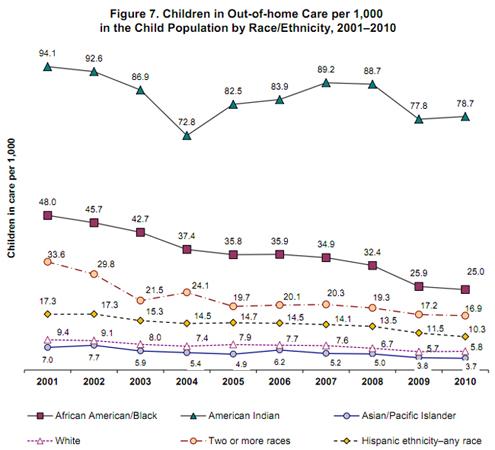
St. Paul, Minn. — Each year about 1,500 American Indian children in Minnesota spend time in foster care or other out-of-home-care, often after allegations of neglect or substance abuse by a parent.           In Minnesota, American Indian children are 14 times more likely to be placed in out-of-home care than white children - the widest such gap in the nation. Officials place 66 percent of the children with relatives or with American Indian foster families.
Even as the total number of Minnesota children in foster care dropped 44 percent in the last decade, the number of American Indian children placed in foster care dropped by only 16 percent.
That worries tribal officials like Erma Vizenor, chairwoman of the White Earth Band of Ojibwe. She said the tribes should be able to determine which of their families need intervention, and what kind.
"When we do not have the decision making and the authority and the control to determine what is best for them, it has become a major concern," Vizenor said.
Aiming to reduce the break-up of Indian families, the White Earth and the Leech Lake band of Ojibwe have taken over responsibility for child welfare on tribal lands. Now the White Earth, Minnesota's largest tribe, is now preparing to care for its children living hundreds of miles away in Hennepin County.
High poverty among American Indian families makes it more difficult to meet a child's basic needs, but that doesn't completely explain why Indian children are much more likely to be removed from their parents' care.
The tribes have questioned whether racial bias is a factor in such decisions, and they've worked with state officials to develop training for county workers to reduce bias in deciding which cases to investigate. The training also seeks to help outsiders understand the traditional role extended families play in raising Indian children.
Dawn Blanchard, the state's ombudsperson for American Indian Families, said removing American Indian children from their homes is "a daily reality."
Blanchard sorts cases into those she can solve over the phone, and those that require an investigation. She reports wide variation in how well counties follow a federal law designed to keep Indian children with other family members, or to at least place them with an Indian foster family.
Blanchard said the most common complaints she handles are disagreements between county social workers and tribes over where children should go.
"The tribe will say we want them to go to Aunt Betty and the county will say, 'we have problems with Aunt Betty. We think that she's not a good person,' " Blanchard said. "Maybe she's too old. 'We've heard' — that's a big one 'we've heard that she's drinking.' Is it substantiated? Do we know for sure if she has a history of drinking or was it 10 or 15 years ago and she's cleaned up her life now?"
Representatives of Minnesota's 11 tribes were so concerned that the needs of their children were not adequately addressed that late last year they sent letters to then-Gov. Tim Pawlenty and Gov.-elect Mark Dayton requesting immediate action to address the problem.
White Earth tribal officials want to take on responsibility for the tribe's children in Hennepin County, hundreds of miles south of the reservation. White Earth children make up a quarter of Hennepin County's American Indian caseload, or about 2 percent of the county's overall cases.
Margaret Thunder, a program manager for Hennepin County child protection, is enthusiastic about the tribe's effort.
"I think it's a huge deal," said Thunder, a member of the Red Lake band of Ojibwe. "They will have 100-percent say. Not that they don't already have a fair percent."
Tribes do have a seat at the table in child protection cases.
The 1978 federal Indian Child Welfare Act requires tribes be notified and involved in decision-making for their children. Hennepin County, with its large urban Indian population, has a high volume of these cases. The county gets high marks for complying with the act, and that's one of the reasons White Earth officials believe addressing the needs of the tribe's children there is a next logical step.
Transferring such cases to the tribe would give it complete control over American Indian cases such as a recent one heard in juvenile court.
Four children, ages 4, 2, 1 and one month, were placed in emergency foster care following reports that their parents were abusing drugs and neglecting the children. The parents didn't show up for the court hearing. Their father is a member of the White Earth band and their mother is enrolled in the Ho-Chunk Nation in Wisconsin.
"Her current address is technically St. Joseph's hospital where the treatment center was," said Mike Hogan, a courtroom monitor for the Minneapolis American Indian Center. "No one's quite sure where she is, even her attorney."
A Ho-Chunk attorney who joined the hearing by speaker phone said the tribe would prepare a list of relatives who could care for the children. White Earth officials agreed to let the mother's tribe take the lead, but they agreed to compile a list of paternal relatives.
A guardian ad litem said the children were doing well under the care of their foster care families.
Hogan's boss, Sheri Riemers, said the embrace of extended families offers the most hopeful outcome for children in such tough situations.
"We do believe when children are removed that their spirit is left behind," said Riemers, program director of Indian Child Welfare for the Minneapolis American Indian Center.
Other tribes around the state and around the country are watching closely.
Erin Sullivan Sutton, assistant commissioner of the state Department of Human Services, said she is not aware of another state transferring public child welfare from a state or county to a tribal system. But there are good reasons to do so, said Sutton, the state's point person on child welfare.
"We're thinking that if services can be provided in a cultural context to Indian families and by tribal agencies that there may be more success," she said.
For state and tribal officials success won't mean eliminating out-of-home placements. There will always be children who need to be removed from unsafe situations, but they hope more tribal involvement will reduce the disparate treatment of American Indian children.
Vizenor said the Hennepin County program could be the beginning of an ambitious venture to expand care for children living off the reservation.
"Without a doubt, I know we will be successful and gradually, we will phase in the metro area and eventually all our children in the state of Minnesota," she said.
White Earth and the state will present a report to the legislature in January. The timeline for the Hennepin County transfer, and the costs, are still to be determined.          

For more, listen:

http://minnesota.publicradio.org/display/web/2011/11/30/american-indian-children-foster-care/

Number of American Indian children in foster care worries tribal leaders

St. Paul, Minn. — Each year about 1,500 American Indian children in Minnesota spend time in foster care or other out-of-home-care, often after allegations of neglect or substance abuse by a parent.           In Minnesota, American Indian children are 14 times more likely to be placed in out-of-home care than white children - the widest such gap in the nation. Officials place 66 percent of the children with relatives or with American Indian foster families.
Even as the total number of Minnesota children in foster care dropped 44 percent in the last decade, the number of American Indian children placed in foster care dropped by only 16 percent.
That worries tribal officials like Erma Vizenor, chairwoman of the White Earth Band of Ojibwe. She said the tribes should be able to determine which of their families need intervention, and what kind.
"When we do not have the decision making and the authority and the control to determine what is best for them, it has become a major concern," Vizenor said.
Aiming to reduce the break-up of Indian families, the White Earth and the Leech Lake band of Ojibwe have taken over responsibility for child welfare on tribal lands. Now the White Earth, Minnesota's largest tribe, is now preparing to care for its children living hundreds of miles away in Hennepin County.
High poverty among American Indian families makes it more difficult to meet a child's basic needs, but that doesn't completely explain why Indian children are much more likely to be removed from their parents' care.
The tribes have questioned whether racial bias is a factor in such decisions, and they've worked with state officials to develop training for county workers to reduce bias in deciding which cases to investigate. The training also seeks to help outsiders understand the traditional role extended families play in raising Indian children.
Dawn Blanchard, the state's ombudsperson for American Indian Families, said removing American Indian children from their homes is "a daily reality."
Blanchard sorts cases into those she can solve over the phone, and those that require an investigation. She reports wide variation in how well counties follow a federal law designed to keep Indian children with other family members, or to at least place them with an Indian foster family.
Blanchard said the most common complaints she handles are disagreements between county social workers and tribes over where children should go.
"The tribe will say we want them to go to Aunt Betty and the county will say, 'we have problems with Aunt Betty. We think that she's not a good person,' " Blanchard said. "Maybe she's too old. 'We've heard' — that's a big one 'we've heard that she's drinking.' Is it substantiated? Do we know for sure if she has a history of drinking or was it 10 or 15 years ago and she's cleaned up her life now?"
Representatives of Minnesota's 11 tribes were so concerned that the needs of their children were not adequately addressed that late last year they sent letters to then-Gov. Tim Pawlenty and Gov.-elect Mark Dayton requesting immediate action to address the problem.
White Earth tribal officials want to take on responsibility for the tribe's children in Hennepin County, hundreds of miles south of the reservation. White Earth children make up a quarter of Hennepin County's American Indian caseload, or about 2 percent of the county's overall cases.
Margaret Thunder, a program manager for Hennepin County child protection, is enthusiastic about the tribe's effort.
"I think it's a huge deal," said Thunder, a member of the Red Lake band of Ojibwe. "They will have 100-percent say. Not that they don't already have a fair percent."
Tribes do have a seat at the table in child protection cases.
The 1978 federal Indian Child Welfare Act requires tribes be notified and involved in decision-making for their children. Hennepin County, with its large urban Indian population, has a high volume of these cases. The county gets high marks for complying with the act, and that's one of the reasons White Earth officials believe addressing the needs of the tribe's children there is a next logical step.
Transferring such cases to the tribe would give it complete control over American Indian cases such as a recent one heard in juvenile court.
Four children, ages 4, 2, 1 and one month, were placed in emergency foster care following reports that their parents were abusing drugs and neglecting the children. The parents didn't show up for the court hearing. Their father is a member of the White Earth band and their mother is enrolled in the Ho-Chunk Nation in Wisconsin.
"Her current address is technically St. Joseph's hospital where the treatment center was," said Mike Hogan, a courtroom monitor for the Minneapolis American Indian Center. "No one's quite sure where she is, even her attorney."
A Ho-Chunk attorney who joined the hearing by speaker phone said the tribe would prepare a list of relatives who could care for the children. White Earth officials agreed to let the mother's tribe take the lead, but they agreed to compile a list of paternal relatives.
A guardian ad litem said the children were doing well under the care of their foster care families.
Hogan's boss, Sheri Riemers, said the embrace of extended families offers the most hopeful outcome for children in such tough situations.
"We do believe when children are removed that their spirit is left behind," said Riemers, program director of Indian Child Welfare for the Minneapolis American Indian Center.
Other tribes around the state and around the country are watching closely.
Erin Sullivan Sutton, assistant commissioner of the state Department of Human Services, said she is not aware of another state transferring public child welfare from a state or county to a tribal system. But there are good reasons to do so, said Sutton, the state's point person on child welfare.
"We're thinking that if services can be provided in a cultural context to Indian families and by tribal agencies that there may be more success," she said.
For state and tribal officials success won't mean eliminating out-of-home placements. There will always be children who need to be removed from unsafe situations, but they hope more tribal involvement will reduce the disparate treatment of American Indian children.
Vizenor said the Hennepin County program could be the beginning of an ambitious venture to expand care for children living off the reservation.
"Without a doubt, I know we will be successful and gradually, we will phase in the metro area and eventually all our children in the state of Minnesota," she said.
White Earth and the state will present a report to the legislature in January. The timeline for the Hennepin County transfer, and the costs, are still to be determined.          

For more, listen:

http://minnesota.publicradio.org/display/web/2011/11/30/american-indian-children-foster-care/

Thursday, December 1, 2011

I'd like to be three again


I'd like to be 3... again... because...
I didn't think about:
food, money, clothing, my age, holiday plans, menus, shopping, gifts, parties...
My mom dressed me, she fed me, and she made sure I learned new words every day.
She decorated our home for the holidays and I was sure there was a Santa Claus because of her.

She made magic.
She read me books.
She made boxes and boxes of cookies and fudge.
She took such good care of us.
She made it look easy (when it wasn't).
She gave and gave and gave, often without a whisper of thanks.

Even though she didn't give birth to me, she gave me life, courage, and strength.
Even though I can't see her right now, I feel her spirit, her energy, her heart.
Even though I cannot imagine my life without her, I have to be brave if she doesn't make it in the coming days.

Keep good thoughts for me, my friends. Keep good thoughts for her, too.


I love you Mom, rest in peace
Edie DeMeyer,87, passed away on Dec. 9 in Roseburg, Oregon...

Wednesday, November 30, 2011

FINALLY! Good news in Utah!

Utah Appellate Court Decides ICWA Case

by Matthew L.M. Fletcher

An excerpt:
A.J. and J.J. (Mother and Father, respectively) appeal the juvenile court's order terminating their parental rights in M.J. and S.J. (the Children). On appeal, Mother and Father argue that the juvenile court erred in determining that it did not have “reason to know” that the Children were Indian children under the Indian Child Welfare Act (ICWA), 15 U.S.C. §§ 1901–63 (2006), and that ICWA, therefore, did not apply in this case; that the evidence was insufficient to justify termination of their parental rights; and that the juvenile co urt committed plain error by failing to follow the proper procedure when ordering the Children to be removed. We affirm.

Monday, November 28, 2011

More Celebrities Adopting

More and more celebrities are adopting. It's a trend. Obviously adopting will not fix the dire poverty in the village, country or continent where an orphan/adoptee was born. That doesn't matter. America becomes their new home and culture - but I wonder, what is American culture?
When celebrities like Madonna and Angelina Jolie made international adoption headlines, we heard nothing about their adopted children (of different skin and ancestry) who lose their language, identity, family connections and traditional diet. It’s taken for granted their adopted children will survive emotionally. Tabloids may cover these families intensely but it’s doubtful Madonna or Angelina will ever leak news about their children’s bonding issues, reactive attachment disorders or any signs of emotional trauma.
This is a repost from March 2010 which I think is very relevant to Adoption Awareness Month - just click AMERICAN INDIAN ADOPTEES: Lost Children, Lost Ones, Lost Birds: Think Tank: .

Have you read of any new celebrity adopters? Leave a comment here!

Sunday, November 27, 2011

The Changing World of Adoption

Adoption is changing! Depending on who you are and if you have adopted or are an adoptee, this story about declining foreign adoptions is a predictor to me that all adoptions will decline. See AP story here:  http://www.washingtonpost.com/national/foreign-adoptions-by-americans-decline-again-to-lowest-level-since-1994/2011/11/16/gIQAIL5bRN_story.html


Why? There has been change in the adoption myth. Adoptees are human beings, and we are not adapting as well as the adoption industry has mythologized. When we are displaced and taken from our home and placed in American homes, there will be confusion, sometimes anger and more than a few questions coming from the adoptee.
As I have said here on this blog many many times, being adopted feels the same as being abducted. Even if the adoptive family is nice, generous and saving you from Third World conditions, adoptees like me question WHY was I adopted?
And if you (the adopter) do not tell them, that is akin to a lie.
If you adopted from China or Ethiopa, their culture and diet is unique. The health consequences, lack of traditional foods, and the lack of medical history, could be the time bomb waiting for the adoptee adult.
Until myths about adoption change completely, until adoption records are unsealed, until every adoptee has the right to possess a copy of their original birth certificate and know their ancestry and name, the Adoption Industry is winning the war with secrecy and deception.

Google "adoptee rights" and you will see there is a battle in the changing world of adoption and the just war is being fought by adoptees.

Saturday, November 26, 2011

Weiner, Thurman, Edwards, Schwarzenegger and other philanderers…

This is a repost from June 2011.

I have decided adoption laws haven’t changed because too many law-men and law-women are not adoptees. That is right. If adoption doesn’t affect them or their wife or their kids or their relatives, they don’t care. There are bigger fish to fry, like getting reelected each time. Usually the law-maker is wealthy, and their friends are the kind of people who adopt.
Think of Arizona Senator John McCain who adopted a daughter from India. Do you really think he wants her to open her adoption and find her Third World family? I don’t think so.
Rich adopters believe the adoptee should be grateful and satisfied to be one of them -- and they’d prefer the adoptee not go looking for trouble. They probably like our adoption laws the way they are – sealed tight and secret. Why? No risk, no complexities, no contact between adult adoptee and his or her birth-family, no headlines. Remember adoptees become legal property and apparent heirs of their adoptive family…and an ungrateful adoptee risks losing all that.
Caring about adoption privacy (or not caring) goes back to the era of “judging” single women. It was thought some of these women could not possibly raise a baby alone. (Oh really?) And darn them for getting knocked up in the first place. (What about the sperm? It takes two people.) Darn those girls for being unable to say no. (You just can’t pass over relic judgments like these that still exist.)  Who is thinking about children who become orphans? (Not a chance. There are lists of people willing to pay thousands of dollars for a baby and adopters prefer secrecy, too.)
A lot changed in the 1970s – which seems pretty recent. Available adoptable babies dropped significantly. There is still no accountability for the guys who knocked up the girls. There is no stigma for the sperm-deliveryman.
This leads me to an interesting idea. Some of these law-men had mistresses (more than a one) and their offspring could have been placed in a closed adoption. Wouldn’t that be a revelation? Think of Anthony Weiner who just lost his Senate seat over sex-ting. At least we know about Strom Thurman and John Edwards who each had a child with a mistress.
Then we have the philanderers. Think of presidential-hopeful Newt! Back in 1999, shortly after Gingrich stepped down from his position as speaker of the House and resigned from Congress, he met Callista. She was 33 to his 56. They had an affair for six years during the Republican-led impeachment of Bill Clinton for his affair with Monica Lewinsky. Gingrich told wife #1, after 18 years of marriage, that he was seeing someone else over the phone. (It could have been worse: According to his first wife, Newt was married when he met Mrs. Gingrich #2, and he asked #1 for a divorce while she was recovering from cancer surgery in the hospital.) Newt married his mistress Callista, now-wife #3, in 2000.
Then we have Austrian-actor-turned-governor Arnold Schwarzenegger whose little tryst with the housekeeper produced a son and caused an uproar and his upcoming divorce to Maria.
Other governors, like David Patterson and Mark Sanford had mistresses. Some 30 years ago, a Maryland governor’s made his mistress his wife. After Marvin Mandel issued a statement confessing his love for the tall, blond Jeanne Dorsey, his wife refused to leave the governors mansion for half a year. The governor had to stay in a hotel. Mandel's divorce was finalized in 1974; that very same day he married Dorsey, and they lived happily ever after. (Well, first Mandel was convicted of mail fraud and racketeering and went to jail. Then he got out and then they lived happily ever after.)
There are reasons for secrets and secrecy, right? Perhaps the rich and powerful make their own rules about family values, hiding the affairs and the offspring.
It seems obvious to me now. Closed Adoption is the perfect way to hide a secret.

Friday, November 25, 2011

"Little Papoose"

Amateur genealogist tracks down daughter's birth mother
11/25/2011 By Noelle McGee, http://www.news-gazette.com/news/people/2011-11-25/amateur-genealogist-tracks-down-daughters-birth-mother.html


Left to right, Susy Riggle of Georgetown; her adopted daughter, Amy Norman, of Indianapolis; her husband, Rich Riggle of Georgetown; and Karen and Cliff Andersen of Baraga, Mich, Norman's birth mother and brother, taken in July in Michigan. Susy Riggle searched for and found Karen Andersen in 2009. This past summer, Andersen reunited with Norman 33 years after she gave her up for adoption.


GEORGETOWN — As an amateur genealogist, Susy Riggle has researched generations of relatives all the way back to before the Civil War.

But one of her most meaningful searches uncovered a woman who isn't related by blood or marriage — her adopted daughter's birth mother.

Riggle found the woman in the fall of 2008 after about a year of searching for her. This past summer, Riggle helped reunite the birth mother with the birth daughter she hadn't seen since placing her for adoption 33 years ago.

"I really believe it was a God thing," said Riggle, who credits God with bringing her daughter — Amy (Riggle) Norman, who now lives in Indianapolis — into her and her husband's lives and bringing Norman and her birth mother together again.

Both lifelong Georgetown residents, Riggle — a retired teacher, guidance counselor and principal in the Georgetown-Ridge Farm school district — and her husband — Rich, a retired coal miner — had a son, Matthew, in 1970. A few years later, after trying unsuccessfully to have another child, they turned to adoption through the Easter House Adoption Agency in Chicago.

Amy Riggle was born on June 27, 1978, in Chicago. The Riggles took her home when she was four days old.

"She was precious," Riggle recalled. "She had dark hair and dark eyes. When my son saw her wrapped up in her blanket he said, 'She looks like a little papoose.'"

The Riggles raised their children on about 30 acres of land 2 miles east of Georgetown that's been in Susy Riggle's family for 175 years. Norman said she had an ideal childhood, growing up in a loving, Christian family with both sets of grandparents nearby.

"I always knew I was adopted, but I never thought anything of it," said Norman, who learned when she was 4 years old. "My mom was a counselor, so she thought it was important to tell me everything she knew, which was two typed paragraphs from the adoption agency. She never spun it like I wasn't wanted. I always viewed it as an unselfish act by someone who knew she couldn't take care of me. Because of that and because I had such a great family, I never felt like I needed to go looking for greener pastures."

The two typed paragraphs didn't reveal much, only that her biological mother was 20 and her biological father was 24. Both parents had dark hair and dark eyes. The back of Norman's adoption decree held one more clue: the name Cadeau.

"We had been told she was French," Riggle said of the birth mother's nationality.

Riggle was inspired to launch a search in the fall of 2007 after meeting a woman who had been adopted through Easter House and recently reunited with a sister. "I always thought if I could do anything to help her find out more about herself or her heritage, I would," said Riggle, who had her daughter's blessing.

With the help of a retired policeman, who was an adoptee himself, and a Massachusetts woman, Riggle got the name of two likely candidates. One was Karen (Cadeau) Andersen who lived on the west side of Michigan's Upper Peninsula.

Rich Riggle had been taking deer hunting trips on the east side for years. So in fall 2008, Riggle joined him, and the two made a side trip to Baraga, where Andersen lived. During their two days there, a librarian found an obituary for a woman named Cadeau, who was a member of the Keweenaw Bay Indian Community in Baraga.

"That's the first time we learned about the Native American connection," Riggle said, adding the woman turned out to be Norman's biological grandmother.

While visiting the local newspaper, the couple tracked down Andersen's cousin, John Cadeau. "He was kind of hesitant at first, but he agreed to let her know we were trying to get in touch," Riggle said. "When we got back home, the phone rang. A woman said, 'I'm Karen Andersen. I heard you've been looking for me.'"

Over the next few months, Riggle, Andersen and Norman, now a mother herself, exchanged phone calls, emails and pictures. Andersen learned that Norman was an exceptional student who graduated in the top of her class at Georgetown-Ridge Farm High School and a standout athlete who set records in volleyball, basketball and track and later attended Georgetown College in Kentucky on volleyball and academic scholarships. She also learned Norman and her husband, Isaac, had a son, Jonah.

"It affirmed her decision to place me for adoption," said Norman, who discovered Andersen wasn't married and didn't have a good job when she got pregnant. "She wanted her child to grow up in a two-parent home, in a home that was religious. She was so happy to learn that I've had a good life."

Norman was equally happy to learn that Andersen is "in a good place." She said her birth mother and her family — who are Ojibwe or Chippewa — moved back to Michigan and reconnected with their Native American community. Andersen married and had a son, Cliff, who's 24. She earned a bachelor's degree, and now works as a wildlife technician for her tribe.

The Riggles first met Andersen, her son and siblings in person at the tribe's annual pow wow in Baraga in July 2009. This past summer, they took Norman and her family — including infant daughter, Elizabeth — and their son, his wife and their kids.

When Norman met Andersen, who was dressed in native attire for the pow wow, she described feeling the way she did when her children were placed in her arms for the first time. "We both teared up, though neither one of us are emotional," Norman said.

That weekend, Norman also got to know her biological brother, an uncle and several aunts, one of whom could pass for her older sister.

"We formed a quick bond," Norman said of Andersen's sister, Denise. "We're both tall and look alike. We played the same sports in high school and college. We also have similar personalities."

Norman said can't help but feel doubly blessed to have her adoptive parents, who "will always be my mom and dad," and this new family, with whom she plans to keep in touch via Facebook. She said she and her husband also hope to visit them every other year or so.

"As my kids get older, I want them to know about this part of their heritage and culture," she said.

I love stories like this!   Trace

The Declassified Adoptee: Indians Still Suffering Ill-Effects of Adoption

The Declassified Adoptee: Indians Still Suffering Ill-Effects of Adoption:
Guest Entry by: Trace A. DeMeyer

Trace's book is on Amazon and Lulu.com...

Thursday, November 24, 2011

ADOPTION TRUTH: Lip Service

As part of Adoption Awareness Month and "No" Vember - here is a fantastic blog post that hits the core of this month's message! For some agencies, adoption is about profit, not keeping families together and intact.

Lip Service


There is a heart breaking story out there about a grandmother who lost her grandson to adoption . . .

A Grandmother Desperate To Adopt Her Grandson Fought The State and Lost

It is, unfortunately, another incident of another adoption agency destroying families at any cost for the sake of profits. Of more proof to the fact that as long as we allow these agencies to go unregulated and unchecked, they will continue to commit such crimes without punishment.

And adds to the sad realization that such agencies are the norm, not the rarity in the billion dollar world of adoption.

I’ve heard the argument, the justifications, but the truth of the matter is . . . there is no such thing as an ethical adoption agency. They don’t exist. They can’t exist under the nature of what adoption is in our culture.

As long as there is no protection for pregnant mothers or the children who are supposed to be the most important in adoption. As long as there is profit to be made off of human beings, government-paid programs teaching counselors how to convince women to give up their babies and more of our taxes going into helping couples adopt over helping mothers keep and raise their children, there will never be anything but corruption and greed, coercion and manipulation in adoption.

And an adoption agency can give hopeful adoptive couples or frightened pregnant women all the lip service in the world, it will never change the fact that it is just that . . .

Lip Service.

Because for an adoption agency to be truly ethical, to really care first and foremost about pregnant mothers and children, they would have to go against just about everything they are in business for. They would actually have to admit that adoption counseling is coercive just in the very nature of how it is done. Admit the damage separating a child from his or her family causes. And turn away from the profits they earn with each “successful” adoption.

A truly ethical adoption agency would refuse, without question or argument, to see or talk to a pregnant mother about adoption until she had received crisis counseling for her situation . . . TRUE crisis counseling. Not the kind that comes from counselors that earn their paychecks from mothers giving up their babies. Or Social Workers who aren’t trained to recognize or work with those who are in the midst of a crisis.

It has to be from those who know. Those who are licensed and have been educated and trained to realize that a mother claiming she wants to give away her child is not a normal reaction. To understand there are fears driving such feelings and a responsibility on the one offering counseling to help her not only work through her fears but overcome them so that any decision made is one done so outside of the emotions that are pushing her to make a rash decision that will affect her for the rest of her life.

But there is not an agency I know of that has such requirements. Instead they work their way around that by claiming they truly care about the pregnant mother because they offer “options” for parenting. What they don’t say, but they know . . . trust me, THEY KNOW . . .is that it doesn’t mean a thing to offer such options to a woman who is already caught up in fear. Already believes she can’t do it.

If she hasn’t been helped to overcome her fears, encouraged to seek solutions and answers to what is pushing her to make such an irrational decision, such options are going to be rejected without thought because she is already living under the terrible fear that she isn’t good enough for her own child. And NOBODY has helped her work through that fear or overcome it.

She has already been denied the help she needed . . . deserved. And is instead being manipulated because of her fears. Her desperate emotions being used to push her to give away her child.

There is nothing ethical about that. Absolutely nothing.

But it doesn’t even stop there. Again, for an agency to be ethical, they would also have to put every effort into making sure a child remain within his or her biological family if at all possible.

Not just in foster care adoptions – such as the grandmother who tragically lost her grandson because of the illegal practices of an adoption agency – but in ALL adoption situations.

They would make sure every pregnant mother who came in their doors was aware of the studies, the research, that shows children do better within their biological families versus being raised by strangers. They would encourage family adoptions over stranger adoptions and they would ALWAYS put their highest effort into keeping a child in their family, through whatever means possible.

There would no longer be counseling that encouraged grandparents to “accept” their daughter’s decision instead of stepping in to help support and raise their grandchild. No more suggestions that family offering to help was the same as them not “respecting” a pregnant mother’s decision.

And there would definitely not be situations such as this grandmother’s where biological families were denied their own grandchildren, nieces, nephews, cousins, because there were already strangers being given the promise of adoption.

Keeping children, whenever possible, within their families would go beyond just a practice. Beyond whatever it is an adoption agency might tell others to appear ethical. It would be a requirement, a must, before any other form of adoption occurred. They would fight for it, be vigilant about it. And wouldn’t stray from it, not even if their profits were threatened.

And that is the final reason why there can never be an ethical adoption agency . . . profit.

They make money. They gain. They succeed off of taking children from their mothers and handing them over to strangers who have the ability to pay for them. They lie to adoptive parents, first parents and even adoptees. They cover their tracks, call themselves non-profit, do whatever they can to hide the one and true reason why they do what they do . . .

MONEY.

The money they will not give up. Money that keeps their manipulative, coercive, corrupt and illegal practices going. Money that pays for lobbyists to push for laws that keep them unregulated, untouched even when they clearly break the law. Money that denies protection for pregnant mother and children.

Money that does and will continue to make it impossible for any adoption agency . . . anywhere . . . to ever be ethical. Because they can’t be. They don’t want to be. And they never will be.

Not it today’s world. Not in the ugly truth that is adoption. The ugly truth that won’t change until our support, our belief . . . our own personal ethics . . . change and demand better.

Follow Cassi's blog here: http://adoptiontruth-casjoh.blogspot.com/

Wednesday, November 23, 2011

Laws protect full-bloods

Some states have revised the Indian Child Welfare Act
Laws Protect Full-Bloods
To protect Indian children from adoption agencies, tribal leaders pushed for the much-needed Indian Child Welfare Act (ICWA), made law in 1978. Since its passage, full blood Indian children are supposed to be protected and kept in their tribal community.
But the Multi-Ethnic Placement Act of 1994, (amended by the Interethnic Adoption Provisions of 1996) decided: “If it turns out that a child is of mixed ancestry, including some Indian heritage, but is not an “Indian child” under ICWA, then the child’s placement is not subject to ICWA and the child is entitled to the MEPA-IEP protections against discriminatory placement decisions. If a caseworker has reason to know that a child may have some Indian heritage, it is essential to determine whether the child is a member of a federally recognized Indian tribe, or may be eligible for membership by virtue of being the biological child of a member. Delays in determining a child’s status as an “Indian child” can have the unfortunate consequence, years later, of disrupting stable placements with non-Indian foster or adoptive parents to rectify an earlier failure to abide by ICWA.”
I’m a mixed blood, meaning my blood was somehow tainted or ruined. The ax cuts both ways. Tribes might lose children if one parent was white and doesn’t disclose the child’s Indian ancestry. Some tribes exclude mixed bloods based on blood quantum. Some tribes dis-enroll members who move off their reservation.
Entire tribes were terminated by the 1950s, when the U.S. government ended its federal trusteeship of roughly three percent of the Native population through a process called termination. Of the 109 tribes and bands terminated, 62 were in Oregon and 41 were in California. Others were in Minnesota, Nebraska, Utah, and Wisconsin. (Many adoptions happened in those states, too, before the ICWA.)
Termination caused cultural, political and economic devastation for those tribes. Some did reestablish the trust relationship but for others, their lawsuits lasted years.
Lost Birds I’ve met want to find their families, even if not federally recognized. Mixed blood children now can certainly fall into these loopholes and disappear. Caseworkers might determine your Indian status based on how you look, which is ridiculous.
Really, it’s a mess. There are 250 tribes on a list of non-recognized tribes, with 150 of them petitioning for federal recognition. State-recognized tribes like the Abenaki in Vermont, who receive no federal benefits, are currently petitioning the federal government. The idea that a tribe doesn’t exist is troubling. If there are tribal members, there is a tribe.
Not long ago, Vermont decided to apologize for sterilizing Abenaki Indian women and children, after a deliberate attempt to make sure there would be no more Vermont Indians. Vermont’s apology took the form of teaching Abenaki tribal history in all its schools. For many years, the Abenaki were so afraid of the government militia called Roger’s Rangers; they did not teach their children the Abenaki culture, language or ceremony.
Some history I wish wasn’t true.

Tuesday, November 22, 2011

Tribal STAR Response to Unwarranted Removal of Indian Children in Recent Media Coverage

Tribal STAR Response to Unwarranted Removal of Indian Children in Recent Media Coverage


PRESS RELEASE:

Contact: Rose-Margaret Orrantia, Tribal STAR Program Manager, 619-594-8291


In response to the recent reports and media (ABC’s 20/20 and NPR) surrounding the mal-treatment of American Indian children, it should be pointed out that there are numerous recent reports[1] that illuminate that this is not an isolated phenomenon. Indian children across the country continue to be subject to inappropriate and questionable removal and placed in non-tribal foster or adoptive homes. The Indian Child Welfare Act was passed to ensure Indian children remained connected to their families and cultural heritage. ICWA was passed in 1978 and the media reports show that we are not living up to our legal and moral responsibilities.

The question is what can we do right now? Here are four directions that states, counties, and tribes may consider:


1. Use existing federal mechanisms to strengthen local response: The Federal Child and Family Services Review (2001) requires child welfare systems to engage with tribes to improve system performance. The Fostering Connections to Success Act (2008) requires that relatives and extended family members be identified for all children in the child welfare system. These mandates and other initiatives[2] can be used to strengthen cultural competence and appropriate engagement of county and state social workers when working with tribes and Native families. Simple steps such as training and communication with ICWA social workers can enhance the county and state social worker’s understanding of the prevailing cultural standards of the local tribes as required by ICWA. State and County child welfare improvement plans should include goals and objectives that increase ICWA-related training, and collaboration between states, counties, and tribes.


2. Improve proper placements and certify more AI/AN homes. Keeping a child connected to family and culture is supported by the Fostering Connections to Success Act through the identification of relatives and extended family members for possible placement. Additionally, states, counties, and tribes need to identify more American Indian/Alaska Native (AI/AN) homes for children in care and support Tribal certification of homes. Encourage local child welfare directors and states to exercise the authority to grant exemptions when red flags occur because of old offenses. Research shows that AI/AN children who stay connected to their cultural heritage and extended families have more protective factors and exhibit more resilience than those placed with strangers while in the child welfare system.


3. Increase judicial support to effect ICWA outcomes. Courts have a key role in ensuring Native children are protected and the mandates of ICWA are followed. Courts need to require that inquiry and notice procedures are followed and ensure that tribal representation occurs at every ICWA-related hearing. We recommend that all judges and court personnel receive ICWA and cultural competency-related training in order to have a clear understanding of the historical and emotional context of the legislation.

The current reality of depleted federal and state budgets leaves little room for additional resources to serve this population. However, it is to the benefit of every state, county, and tribe to identify every AI/AN child and link them to culturally appropriate services such as Title VII Indian Education (supports mentoring, tutoring for completion of primary and secondary education, and provides cultural restoration), Tribal TANF (temporary assistance for needy families), and some Tribal health services. When tribal children are identified and linked to these services the costs are shared, diffused, and ultimately reduced. Unfortunately the current funding mechanisms provide resources based on the number of children served by the system with few options for focusing on prevention. How can we reduce the number of children in our care when our system funds jurisdictions based on children in care?


4. Prevent new cases through collaboration and active efforts. Collaboration and authentic engagement with tribes and urban tribal communities needs to occur at federal, state, and local, levels to reduce the disproportionate representation of Native children in child welfare and prevent new cases from entering the system. Once an Indian child is identified, states, counties, and tribes should begin active efforts[3] to link the child and family to services and resources that can reduce risk and prevent the case from entering the child welfare system.


There are a number of promising and model programs that demonstrate collaboration and court involvement to achieve ICWA compliance. For more information go to the following websites:

· National Resource Center for Tribes: www.NRC4Tribes.org

· National Indian Child Welfare Association: www.NICWA.org

· National Council of Juvenile and Family Court Judges: www.NCJFCJ.org

· American Indian Enhancement Project of California Toolkit: http://calswec.berkeley.edu/CalSWEC/AIE/AIE_home.html


Tribal STAR is a program of the Academy for Professional Excellence, SDSU School of Social Work, funded by the State of California Department of Social Services. Since 2003 Tribal STAR has provided training and technical assistance to Southern California Counties with a mission to ensure that American Indian/Alaska Native children remain connected to culture, community and resources.

For more information go to  http://theacademy.sdsu.edu/TribalSTAR.


[1] Disproportionality Rates for Children of Color in Foster Care: National Council of Juvenile and Family Court Judges, California Disproportionality Report, and “An Unsettling Profile” Coalition of Communities of Color: Portland Oregon State University.


[2] Family to Family, Family Finding, Client Engagement, Signs of Safety, and Active Efforts.


[3] Indian Child Welfare Act : Pub.L. 95-608, 93 Stat. 3071, enacted November 8, 1978.


Please share this with tribal officials and contact Tribal STAR for more attention.... Trace

CLICK OLDER POSTS (above) to see more news

CLICK OLDER POSTS  (above) to see more news

MEGWETCH THANK YOU

HUGE Thank you for visiting this blog and sharing this with your kin. It's appreciated. Contact Trace anytime! Use the form below.

BOOKSHOP

Please use BOOKSHOP to buy our titles. We will not be posting links to Amazon.

Popular Posts

To Veronica Brown

Veronica, we adult adoptees are thinking of you today and every day. We will be here when you need us. Your journey in the adopted life has begun, nothing can revoke that now, the damage cannot be undone. Be courageous, you have what no adoptee before you has had; a strong group of adult adoptees who know your story, who are behind you and will always be so.

OUR HISTORY

OUR HISTORY
BOOK 5: Lost Children of the Indian Adoption Projects