2021 SPEAKER SERIES: Kenn Richard LINK: https://www.youtube.com/watch?v=Ku8DCJSLEKc

Port Hawkesbury, NS, Canada / 101.5 The Hawk
Jul 11, 2024 | 2:56 PM

National Chief Cindy Woodhouse
Nepinak of the Assembly of First Nations speaks to reporters on July 11, 2024.
Image: CPAC video capture
It is being described as a historic and groundbreaking milestone for First
Nations children and their families.
Ottawa has agreed to commit $47.8 billion over 10 years to reform First Nations child and family services.
The settlement agreement was announced during the Assembly of First Nations’ annual general meeting on Wednesday.
National Chief Cindy Woodhouse Nepinak said this deal will lead to improved support for First Nations children and their families.
“It is hard to think of this as a celebration because everything that has happened so far is so, so sad,” said Woodhouse Nepinak.
“Since the beginning of the Sixties Scoop, First Nations children have faced discrimination in Canada’s child welfare system due to longstanding discriminatory policies and attitudes toward First Nations people. We are moving toward prevention, rather than apprehension.
“In 20 years from now, I hope that many of our families are back together again, sooner than that, but at the same time we fix this system so it quits hurting our First Nations families.”
The agreement is on top of a landmark $23-billion settlement approved by the Federal Court in October for 300,000 First Nations children and their families.
The settlement is the largest in Canadian history and was based on a human rights tribunal ruling which found the federal government discriminated against First Nation children and their families.
Indigenous Services Minister Patty Hajdu said Thursday’s agreement will put an end to “discriminatory” and “systemically oppressive policies.”
“This was a tool that was used to destroy the strength of First Nations peoples so that people could not fight for their own rights to exist in a way that they had since time immemorial,” said Hajdu.
“Today’s agreement is about a change to all of that. It’s about restoring power and control to communities and families so that no child ever again will grow up without being surrounded by love and culture and language, knowing who they are.
“It’s also a day that Canada moves
from compensating for harm to investing in prevention. It means that we can see
an end to the days where families are ripped apart because they don’t have a
safe place to sleep, because they can’t afford the food to feed their children,
because they don’t have the supports they need.”
The DNA of ancient human remains in the United States may hold the answers to some of the most hotly debated questions in North American history. Danish professor Eske Willerslev has spent more than 10 years travelling around the US to study DNA data and what it can tell us about early humans. His encounters with Indigenous tribes, who are today fighting to have the remains of their ancestors reburied, forces Willerslev to reconsider his own position and possible biases in his interpretation of the ambiguous data. His objective ideals as a scientist are put to the test as he is confronted with ethical and personal dilemmas. Remains is a documentary film by Linus Mork.
Sudbury chef bids farewell to find peace with her Indigenous family in Saskatchewan
Tammy Maki will close her downtown chocolate boutique at the end of the summer
Nishat Chowdhury · CBC News : July 10
https://www.cbc.ca/news/canada/sudbury/downtown-sudbury-tammy-maki-sixties-scoop-1.7259456
 |
| Tammy Maki and her dog Frankie sit for a moment in her shop surrounded by pictures of her late daughter and her grandchildren. (Kate Rutherford/CBC) |
A well-known Sudbury business woman is packing her bags and leaving the downtown to explore and connect with her Indigenous heritage in rural Saskatchewan.
Adoptee Tammy Maki, 59, owner of Raven Rising-Global Indigenous Chocolates on Cedar Street, says she'll close the doors to her shopfront at the end of the summer and someone else will take over the lease.
A child of the Sixties Scoop and member of White Bear First Nations, a community located about 210 kilometres southeast of Regina, Maki says she wants to reconnect with her Indigenous relatives after spending most of her life in Sudbury.
"I've never had a chance to experience my culture, my relatives, my people, ceremonies," she said. "I feel like an interloper in my own heritage."
The sudden loss of her only daughter last year and her grief became a catalyst for her to explore where she belongs, and is the final push for her departure.
"This shop, we came to look at it together when I was looking for a place to lease. She worked here, she sat in the chair. It's always her, her, her in my mind," said Maki.
The chocolate shop won't be closing forever. Instead, the e-commerce business will be running out of White Bear First Nations.
Reconnecting with biological family
Maki was taken from her birth mother in the 1960s and a Sudbury family adopted her at a young age.
In the last five years, Maki found out she had three brothers and she was 56 when she saw a picture of her biological mother for the first time.
"It's so weird, you go through life and you wonder, 'oh, do I look like anybody?" she said.
The Department of Indigenous Affairs indicates that the number of Indigenous children adopted between 1960 and 1990 was more than 11,000. However, more recent research suggests upwards of more than 20,000 First Nation, Métis and Inuit children were removed from their homes.
According to the Canadian Encyclopedia, the number of children taken away from their birth families varied by province, but the practice was most common in the Prairies.
In Saskatchewan, there were specific programs designed to facilitate adoptions.
"I'm going back with the attitude of not what my First Nation can do for me, but what I can do for them, and hopefully I find some peace there as well," said Maki.
Looking forward to the move
While personal soul searching is the prime reason for the move, Maki says it's also been challenging to operate a business in Sudbury's core.
She says major changes need to be made to address the issues of homelessness connected to the toxic drug crisis.
"To tell me that I need to have a storefront downtown Sudbury in order to create foot traffic is fine, but when people are worried about coming here, then what does that do for me?"
Maki says she's looking forward to living in rural Saskatchewan where she says she feels like she can finally breathe, and where she has scattered some of her daughter's ashes.
"As sad as it's going to be, it's also very exhilarating and I'm really looking forward to experiencing that Indigenous side of myself, that side that's been just crying for years," she said.
LINK: https://www.cbc.ca/player/play/video/9.6441534

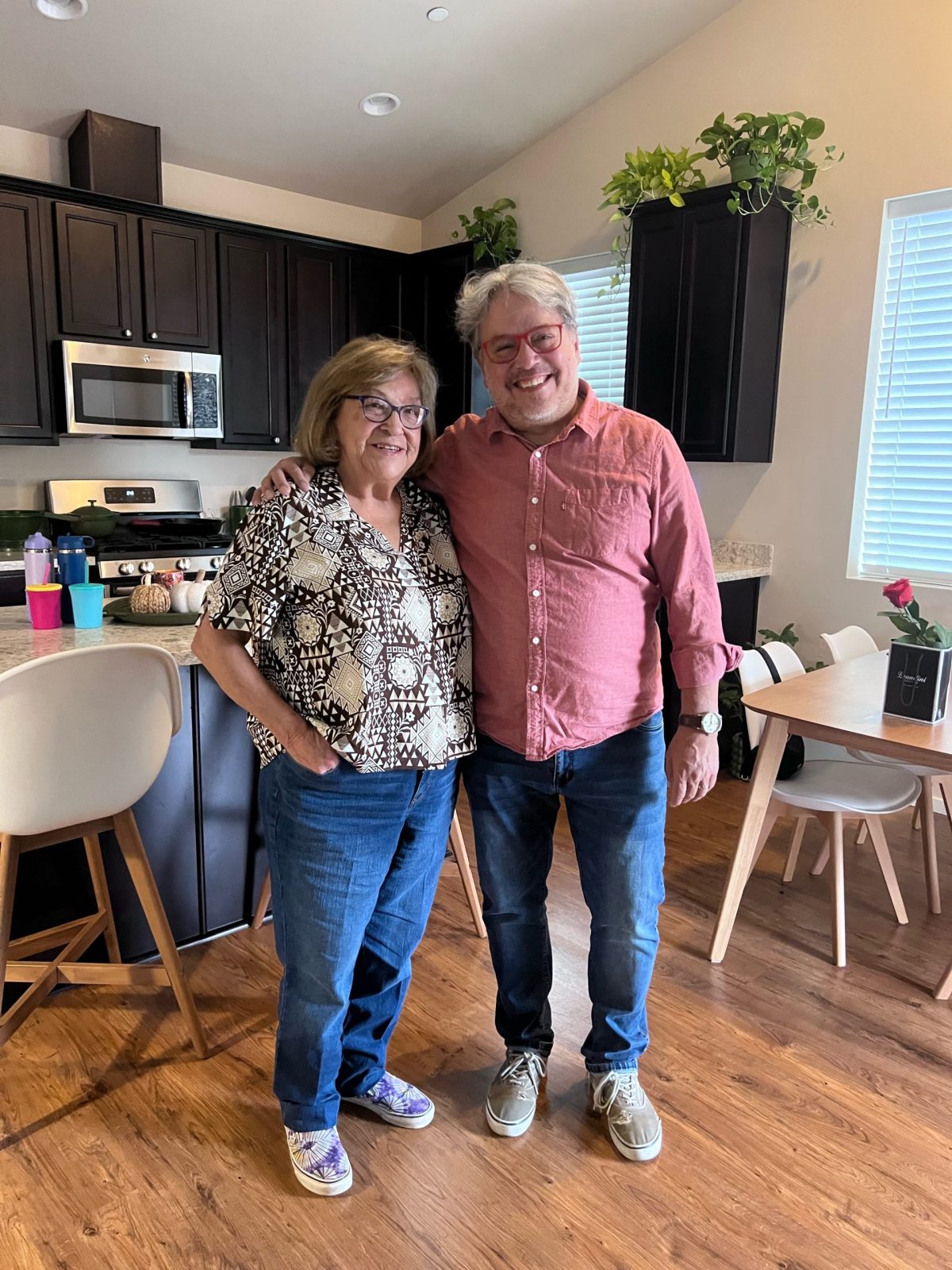 |
| Selma Matte and Jerome Joseph Gentes during their September 2023 reunion. |
Gentes, 60, was given up for adoption when he was about a year old by his mother, who was 20 at the time. He reunited with her in Seattle last year.
Matte, now 80, was born and raised at the Fort Belknap Indian Reservation in Montana with four sisters and three brothers. She was 19, living in San Francisco and working at Bank of America, when she got pregnant. Jerome’s birth father promised to help after the baby was born, but instead returned to his Indian reservation in North Dakota before the birth, because his grandmother was ill. He never came back.
(Gentes’ birth father died two months before the reunion with Matte.)
NEW ZEALAND
 |
| Tauranga's Ekaterina (Kat) Clark is in a documentary about adoptees seeking their birth parents. Photo / Alex Gilbert, I'm Adopted |
Ekaterina Clark began her search for her birth mother knowing there could be a tragic reason behind her adoption.
But she was unprepared for what she discovered.
The Tauranga woman, known as Kat and born in Russia as Ekaterina Ivanova Popovskya, appeared in an episode of the documentary series An Adoption Story.
A Chilean-American adoptee raised in the United States filed a criminal complaint against Chile on July 1, 2024, alleging the country engaged in a systematic plan to steal thousands of babies from perceived enemies of the state in the 1970s and 1980s. (AP/Mauricio Cuevas and Nathan Ellgren) Read more here: http://apne.ws/RfnEq46
👆Native America Calling (listen) (7/9/2024)
 |
| NABS Photo: CARLISLE students |
For the first time, a bill to create a Truth and Healing Commission on Indian boarding schools has reached the floor of the U.S. Senate. A companion bill is working through the U.S. House. The concept of an official panel to look into the abuses of boarding schools has surfaced previously but failed to take hold. The action comes as the National Native American Boarding School Healing Coalition is launching a database of documents, photographs, and other records to help survivors and others connect understand the full weight of the boarding school era. And an important event to promote healing from Canada’s residential school era is taking place in Ontario. Some voices in Canada are calling for residential school “denialism” be criminalized.
GUESTS
Fallon Carey (Cherokee Nation), interim digital archives manager for the National Native American Boarding School Healing Coalition
Edward Washines (Yakama), member of the Washington State Truth & Reconciliation Tribal Advisory Committee
Eleanore Sunchild (Thunderchild First Nation), Cree Indigenous lawyer practicing law in Calgary
 |
| CARLISLE GRAVES |
NABS: https://nibsda.elevator.umn.edu

👉 What We're Reading: Lost Birds (fiction)

"Lost Birds" by Anne Hillerman intertwines two searches on the Navajo Nation. Photograph by Inga Hendrickson.
AT THE OUTSET of Lost Birds (Harper), Anne Hillerman’s gripping ninth novel in the Leaphorn, Chee, and Manuelito series, a man rings up retired detective-turned-private-eye Joe Leaphorn for help. As Cecil Bowleg begins to explain that his wife has gone missing from the Navajo Nation, a sudden explosion on the line interrupts the call. Meanwhile, Leaphorn’s also searching for the biological parents of a Diné woman who was adopted by a bilagáana (Anglo) family. How’s it all going to come together with the help of Off. Bernadette Manuelito and Lt. Jim Chee? Read on. According to Hillerman, the plot is inspired by the recently upheld Indian Child Welfare Act (ICWA), designed to protect Native children from removal from their communities.


