OUR HISTORY: Lost Children of the Indian Adoption Projects

back-up blog (last updated 4/4/2025)

OUR HISTORY: Lost Children of the Indian Adoption Projects

back-up blog (last updated 4/4/2025)

Pages

▼

Thursday, April 30, 2015

National Indian Child Welfare Association Applauds Robust Participation in ICWA Hearings


Apr 29, 2015  LINK 


Diverse Native Turnout Demonstrates Widespread Support for Proposed Regulations


PORTLAND, Ore., April 29, 2015
/PRNewswire-USNewswire/ -- Citing strong participation at each hearing
hosted by the Bureau of Indian Affairs (BIA) in Portland, Oregon, last
week and overwhelming feedback from constituents, the executive director
of the National Indian Child Welfare Association, today offered
continued support for proposed regulations that will strengthen Indian
Child Welfare Act (ICWA) protections for children.


"The first week of hearings and consultations
demonstrated a tremendous groundswell of support in Indian Country,"
said Dr. Sarah Kastelic. "It's exciting to see the momentum created by
such a diverse cross section of our communities. Foster and adoptive
parents, Native adoptees, foster youth, attorneys and law professors,
child psychologists, families still searching for displaced relatives,
and staff from state agencies all stood up to express their support for
the proposed regulations. Their message is clear. Our children need
these protections."


Kastelic pointed to some key provisions of the
regulations that could prove most impactful. For example, the proposed
regulations provide clarity in how parents, custodians, and tribes must
be notified in cases—including voluntary cases like private
adoptions—involving Native children. They require that active efforts be
made immediately to prevent the breakup of a Native family, and specify
that certain key witnesses in placement hearings must be qualified to
speak on the child's specific cultural considerations.


The proposed regulations also definitively reject
what is commonly known as the "Existing Indian Family Exception," a
clarification that Kastelic says is long overdue.


"In the past, some courts created exceptions that
allowed state judges the discretion to decide who is an Indian and who
is not based on what was often very limited knowledge and expertise.
Even though an overwhelming number of states and the U.S. Supreme Court
have rejected this exception, we applaud the BIA for leaving no question
about its intention to close this destructive loophole once and for
all."


Additional hearings are scheduled in New Mexico,
Minnesota, and Oklahoma. The deadline for submitting comments to the BIA
is May 19, 2015.


The National Indian Child Welfare Association is
dedicated to the well-being of American Indian and Alaska Native
children and families and works to support the safety, health, and
spiritual strength of Native children along the broad continuum of their
lives.


Contact: Nicole Adams

E:nicole@nicwa.org

P: (503) 222-4044

W:www.nicwa.org


LT at 9:17:00 PM No comments:
Share

National Indian Child Welfare Association Applauds Robust Participation in ICWA Hearings

Apr 29, 2015  LINK 

Diverse Native Turnout Demonstrates Widespread Support for Proposed Regulations

PORTLAND, Ore., April 29, 2015 /PRNewswire-USNewswire/ -- Citing strong participation at each hearing hosted by the Bureau of Indian Affairs (BIA) in Portland, Oregon, last week and overwhelming feedback from constituents, the executive director of the National Indian Child Welfare Association, today offered continued support for proposed regulations that will strengthen Indian Child Welfare Act (ICWA) protections for children.

"The first week of hearings and consultations demonstrated a tremendous groundswell of support in Indian Country," said Dr. Sarah Kastelic. "It's exciting to see the momentum created by such a diverse cross section of our communities. Foster and adoptive parents, Native adoptees, foster youth, attorneys and law professors, child psychologists, families still searching for displaced relatives, and staff from state agencies all stood up to express their support for the proposed regulations. Their message is clear. Our children need these protections."

Kastelic pointed to some key provisions of the regulations that could prove most impactful. For example, the proposed regulations provide clarity in how parents, custodians, and tribes must be notified in cases—including voluntary cases like private adoptions—involving Native children. They require that active efforts be made immediately to prevent the breakup of a Native family, and specify that certain key witnesses in placement hearings must be qualified to speak on the child's specific cultural considerations.

The proposed regulations also definitively reject what is commonly known as the "Existing Indian Family Exception," a clarification that Kastelic says is long overdue.

"In the past, some courts created exceptions that allowed state judges the discretion to decide who is an Indian and who is not based on what was often very limited knowledge and expertise. Even though an overwhelming number of states and the U.S. Supreme Court have rejected this exception, we applaud the BIA for leaving no question about its intention to close this destructive loophole once and for all."

Additional hearings are scheduled in New Mexico, Minnesota, and Oklahoma. The deadline for submitting comments to the BIA is May 19, 2015.

The National Indian Child Welfare Association is dedicated to the well-being of American Indian and Alaska Native children and families and works to support the safety, health, and spiritual strength of Native children along the broad continuum of their lives.

Contact: Nicole Adams
E:nicole@nicwa.org
P: (503) 222-4044
W:www.nicwa.org
LT at 9:17:00 PM No comments:
Share

National Indian Child Welfare Association Applauds Robust Participation in ICWA Hearings

Apr 29, 2015  LINK 

Diverse Native Turnout Demonstrates Widespread Support for Proposed Regulations

PORTLAND, Ore., April 29, 2015 /PRNewswire-USNewswire/ -- Citing strong participation at each hearing hosted by the Bureau of Indian Affairs (BIA) in Portland, Oregon, last week and overwhelming feedback from constituents, the executive director of the National Indian Child Welfare Association, today offered continued support for proposed regulations that will strengthen Indian Child Welfare Act (ICWA) protections for children.

"The first week of hearings and consultations demonstrated a tremendous groundswell of support in Indian Country," said Dr. Sarah Kastelic. "It's exciting to see the momentum created by such a diverse cross section of our communities. Foster and adoptive parents, Native adoptees, foster youth, attorneys and law professors, child psychologists, families still searching for displaced relatives, and staff from state agencies all stood up to express their support for the proposed regulations. Their message is clear. Our children need these protections."

Kastelic pointed to some key provisions of the regulations that could prove most impactful. For example, the proposed regulations provide clarity in how parents, custodians, and tribes must be notified in cases—including voluntary cases like private adoptions—involving Native children. They require that active efforts be made immediately to prevent the breakup of a Native family, and specify that certain key witnesses in placement hearings must be qualified to speak on the child's specific cultural considerations.

The proposed regulations also definitively reject what is commonly known as the "Existing Indian Family Exception," a clarification that Kastelic says is long overdue.

"In the past, some courts created exceptions that allowed state judges the discretion to decide who is an Indian and who is not based on what was often very limited knowledge and expertise. Even though an overwhelming number of states and the U.S. Supreme Court have rejected this exception, we applaud the BIA for leaving no question about its intention to close this destructive loophole once and for all."

Additional hearings are scheduled in New Mexico, Minnesota, and Oklahoma. The deadline for submitting comments to the BIA is May 19, 2015.

The National Indian Child Welfare Association is dedicated to the well-being of American Indian and Alaska Native children and families and works to support the safety, health, and spiritual strength of Native children along the broad continuum of their lives.

Contact: Nicole Adams
E:nicole@nicwa.org
P: (503) 222-4044
W:www.nicwa.org
LT at 9:17:00 PM No comments:
Share

National Indian Child Welfare Association Applauds Robust Participation in ICWA Hearings

Apr 29, 2015  LINK 

Diverse Native Turnout Demonstrates Widespread Support for Proposed Regulations

PORTLAND, Ore., April 29, 2015 /PRNewswire-USNewswire/ -- Citing strong participation at each hearing hosted by the Bureau of Indian Affairs (BIA) in Portland, Oregon, last week and overwhelming feedback from constituents, the executive director of the National Indian Child Welfare Association, today offered continued support for proposed regulations that will strengthen Indian Child Welfare Act (ICWA) protections for children.

"The first week of hearings and consultations demonstrated a tremendous groundswell of support in Indian Country," said Dr. Sarah Kastelic. "It's exciting to see the momentum created by such a diverse cross section of our communities. Foster and adoptive parents, Native adoptees, foster youth, attorneys and law professors, child psychologists, families still searching for displaced relatives, and staff from state agencies all stood up to express their support for the proposed regulations. Their message is clear. Our children need these protections."

Kastelic pointed to some key provisions of the regulations that could prove most impactful. For example, the proposed regulations provide clarity in how parents, custodians, and tribes must be notified in cases—including voluntary cases like private adoptions—involving Native children. They require that active efforts be made immediately to prevent the breakup of a Native family, and specify that certain key witnesses in placement hearings must be qualified to speak on the child's specific cultural considerations.

The proposed regulations also definitively reject what is commonly known as the "Existing Indian Family Exception," a clarification that Kastelic says is long overdue.

"In the past, some courts created exceptions that allowed state judges the discretion to decide who is an Indian and who is not based on what was often very limited knowledge and expertise. Even though an overwhelming number of states and the U.S. Supreme Court have rejected this exception, we applaud the BIA for leaving no question about its intention to close this destructive loophole once and for all."

Additional hearings are scheduled in New Mexico, Minnesota, and Oklahoma. The deadline for submitting comments to the BIA is May 19, 2015.

The National Indian Child Welfare Association is dedicated to the well-being of American Indian and Alaska Native children and families and works to support the safety, health, and spiritual strength of Native children along the broad continuum of their lives.

Contact: Nicole Adams
E:nicole@nicwa.org
P: (503) 222-4044
W:www.nicwa.org
LT at 9:17:00 PM No comments:
Share

Thursday, April 16, 2015

State issues emergency rules to ease adoption for Alaska Natives

Alaska News | Alex DeMarban | April 15, 2015  SOURCE

Following pressure from several Alaska Native groups, the Walker administration has issued an emergency regulation designed to ease burdens on Alaska Natives hoping to adopt Native children.
The regulation, issued Wednesday, comes in response to concerns that current state requirements pose barriers to Native families seeking to adopt, particularly those in remote settings with limited access to state courts.

Julie Kitka, president of the Alaska Federation of Natives, applauded Walker’s willingness to listen and dig into challenging issues. She said he met the Native community “more than halfway.”
“You’re seeing a new sensitivity and understanding by the governor that there are very complex issues there and that Alaska Natives have very strong views on things that affect Native children and their communities,” she said. “What’s new here is he’s taking this extra effort to understand what people are talking about as opposed to battling it out in court.”

The emergency regulation, an idea the AFN organization came up with, will immediately protect at least 200 children, Kitka said.

The regulation came with an adoption order signed by state Health Commissioner Valerie Davidson with filing certification by Lt. Gov. Byron Mallott. It became effective Wednesday.

The state currently requires that families file for adoption in a state court, a requirement that was “sufficiently challenging,” particularly in rural Alaska, said an emergency finding associated with the regulation. It placed an obstacle between Native foster children in state care and families hoping to adopt under the Indian Child Welfare Act.  

“For example: Child In Need of Aid proceedings, the proceedings by which children in the custody of (the state health department) may be freed for adoption, are confidential; filing a petition to adopt a Native child requires the assistance of a lawyer; the majority of rural Alaskans and low-income Alaskans do not have access to a lawyer; in rural Alaska, limited access to computers, printers, reliable internet service, and the lack of Native-language court forms further limit access to the courts,” said the finding.

The development stems from a state Supreme Court decision made in September in Native Village of Tununak v. State, a case brought in 2011 involving a woman from that Southwest village who wished to adopt her young granddaughter.

The state had said the woman never formally filed to adopt her, though she had taken several steps to do so, including expressing her intentions in a courtroom hearing as state officials had instructed, said her attorney, Jim Davis of Alaska Legal Services.

The state court’s decision, citing a U.S. Supreme Court case, said a formal filing or a proxy was required, Davis said. Yet the state had not defined the steps needed to satisfy a proxy.
The new emergency regulations say a proxy can consist of the request of a relative, tribal member or other Indian family interested in immediate placement and adoption of a child at any court hearing in the Child in Need of Aid matter; the request of a relative, tribal member or other Indian family interested in immediate placement and adoption of a child, conveyed to the department by phone, mail, fax, electronic mail, or in person; or the request by the child's tribe or tribe in which the child is eligible for enrollment to the department on behalf of a relative or tribal member who the tribe has confirmed is requesting immediate placement and adoption of a child.

Native organizations, including AFN and the Tanana Chiefs Conference, had petitioned Gov. Bill Walker and Lt. Gov. Byron Mallott to urge the state Supreme Court to reopen the case. The state’s deadline to respond was Wednesday and Davis said he had not seen what the state intended to do.
But he said the emergency regulations are a “huge” improvement.

“Whether it fixes all the problems, time will tell, but it’s certainly a very positive step that AFN and the governor took relatively quickly,” he said. “They and commissioner Davidson put their heads together and said, ‘How do we make things right so Native kids are not left in limbo for years?’ ”
The finding notes most children in state foster care are Alaska Native or American Indian. About 525 of those 1,500 Native or Indian children will achieve permanency through adoption, it notes.
“There is an immediate need to improve access to the formal adoption process” for those children and Native families, the regulation says. The longer they wait, the more likelihood there is that trauma will occur to the children.

“Placement with a relative or a tribal member for purposes of adoption allows for the child to grow up with the necessary familial and cultural connections to reduce this trauma. For those children who will ultimately find permanency through adoption, their best interests are served by adoptive placement in homes that reflect the unique values of Native culture: ICWA-preferred adoptive placements,” the finding notes.
Davidson, reached Friday, said she could not comment.

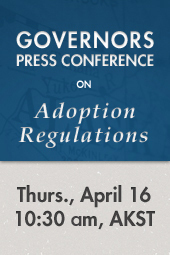
Kitka, Davidson, Mallott and the governor are scheduled to appear at a live-streamed press conference Thursday morning at 10:30 in the Capitol building in Juneau to discuss the emergency regulations.
LT at 11:30:00 AM No comments:
Share

#ASimplePieceOfPaper: NY STATE Bill of Adoptee Rights

By Trace Hentz (who still doesn't have a simple piece of paper called her original birth certificate)

I have been researching adoption for 10+ years as a journalist and started my own search for my identity at age 22 - a very long time ago (as an adoptee).

Can anyone tell me why it has taken years and years for any progress on open adoption files and letting an adoptee have their original birth certificate and the name of their parent(s)??

We have to start somewhere. Read this:

http://www.watertowndailytimes.com/news03/bill-of-adoptee-rights-gains-support-locally-and-across-the-state-20150415

MELANIE KIMBLER-LAGO / WATERTOWN DAILY TIMES
Bridget J. Gordinier holds a picture of her daughter, Cherilyn M. Bush, whom she placed for adoption in 1978, at her home in Hammond. Ms. Gordinier is an advocate for a state bill that would give more rights to adoptees who want to access their original birth records.

Bill of Adoptee Rights gains support locally and across the state

By ELI ANDERSON | TIMES STAFF WRITER | APRIL 15, 2015
HAMMOND — Bridget J. Gordinier had almost given up hope of ever speaking to her daughter, 35 years after she was born.
“I lost all hope. I knew I would never see her again,” Ms. Gordinier said.
In March 1978, Ms. Gordinier made one of the most difficult decisions she would ever make: to place her daughter up for adoption.
“I was 17 at the time, and just was not able to raise a child on my own,” she said. “I let her go, knowing that she would get a better life than what I could give her.”
“It was a different era back then,” Ms. Gordinier said. “People didn’t talk a lot about it — it was kind of hush-hush.”
There were also very few options for parents who chose to place a child up for adoption in the ’70s, she said.
“I knew that I was signing every right away,” Ms. Gordinier said. “I would never get to know anything about her — where she went or who had her. My only option would be, on her 18th birthday, I would be able to register with New York state.”
So, 18 years later, Ms. Gordinier did exactly that. She made her information public, hoping that her daughter, now legally an adult would be looking for her.
However, the prospect that she would ever be reunited with her daughter was dashed by restrictions in New York’s legal system.
Even if her daughter was registered and looking for her, Ms. Gordinier said, her daughter would get only “non-identifying information,” and that would be after she went to court to get it.
Under New York state law, original birth records have been restricted to adoptees since 1935. When adoptions are completed, the state issues an amended or adoptive birth certificate.
Adoptees who need their original birth record to find information about their genealogy or family medical history, or — in Bridget’s daughter’s case — to contact a birth parent, are unable to access it, regardless of their age.
REUNION
Fast-forward another 18 years, to October 2013. Ms. Gordinier stood in the parking lot of a Pizza Hut in Canton, hugging her daughter, Cherilyn M. Bush, who was now almost 36.
“I didn’t think I would ever be able to do that,” she said. “I just thought that I didn’t want to let go — never wanted to let go again.”
It was their first moment together in more than three decades. Ms. Gordinier had found her daughter through a “search angel,” a woman from New York City who specialized in helping to reunite adoptees with their birth parents.
“I gave her the little bit of information that I did have, and then a week later, my phone rang and it was my angel,” Ms. Gordinier said. “She said, ‘Your daughter is in Brasher Falls.’”
For the 35 years they spent apart, Ms. Gordinier and her daughter never lived more than a two-hour drive away from each other.
“She grew up in Massena, and I was always either in Brier Hill or Hammond,” she said.
In fact, Ms. Bush and her biological brother, who is a couple of years younger, both attended SUNY Canton.
“They can tell each other parties that they were at on the same night,” Ms. Gordinier said. “He was really good friends with one of her best friends in college.”
‘PAYING IT FORWARD’
Nonetheless, it took mother and daughter 18 years to find each other. Ms. Gordinier said that is why she is fighting for New York to pass a piece of legislation called the Bill of Adoptee Rights.
“My daughter started searching at 18,” she said. “I was registered when she turned 18. We could have been together at her age of 18 instead of 18 years later, when she was a month away from turning 36. I don’t want anyone else to have that time stolen from them.”
Ms. Gordinier is active in New York Adoption Equality, an organization working to reform state adoption laws. She will join thousands of other New Yorkers on Thursday when she takes part in a campaign called “A Simple Piece of Paper.”
The campaign’s name reflects just what its supporters seek to gain: a simple piece of paper, or in this case, an adoptee’s original birth certificate. Participants will post photos of themselves displaying the hashtag #ASimplePieceOfPaper to social media.
“It’s about being treated with equal dignity by the state,” said C. Catherine Henderson Swett, the organization’s downstate coordinator. “All adoptees are denied their original birth certificate in New York state. We are fighting to restore access to the people whose names are on them.”
The bill would allow adoptees to access their original birth certificate upon turning 18. Ms. Swett said it is a basic civil right, and she is confident the bill will be signed into law in the next couple of years.
“There is overwhelming support,” she said. “We just need a few more Assembly members to confirm that they support the bill.”
State Sen. Patricia A. Ritchie, R-Heuvelton, is one of the bill’s cosponsors. She was unable to be reached for comment despite several attempts this, and last, week.
Ms. Gordinier said fighting for this bill is her way of “paying it forward.” She said she believes adoptees should have the right to access their birth information upon turning 18.
“It’s a struggle to get passports, go into the service, or get a job in some fields because they don’t have their original birth certificates,” she said.
Ms. Gordinier said denying adoptees this information can also be dangerous for health-related reasons.
“There are people out there that are carrying around hereditary, life-threatening diseases that have no idea,” she said. “They could be taking preventive measures, but they just don’t know.”
Ms. Gordinier and her daughter see each other regularly now. Ms. Bush has three children of her own; she lives in Central Square.
“Things are really great,” Ms. Gordinier said. “I was just at her house the other day.”
She and her daughter have occasional setbacks, but Ms. Gordinier said that is to be expected.
“We’re very lucky,” she said. “We are building a beautiful relationship.”
Ms. Gordinier said she is traveling to Albany on April 21 to gather with other members of the New York Adoption Equality organization as they continue lobbying for the bill’s passage.

LT at 5:55:00 AM No comments:
Share

Wednesday, April 15, 2015

Bill aims to keep American Indian children with families

Archive Photo
LINCOLN, NE — While applying for her driver's license at age 16, Karen Hardenbrook saw her birth certificate and learned what her adoptive parents from Broken Bow never told her: she was born in Winnebago and her mother was a member of the Omaha Tribe of Nebraska. As a baby, the state removed her from her biological grandmother's crowded home on the reservation.

Today Hardenbrook, 57, lives on the Omaha Reservation in Walthill. She's an enrolled member but at times still feels like an outsider.

"I had a wonderful, beautiful (adoptive) home. I couldn't have asked for anything more," Hardenbrook said. "But I still wish I would have never left the res. I would have learned to dance. I would have learned to sing the songs. Now when I get out to the arena, I have to watch everyone, at 57 years old, because I don't know the steps."

A bill slated for a committee vote this week in the Nebraska Legislature would further strengthen protections of cultural identities for children like Hardenbrook by engaging tribal government and extended family mediation before removing children from tribal homes.

In 1978, Congress passed the Indian Child Welfare Act in response to what it deemed "a crisis of massive proportions." Between 25 percent and 35 percent of American Indian children were living in out-of-home placement, endangering the preservation of already dwindling American Indian tribes.
The federal law created standards that encouraged states to recognize the interests of Indian families and tribal governments when handling child custody issues. Nebraska adopted a nearly identical version in 1985.

"As sovereign entities, when one-third of the population gets taken out of your community, you won't have a tribe much longer," said Robert McEwen, attorney for legal nonprofit Nebraska Appleseed.
American Indian children represent just 2 percent of Nebraska's children but account for more than 5 percent of all children in out-of-home placement, one of the highest disparities in the nation, according to 2014 data from Nebraska's Foster Care Review Office.

The bill by Sen. Colby Coash of Lincoln would explicitly define when social workers can remove Native American children from their homes, making it harder to separate families and break the cultural ties

Coash said Nebraska's 30-year-old child welfare laws are too hazy for courts and caseworkers to effectively implement the federal law. When children or one of their biological parents are tribe members, state and federal laws require social workers to make "active efforts" to keep Native American families together — but state law doesn't define "active efforts."

"The state has a responsibility to not only provide for safety, but to keep the cultural connections," Coash said.

Under the bill, caseworkers would first have to contact tribal leaders, consult with mediators and exhaust all family counseling and mediation options before forfeiting parental rights. The Department of Health and Human Services would have to document each step.

The bill also broadens the definition of "expert witnesses," who are required to testify in American Indian child custody cases.

Judi gaiashkibos, executive director of the Nebraska commission on Indian Affairs, said tribal culture and state standards often clash in the welfare system, contributing to high numbers of Native American foster children.

"A caseworker might say, 'That's too crowded, that's not a good thing for the family. The child might be better in this white family. They get their own bedroom and bathroom,'" gaiashkibos said. "But they're not with the people they look like, their family and their tribal family."

Only 135 of Nebraska's 2,663 licensed foster homes are recognized as Native American, according to a DHHS spokesman. Many children are placed with non-native families, effectively severing tribal ties, gaiashkibos said.

She acknowledged that in emergency situations, temporary out-of-home placement might be needed.
The bill specifies that if a child can't remain safely at home, custody preference should be given to a foster home or adoptive parents that can best preserve and grow a child's political, cultural and social relationship with his or her tribe.

The Department of Health and Human Services has not taken a position on the bill, a spokesman said.
The Judiciary Committee is expected to discuss advancing the bill on April 14, according to the Associated Press. The bill is LB566.
LT at 7:48:00 AM No comments:
Share

Monday, April 13, 2015

Father Daughter Reunion After 41 Years Apart


LT at 4:26:00 PM No comments:
Share

No statistical data required on Indian children from State or Tribal child and family care?

Archive Photo
By Trace

I tweeted today that adoptees are the biggest threat to the adoption industry! It's true.
WHY? We watch the news, watch legislation, watch ICWA and we watch and pray for future generations.
Years ago I interviewed musician Brule (Paul LaRoche) who is a late discovery adoptee and a member of the Lower Brule Band of Lakota.  He told me, "Our grandparents prayed for us to be born, even before our parents had the idea. WE STAND IN THE CIRCLE. We are all related."
The circle includes you and me. We stand together as relatives. Future generations are our responsibility!

NEWS:

Measuring Compliance with ICWA

  April 13, 2015 by Kate Fort| Turtle Talk
 
Here is a Casey Family Programs publication, “Measuring Compliance with the Indian Child Welfare Act”
At present, no federal agency is tasked with ensuring state compliance with the protections mandated by ICWA. Without federal oversight, state legislatures, public child welfare authorities and courts are left to interpret ICWA provisions and definitions of “active efforts.”22, 23 Despite overall decreases in rates of out-of-home placements, Indian children remain disproportionately represented in the foster care system, at more than twice the rate of the general population,24 though this varies among states.25
Related, here is a copy of the law professors comments to the original AFCARS proposed rule on collecting data.
There is no statistical data required on Indian children from State or Tribal child and family care agencies. There is also no data on State compliance with ICWA. Under § 429(c), the ACF already possess and exercises the requisite authority to collect ICWA data. 42 U.S.C. 479(c)(3)(A)-(D).
The AFCARS regulations should follow the same requirements for Title IV-B Agencies in ICWA data reporting, as seen in the  PIs released by HHS. [ACYF-CB-PI-14-03 (2014)]. HHS has defined “Title IV-E Agency” “as the State or Tribal agency administering or supervising the administration of the title IV-B and title IV-E plans.” 77 F.R. 896. Under this definition, Title IV-B Agencies may also be Title IV-E Agencies. Due to this, ACF should also include similar ICWA data requirements in AFCARS.
In addition, the SSA also requires AFCARS to “provide comprehensive national information” regarding “the extent and nature of assistance provided by Federal, State, and local adoption and foster care programs and the characteristics of the children with respect to whom such assistance is provided.” 42 U.S.C. 479(c)(3)(d). Not only does this encompass Title IV-B Agencies, but also Title IV-E Agencies, which HHS provides direct Title IV-E funding to Tribes and Tribal child and family service programs under the Fostering Connections to Success and Increasing Adoption Act of 2008. The American Indian / Alaska Native children in these Title IV-B or Title IV-E Agencies are ICWA children, and that data should also be collected in order to “ensure that the [AFCARS] system functions reliably throughout the United States.” 42 U.S.C. 479(c)(4).
Under this legal and policy background, and as recommended by HHS, we recommend ACF add the following data elements and questions to the AFCARS in order to comply with ICWA.

From the report:
Although the Indian Adoption Project ended in 1967, it was succeeded by the Adoption Resource Exchange of North America, which continued to promote the adoption of Indian children into non-Indian families until the enactment of ICWA in 1978. During this time, approximately 25 percent to 35 percent of all Indian children were separated from their families, tribes, and culture and were placed in non-Indian foster homes, adoptive homes, or institutions. In 1974, the Senate Select Committee on Indian Affairs heard testimony documenting the long-term detrimental impact of these policies and practices on Indian children’s and families’ well-being.
LT at 4:03:00 PM No comments:
Share

Friday, April 10, 2015

Adoption Truth: Repeat After Me

Adoption Truth: Repeat After Me


The promise of Birth Mother privacy is a lie!
Let’s say it one more time . . .
The promise of Birth Mother privacy is a lie!


This is absolutely true. Please read and share Cassi's post.
LT at 10:36:00 AM No comments:
Share

Adoption Truth: Repeat After Me

Adoption Truth: Repeat After Me

 
The promise of Birth Mother privacy is a lie!
Let’s say it one more time . . .
The promise of Birth Mother privacy is a lie!

This is absolutely true. Please read and share Cassi's post.
LT at 10:36:00 AM No comments:
Share

Adoption Truth: Repeat After Me

Adoption Truth: Repeat After Me

 
The promise of Birth Mother privacy is a lie!
Let’s say it one more time . . .
The promise of Birth Mother privacy is a lie!

This is absolutely true. Please read and share Cassi's post.
LT at 10:36:00 AM No comments:
Share

Adoption Truth: Repeat After Me

Adoption Truth: Repeat After Me

 
The promise of Birth Mother privacy is a lie!
Let’s say it one more time . . .
The promise of Birth Mother privacy is a lie!

This is absolutely true. Please read and share Cassi's post.
LT at 10:36:00 AM No comments:
Share

Feds pay for kidnapping in South Dakota

South Dakota Kidnapping Native American Children While Making The Federal Government Pay For It (AUDIO)

Author: Nathaniel Downes 
Native Americans have long been treated poorly in this country, even long after their initial conquering. Note the sign: “Positively No Beer Sold To Indians,” reminiscent of those found in the Jim Crow south.  Image @LibraryOfCongress
Native Americans have long been treated poorly in this country, even decades beyond their initial conquering. Note the sign: “Positively No Beer Sold To Indians,” reminiscent of those found in the Jim Crow south. Image @LibraryOfCongress

The history of Native American relations in the United States is at best abysmal. From intentionally introducing disease, village massacres, and widespread racism against the native population, the United States has not been a friend of our indigenous people. Those of native culture have had their lands stolen, treaties ignored, and been subject to humiliating and degrading treatment for centuries.

The most horrifying, however, has been the systematic attempt to exterminate them as a people entirely; new light has come out that, despite laws to the contrary, these policies continue to be in effect, as recently covered at the Great Plains Indian Child Welfare Act Summit from May 15 through May 17 2013 in Rapid City, South Dakota. At the conference, a report by the Indian Child Welfare Act directors in South Dakota made a huge splash. The total population of South Dakota under the age of 18 is around 200,000, according to the U.S. Census taken in 2010. Of those children, approximately 23,000 children are Native American. And of those children, the state of South Dakota have seized approximately 750 every year from their immediate families. This statistic alone is troubling, especially when combined with the issue of tribal authority (the state of South Dakota does not have authority over the tribes), but even more so is what happens next.

 What the study found was that rather than place these children with other tribal members or relatives, as required by law, the state instead places them almost exclusively with white families, away from their cultural heritage.

In so doing, South Dakota is running afoul of a definition, that of genocide. While in traditional thinking, genocide refers to a direct attempt to exterminate a racial or cultural group through direct extermination, there is another form of genocide, that of cultural elimination. The definition of genocide, according to the United Nations General Assembly’s Convention on the Prevention and Punishment of the Crime of Genocide, is as follows: … any of the following acts commit with intent to destroy, in whole or in part, a national, ethnical, racial or religious group, as such: (a) Killing members of the group; (b) Causing serious bodily or mental harm to members of the group; (c) Deliberately inflicting on the group conditions of life calculated to bring about its destruction in whole or in part; (d) Imposing measures intended to prevent births within the group; (e) Forcibly transferring children of the group to another group. The Native American population is the poorest in the nation, with an astounding 50% poverty rate. There has been a targeted effort to forcibly sterilize Native American women.

And here we find South Dakota with a system which has resulted in over half of the children in their foster care system being from Native American families. NPR covered this heavily for their report “Native Foster Care: Lost Children, Shattered Families” in 2011.

Here’s the audio: LINK

But for those in power within South Dakota, this program brings with it a double benefit. Not only do they contribute to exterminating the Native culture, they get to have Uncle Sam pay for it. Every Native American child within the foster care system is paid for by the federal government, to the sum of almost $80,000 per child, per year, of which South Dakota only pays out under $10,000. This $70,000 surplus, which is intended to go into anti-poverty programs, healthcare, and family support for troubled children, instead goes right into the general fund for the state. It is a calculated scheme to defraud the United States government of tens of millions per year. It is a tragedy, how we as humans have allowed the systematic persecution of the Native population. To see such a program in this day and age makes the tragedy even more real. The forced sterilization programs, in which thousands of women were sterilized, either by force or through trickery, dropped the average child-per-Native woman from 3.29 in 1970 to 1.30 in 1980. The damage done by this program was so severe that even decades after its official end, the fertility rate remains dangerously low. And now the implementation of a program to take away what few children they can have is almost too much to bear.

This abuse of power has put the entire child welfare system in South Dakota in danger, making every child taken in to the system’s care suspect. Situations where true abuse have happened are dwarfed by those where it has not. The state is in danger of having its system called into question, potentially dismantled, all due to the systemic abuse of Native people. There is no room for racism, for this culture war, in a modern society. South Dakota should be ashamed of itself, and return those children taken illegally immediately to their families. Following this, a complete and thorough policy audit should be mandated, along with the termination of the management who enacted and enforced this policy.

Lastly, the money which was defrauded from the federal government should be turned over to the families as restitution. A culture survives through its children. We are the United States, a multi-cultural melting pot of people. This attempt by bigoted people to undermine the very principle of the United States, of the Declaration of Independence and the Constitution, brings shame to this grand nation of ours, and it must end now.

Author: Nathaniel Downes is a native of New Hampshire, now living in Seattle Washington developing the next-generation super-powered MMORPG, City of Titans. Feel free to follow Nathaniel Downes on Facebook or Google Plus. He has just released his first book, available in Hardcover, Paperback, and Kindle.
LT at 9:22:00 AM No comments:
Share

Tuesday, April 7, 2015

ARENA: what came after the Indian Adoption Projects

AMERICAN INDIAN ADOPTEES: ARENA: what came after the Indian Adoption Project...: Beginning in 1916, the U.S. Children's Bureau brought its baby-week campaign to thousands of cities...


Reblogged from 2013... definitely worth a read... Trace
LT at 9:07:00 PM No comments:
Share

Sunday, April 5, 2015

Re-Membering Through Adoption


David Wilkins |4/4/15 | Indian Country Today Media


Historically, Native nations were bounded but inclusive socio-cultural communities that prided themselves on maintaining distinctive religious-cultural identities while also incorporating — whether through force or invitation — individuals from other indigenous, racial, and ethnic groups. Our peoples have always managed to creatively and successfully augment their numbers and incorporate new blood and ideas. Outsiders, be they Natives, Europeans, Africans, or others, were frequently welcomed into tribal communities through ceremonies or via tribal council action. This openness is evidence of an inherent cultural confidence and generosity that are hallmarks of Native nations— qualities that, for millennia, were bolstered, not threatened, by inclusion.
The strength of inclusion is one we need to recall and to draw upon today, as our Nations are infected by the colonizers’ world-view that rewards individual gain over survival of the people. These unhealthy values are evidenced in our modern sovereign communities that are either directly weakened or indirectly threatened by the scourge of disenrollment. We must take action through a positive, traditional way of building, healing, and protecting our members before this infection becomes so deep that the federal government steps in with its own sovereignty-suppressing cure.

While it may sound simplistic, I believe we can and must use the traditional inclusive tool of adoption as an effective means to begin to address some of these citizenship troubles.       

The establishment of kinship bonds, whether genetic or chosen, is as critical today as back then. We know this as we fight to keep our children, our future, from being taken by the foster care system or adopted out of our communities. And yet, we also bear witness as nearly 70 Native nations engage in formal banishment, disenrollment, or both, of bona fide tribal citizens for economic or political reasons. It is hard to understand the rationale of such radical behavior which so strikingly veers away from the traditions of our ancestors who knew the importance of strengthening and growing their communities.         

Nearly 500 Native nations have been wise enough to avoid dismembering their communities. At the same time, their leaders have largely remained silent as some Native governments violate the civil and human rights of their people. Many of those standing by have calculated that if they call attention to this problem the U.S. government will intervene in a way that irrevocably damages sovereignty throughout Indian Country. Their concerns are justified. We all know the folly of publicly condemning the sovereign actions of other Nations, as well as the disastrous results of taking our issues into the federal court system. In the end, this type of criticism and infighting only undermines the well-being or all our Nations.

Unfortunately, in the void created by this fearful silence across Indian Country, the problem only worsens and may ultimately make federal intervention inevitable. Native leaders are hoping this infection will heal itself, but without the right medicine, in time, it will spread and cause profound harm to us all by finally crippling sovereignty.

Because, without action to help forestall it, the U.S. Congress or, more realistically, the Supreme Court, will impose their radical treatments. As we all know too well, once those federal remedies are imposed, they will affect us all, not just those who are actively and cavalierly violating the civil liberties and human rights of their own citizens. It is time for those who have averted their eyes from the plight of the dismembered to show courage and act for the good of all Native nations.

I would suggest that the nearly 500 strong, confident Nations recognize their shared responsibility and take a simple, radical step that would prevent federal interference and provide relief to disenrollees, yet cost nothing except time and consideration. If each intact Nation would adopt 10 indigenous refugees of the disenrollment epidemic, those nation-less individuals who now feel their only avenues for help are within the federal or state legal system, would have Native support and recognition of their humanity as Native. Once Indian Country steps up to help our own, without casting blame against the Nations who used their authority to purge their tribal rolls, the calls for federal or state intervention would be greatly diminished. Through unified action we protect both the lives and liberties of those dismembered and the sovereign authority of all Nations.

As leadership and political winds are ever changing it is even possible that, with time, many disenrollees may find long-term remedies to their situations at home. There are examples where as soon as one set of tribal officials was voted out of office, disenrolled citizens were re-membered back into the community. In one case, a former disenrollee now serves as the Chairwoman of her Nation.

If the idea of adopting 10 seems overly ambitious, then at least take the step of adopting, at a minimum, one elder and one child. While this wouldn’t solve the problem of all those who have been outcast, it would at least give those most vulnerable some modicum of safety, stability, and dignity. Most importantly, they would retain their identities as indigenous persons.

I can already hear the hue and cry about how no one wants to take on someone else’s problems when many Nations are still struggling to get by. All the attorneys out there are fretting about liability and definitions of citizenship. Native academics are already racing to claim the term “adoptive sovereignty.”  But I’m not calling for mass migrations or shared per caps. I’m simply talking about a powerful and preemptive acknowledgment of the kinship and humanity of all those who now find themselves tribe-less. We have capable elders and other leaders who can figure this out. It’s time to talk seriously about how to make something work, rather than simply dealing with the worsening fall-out caused by a number of tribal political figures.

There are many examples of Natives who were born to one indigenous community but who later joined a different one. In the 1840s, the Eastern Shoshone chief, Washakie, left Umatilla lands while an adolescent and was assimilated into the Eastern Shoshone, eventually becoming one of their most famous leaders.

Or Richard Throssel, an early 20th century photographer of Crow life, who was born in Washington, and of Canadian Cree, Scottish, and English ancestry. He and his family moved into Crow country in 1902 and were adopted by Tribal Council action in 1906. As new Crow adoptees, the Throssel family also received land allotments, a generous gesture on the part of the Crow Council, through a formal process that was approved by the Commissioner of Indian Affairs and the Secretary of the Interior in 1908.

At least 160 tribal constitutions contain clauses recognizing adoption as one of the chief processes available to expand tribal rolls and nearly 200 others have the ability to incorporate such a clause into their organic charters. Those with more traditional types of governing structures and their governments may have adoption procedures as well. All sovereign Nations certainly have the authority to authorize such a process. Ironically, one of the Nations seeking to disenroll over three hundred of its citizens is currently led by an adoptee who, along with the Council, recently oversaw an amendment to their Tribe’s constitution that suspends future adoptions. Interestingly, it does not go so far as to nullify existing adoptees’ status.

Without going into a lot of detail on constitutions, while all have unique approaches, adoption provisions generally provide for the physical and economic incorporation of new members. I suggest that these be expanded to include a separate category of adoption of disenrollees from other Nations. Those willing to extend citizenship could do so initially in a limited way so that disenrollees were simply able to retain their basic social and health benefits that come to everyone through the BIA or other federal agencies. There would be no immediate guarantee of land, housing, or other substantial economic benefits provided by the tribal government unless the tribes were so inclined to provide those. No one would be forced to leave their families or relocate from their home country to retain their identities.

Since a majority of tribal constitutions were drafted under the auspices of the 1934 Indian Reorganization Act, many of them contain language that declares that the Tribal Council has the authority to enact ordinances for the “adoption of new members,” but that such procedures, like the Throssel family’s adoption into the Crow nation, are “subject to approval by the Secretary of the Interior.” While secretarial review is patently paternalistic, in this case it is an important provision as it reminds federal officials that they have a trust and, in many cases, a treaty obligation to provide a measure of protection to indigenous citizens, who also happen to be US citizens.

Respected organizations like the Native American Rights Fund and the National Congress of American Indians could provide guidance for those Native nations with existing adoption procedures or those who might wish to create adoption ordinances to help facilitate outreach to disenrolled tribal refugees who are suffering profound psychic, economic, and political losses due to their now tribe-less status.

While we are no longer living in a time where we find it easy, or even wise, to fully embrace outsiders into our communities, it is imperative that we protect those who have been or may become dismembered. We can, at the very least, provide them with a sense of refuge and a basic set of rights that political refugees the world over receive when they seek asylum after having been forced out of their own territory. So many of our Nations are generous with those overseas. Surely we can turn our empathy and resources towards helping our own indigenous citizens.

Let us use our own medicine to heal, protect, and make our communities whole again by harkening back to our ancestors’ strategies to strengthen and augment our peoples. By re-membering those who have been disenrolled, Indian Country can finally begin to fight the worsening infection of dismemberment. It is not just the right thing to do for the human rights of these individuals. It is the right thing for all our Nations if we truly want to protect our sovereign abilities to make our own decisions.

Otherwise, as we’ve seen before, the disease will become unmanageable and the federal government may step in and impose its will upon us all.

David E. Wilkins (Lumbee) holds the McKnight Presidential Professorship in American Indian Studies at the University of Minnesota. His most recent books include The Hank Adams Reader (2011), The Legal Universe (with Vine Deloria, Jr.) (2011), and Documents of Native American Political Development: 1500s-1933 (2009).

[David is one of the best thinkers we have in Indian Country...We need more thinkers and doers... Trace, dis-membered and someone in the Lost Bird category]

Read more at http://indiancountrytodaymedianetwork.com/2015/04/04/re-membering-through-adoption
LT at 5:55:00 AM No comments:
Share

Saturday, April 4, 2015

AAC, SEO, Adoption Industry Profits? Read this

By Trace Hentz (blogger-author-adoptee)

I was very fortunate to attend the American Adoption Congress annual gathering in Cambridge, Massachusetts one week ago today... I sat on the Lost Daughters panel made up of unique and passionate adoptees who like me have been blogging on Lost Daughters and writing on their own blogs. It was my first time meeting them in person and they are all honest outspoken activists who care deeply about adoptee rights and finding our voices. You might recall last November seeing a trend of tweets about #FLIP THE SCRIPT and #VALID VOICES - those hashtags (#s) originated at Lost Daughters BLOG, created by Lost Daughter blogger Rosita!

One big thing I felt about AAC was the unity.  The first moms and adoptees had their voice respected and heard.  My friend Lindy was with me and she is a first mom.  Lindy is working on a book interviewing 15 birth moms and she blogs "Telling Our Stories for the Sake of Truth" here.  We are still talking about what we learned, who we met, and the conference itself.

The morning workshop we attended was on SEO (search engine optimization) and blog tips that help readers find blogs and websites, taught by savvy first mom Claudia Corrigan DArcy. (Claud is in reunion with her son Max who was there!)

SEO is critical in the age of social media to help readers find relevant writing and new thinking on adoption by searching Google, Bing and other search engines. I learned so much from Claud and will put it to work on this blog. (I am doing some things correctly as I do share these posts on Facebook and Twitter.) (You can share these posts too!)

Claudia blogged recently about Adoption Industry Profits. I wrote on this blog that billions are earned each year and it's alarming as well as profit-driven.

Please take a look and read the stats:
http://www.adoptionbirthmothers.com/adoption-industry-profit-data-2015/

I want to thank you all for reading this blog. It's truly appreciated.

Please read Lost Daughters blog and subscribe!

The more we learn and share, and help each other, the greater the impact!

xox Trace

[I am getting a brand new second edition of TWO WORLDS ready for publication. I will post more when it's all done...]

LT at 10:39:00 AM No comments:
Share

Friday, April 3, 2015

Metis adoptee in England crowdfunding to meet 11 siblings in Canada he never knew he had #60s Scoop


National News | April 2, 2015 by Kenneth Jackson
APTN National News

Daniel Frost would flip through family photo albums growing up and see people that didn’t look like him.

He knew them as grandpa or grandma, but they weren’t his grandparents.

Born Metis, he was adopted as an infant from northern Saskatchewan by British parents who moved him across the Atlantic ocean to the United Kingdom.
He’s built a life there.

Then last year he decided to make a real effort to find his birth family.
Frost figured he’d have a couple siblings.

What he found was a family tree that extended far beyond that.
Thirteen brothers and sisters (two deceased).

He first found his birth sister Edna Smith who sent him photos of his siblings.

“Suddenly, I saw people looking back at me that looked like me,” said Frost from London where he is training to be a nursing assistant. “I’ve even got a brother that looks like me. It’s something that is quite extraordinary.”
Daniel Frost 1
Daniel Frost

Frost was born Darin Maurice to Metis parents from Buffalo Narrows in Saskatchewan in 1968. He was quickly taken by the province’s child welfare system and put in foster care.
This was the era of the 60s Scoop.

It’s now well-known that thousands of Indigenous children were taken from their families and adopted into non-Indigenous homes.

Edna Smith was also adopted by a British family but they stayed in Saskatchewan.
She said a death in the immediate family ripped the home apart, which led to many of the children being put in foster care and later adopted.
 
 
Edna Smith
Edna Smith/facebook

“I have a sister in B.C., I have a sister in Washington (State), I have a sister in Red Deer, one in North Battleford, a brother in Saskatoon, two brothers in Calgary, a brother in Regina, a brother in Dillon and Dan,” said Smith.

Frost is raising money for travel costs to visit his family through a crowdfunding site.

“I think it’s awesome and we can’t wait for him to get over here,” said Smith. “I look at him and I know he’s my brother.”

It’s that connection that Frost has always been looking for.

Growing up in the United Kingdom, Frost was always confused as Spanish or Italian, even Jewish, because of this skin colour. He was known as the “little brown boy.” His parents never hid where they got him and he knew he was Indigenous. 

“Most people in Europe kind of think that First Nation or Native people are no longer around. They’re found in history books,” said Frost.

Then he came to Toronto in the 1990s to visit friends.

“It was the first time I experienced any kind of recognition of who I was. It was both in a good way and a bad way,” he said.

Some would come up to him and ask if he was Cree and he felt welcomed.

“I also had other people who were like ‘We know about your people. You’re all alcoholics,’” said Frost, adding despite the racism, “In a way, it was quite life-fulfilling, even the bad stuff, because you’re understanding who I am.”

Both of his birth parents have passed away, his father in 2013 and his mother in 2010.

But in the 90s he made his first attempt to find his birth family and received a package from the province of Saskatchewan.

It included a hand written note from his mother scribbled on a scrap piece of paper.

She addressed it “my darling son.”

“I was quite overwhelmed by it,” said Frost. “Someone else was calling me her son.”

He lost that note in a fire and never pursued his search.

“I’m not sure I was mature enough to handle it at the time,” he said.

But the “little brown boy” from England is now determined to end his search.


Tags: 60's scoop, Daniel Frost, Edna Smith, Kenneth Jackson

Kenneth Jackson

 
LT at 5:55:00 AM No comments:
Share
‹
›
Home
View web version

About Me

My photo
LT
Adoptee, Author, Editor, Publisher, Mosaic Artist, Blogger, wildly curious
View my complete profile
Powered by Blogger.